Discovering Cebu

Author: helloaprilhan

  • Mindful Travel Blog: Why Start Blogging About Ecotourism Now

    Discover why starting a mindful travel blog focused on ecotourism is a powerful way to inspire change and support responsible travel.

    If you share my love for the thrill of a passport stamp while also feeling a deep concern for the well-being of our planet, then this mindful travel blog is the perfect place for us to gather and find solace. For those of us who have witnessed numerous sunsets and accumulated impressive amounts of frequent flyer miles, we understand that our style of travel has a profound impact on the world we leave in our wake. 

    Allow me to regale you with tales of Singapore. One might envision towering skyscrapers, far from being the epitome of eco-friendly tourism. But then there was that unexpected layover that completely altered the course of events. Amid the vibrant glow, I stumbled upon a city with a resolute commitment to embracing a more sustainable future. It’s in the refreshing taste of the recycled water straight from the tap (kudos to their innovative NEWater initiative!), and the magnificent Supertrees of Gardens by the Bay, a marvel created with a commitment to sustainability. Changi Airport, even in its grandeur, sets a new standard for eco-luxury.

    That journey ignited a certain spark within me: the exhilaration of discovering how even the most unforeseen destinations can astonish us.  

    This blog doesn’t focus on tedious checklists; instead, it delves into the delicate balance between embracing our wanderlust and responsibly caring for our surroundings. We’ll explore lesser-known ecotourism spots, dispel misconceptions, and discover how to make mindful choices that express gratitude for the awe-inspiring destinations we love.

    Travel, when approached with care, is not merely a means of escape, but a powerful catalyst for positive change.

    Changi Airport Singapore

    What Exactly is Ecotourism?

    Let’s delve into the question that’s likely on your mind: what exactly is ecotourism? If you find yourself envisioning mosquito nets and accommodations with zero stars, it’s about time you face the facts.

    Ecotourism is not about compromising on comfort or glorifying discomfort as a form of prestige. It’s all about changing your perspective, adopting a travel approach that prioritizes the planet and its people as much as your own pleasure. Consider it as a refined and compassionate alternative to conventional tourism. 

    Well, let me break it down for you: ecotourism is all about traveling responsibly to untouched destinations. It’s all about making choices that have a positive impact on the environment and the local communities you visit. And above all, it’s about departing those places slightly improved from how you discovered them.

    Now we have a little issue to discuss: greenwashing. Isn’t it just fascinating how certain companies love to talk about being eco-friendly, but fail to actually follow through with their actions? That’s the complete opposite of ecotourism. Genuine ecotourism values openness – if they are making a positive impact, they are eager to demonstrate how and why.

    And you know what? Ecotourism adventures come in many forms to cater to different preferences. Here’s a small selection:

    • An exhilarating escapade. Exploring the depths of vibrant rainforests, gliding through untouched waterways, or conquering towering peaks, all while prioritizing our planet’s well-being. Extra credit for championing local guides!
    • A dive into culture. Instead of falling into the typical tourist traps, consider immersing yourself in the local culture by staying with families, learning traditional crafts, or getting involved in community projects.
    • Responsible wildlife experiences. Opt for safaris or expeditions led by experts in conservation, where the well-being of the animals is the top priority.

    In essence, if you desire your mindful travel blog to center around ecotourism, it’s all about possibilities. It’s all about broadening your options. It’s about exchanging the temporary sense of “been there, done that” for the lasting fulfillment of “helped a little, learned a lot”. Now, doesn’t that sound much more enticing than a rough sleeping bag?

    Why Women in Their 30s and 40s Should Care

    Let’s debunk the myth of ‘roughing it.’ Ecotourism goes beyond the typical accommodations and nibbles, embracing a more sustainable and conscious approach. Consider it the perfect remedy for those fast-paced, cookie-cutter tours that leave you feeling disoriented and overwhelmed. For those of us in our 30s and 40s, there is a yearning for something beyond the ordinary – and that’s where ecotourism truly shines.

    Rather than simply going through a list of popular IG-worthy spots, you have the opportunity to immerse yourself in the art of traditional weaving, taught by a women’s cooperative in a charming Guatemalan village. Perhaps you’re out there, in the depths of Borneo, diligently monitoring the movements of orangutans, fully aware that your noble efforts contribute to the crucial funding for their conservation. That’s the level of connection ecotourism provides – the kind that truly speaks to us in this phase of life. 

    Now, let’s not avoid discussing the weighty concept: Responsibility. Consider how we allocate our funds in our hometown – we prioritize supporting local businesses and ethically-produced goods, among other commendable practices. Shouldn’t travel be a reflection of our core principles? Our tourism dollars wield significant influence. Opting for the family-run lodge with its breathtaking view of the Costa Rican rainforest instead of the generic chain resort is a powerful statement of our values.  

    Furthermore, haven’t we worked hard enough to deserve travel that is, dare I say, meaningful? That’s where your mindful travel blog comes in. Curiosity is the antidote to boredom. Ecotourism satisfies that curiosity. It opens the door to discovering fascinating wildlife, diverse cultures, and our potential to make a positive impact on the world. Your travel blog can be a source of inspiration for others, igniting their wanderlust with every adventure you share.   

    What Makes a Great Mindful Travel Blog?

    If you believe that creating a mindful travel blog centered around ecotourism is as easy as putting a “sustainable!” label on every beach house and nature lodge, then you’re in for a rude awakening, my dear. A truly exceptional ecotourism blog delves into the depths. It’s not a guidebook for the holier-than-thou, but rather a glimpse into destinations and moments that enrich both the world and your spirit.

    Imagine the contrast between perusing a mundane hotel brochure and being completely captivated by a beautifully crafted novel that takes place in a mesmerizing location. That’s where the art of storytelling comes into play. A truly remarkable mindful travel blog captures the essence of the experience. It beautifully captures the essence of the rainforest at daybreak, the haunting melodies of endangered gibbons resonating through the mist, or the heartfelt grin of a seasoned local guide whose ancestors have coexisted with sea turtles for centuries. It’s all about revealing the passion that lies within the destination.

    It’s great to write inspiring stuff, but it’s meaningless if your readers can’t put it into action. That’s where practicality comes in. So, you went on a journey to a secluded eco-retreat? That’s amazing! Can you tell me about those miraculous boots that saved you from getting blisters? Also, did you have any trouble finding vegan options on the island? I think an ecotourism blog should blend practical guidance with exciting adventures. Do you have any advice for tackling that obstacle? A mindful travel blog flourishes by blending practical guidance with exhilarating escapades.  

    It’s reminiscent of that famous quote, often attributed to Maya Angelou, about the lasting impact of how we make others feel. People may forget our words and actions, but the way we make them feel is something they’ll always remember. Invite readers to forge a deep connection with the places you describe, and the yearning to visit with a sense of responsibility will effortlessly flourish.  

    Your Journey as an Ecotourism Blogger

    The thought of becoming an “ecotourism blogger” can be quite daunting. Is a degree in environmental science necessary? Should I have already embarked on a solo backpacking adventure through the Amazon? Nope! Embracing our true selves is far more important than striving for perfection, particularly for women in their 30s and 40s. We possess a certain wisdom that those in their twenties have yet to acquire – a unique perspective that combines wonder with a clever and biting sense of humor.

    Consider your mindful travel blog as a delightful chat with your gal pals over some fancy drinks. You generously recount the breathtaking waterfall you stumbled upon, along with the amusing anecdote of your trailblazing misadventure and the thought-provoking conversation you engaged in with a talented local craftsman. Your authentic voice will truly resonate.

    Fortunately, discovering responsible tourism options is not as perplexing as unraveling ancient hieroglyphs. There are plenty of excellent resources available:

    • Ethical Travel Guides. Websites such as “Responsible Travel” or publications like Lonely Planet’s “Global Sustainable Tourism” provide carefully selected lists of approved operators.
    • Certifications. Seek out certifications such as Green Globe or Travelife – while not infallible, they can serve as useful indicators.

    Listen to your instincts: Take the time to read reviews and explore company websites. Does their mission statement come across as genuine and sincere, or does it sound like generic corporate jargon?  

    Now, let’s talk about transforming your passion into real impact. This is where discovering your unique niche truly stands out. Do you possess an uncanny ability to unearth secret havens for wildlife? Are you a fan of community-based tourism? Perhaps you have a taste for culinary experiences that celebrate locally sourced ingredients. Embrace the essence of your adventures, and watch as your audience becomes captivated. 

    Benefits of Mindful Travel Beyond the Obvious

    Alright, let’s explore the lesser-known wonders of ecotourism, the kind of advantages that extend far beyond a passing trend!

    Contributing to the growth and empowerment of women-owned businesses and local communities.

    This is the place where enchantment unfolds. Ecotourism typically involves accommodations in cozy guesthouses, dining at local family-run eateries, and enlisting the services of guides from the surrounding community. Imagine a scene: a weaving cooperative where women of all ages come together to share their skills, a bustling village market adorned with colorful textiles and filled with the sound of joyful laughter. Your travel blog takes on a whole new dimension as it becomes a platform to showcase these remarkable women, their captivating stories, and their thriving businesses. It goes beyond fair trade, it’s about forging a real connection that stays with you long after you’ve settled in.

    Embracing the art of slow travel, finding solace in escaping the chaos.

    Ecotourism provides a way to escape the feeling of constantly chasing after life as it passes by in a blur. It compels one to embrace a slower pace, aligning with the cadence of a rainforest expedition or the ebb and flow that guides a nearby fisherman. There’s a moment to ponder, to inhale deeply, to just exist. It’s a refreshing act of self-care in a world that idolizes constant activity. Consider it a method to declutter your mind, replacing chaos with tranquility. 

    Embracing the wonders of education through every journey – the beauty of wildlife, the importance of conservation, and the richness of new cultures.

    Ecotourism transports you back to a time of childlike curiosity. All of a sudden, a butterfly takes on a whole new meaning as it becomes an integral part of a fragile ecosystem that your knowledgeable guide enlightens you about. You venture into a sanctuary, fully grasping the passionate devotion fueling wildlife conservation endeavors. Perhaps you fumble through your initial attempts at speaking the local language, discovering a charming custom that brings a smile to your face. It’s a truly humbling experience that fills you with joy and serves as a reminder that age is no barrier to personal growth.  

    Imagine your travel blog filled with valuable insights that not only benefit you but also inspire countless other women to explore new experiences with the same enthusiasm as they do when getting their passports stamped.

    Is Ecotourism the Sole Path to Ethical Travel?
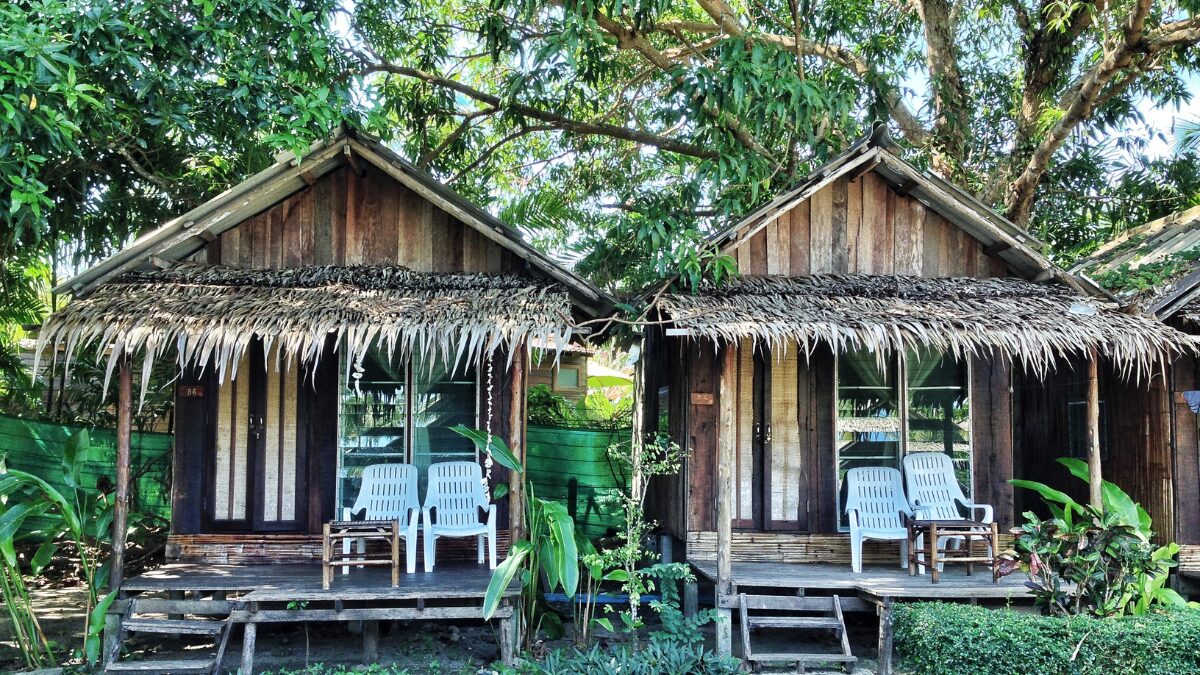
    Bamboo huts on Ko Chang Thailand

    Life is far from being a simple dichotomy, especially when it comes to the moral complexities of traveling the world. Now, I firmly believe that ecotourism should always be our guiding principle. However, in this chaotic and extraordinary world, there are inevitably moments when alternative options present themselves.

    Imagine it as that beloved vintage store you once thought was your go-to for sustainable fashion… until your best friend’s destination wedding demanded a new dress that couldn’t possibly be found secondhand. Occasionally, the most thoughtful choice in the present isn’t flawless.

    You might find yourself having to take a long flight for a family reunion or discover that the only available accommodation in your dream destination isn’t a trendy bamboo eco-lodge. Does this make you a phony? No way. It implies an understanding that this voyage of conscious exploration is a continuum, rather than an inflexible boundary.

    Our goal is to make progress, not chase after perfection. In the spirit of sharp-tongued literary heroines, who never hesitated to speak their minds (ahem, Elizabeth Bennet), we can embody both our principles and practicality. 

    When faced with that familiar wave of guilt, remember this: “While an eco-retreat would be perfect, the world won’t collapse if I have to endure a chain hotel for a night. Why don’t we reserve our indignation for the genuinely shocking transgressions, shall we?

    It’s all about making thoughtful decisions, finding a middle ground, and appreciating each small progress that brings us towards a more responsible way of traveling. And that, my dear companions, is a goal worthy of toasting with a (ideally locally sourced) cocktail. 

    Takeaway Message

    Like the pages of well-worn guidebooks, every decision sends ripples through the world. An evening spent in a charming family-run homestay rather than a generic chain hotel, accompanied by a knowledgeable local guide instead of being herded around in a crowded tour bus… and let’s not forget the small act of bringing along a reusable water bottle to demonstrate our concern for the environment. 

    If you have an insatiable curiosity, here are a few destinations to embark upon. These suggestions barely scratch the surface, but they offer a marvelous opportunity to explore the realm of mindful travel:

    We don’t have to strive for perfection, but we must remain alert and aware. Imagine a world where every woman in our generation, filled with a burning desire for adventure and a strong sense of responsibility, began to inquire about important matters.

    Are you set to begin exploring the world of ecotourism? Siquijor is a haven for nature lovers, with its pristine landscapes, commitment to sustainable practices, and vibrant biodiversity. The island also offers unique opportunities for cultural immersion, allowing visitors to truly experience the local way of life. Learn more by reading my Cebu To Siquijor Travel Guide today!


  • Digital Nomads Must Have These Survival And Security Essentials

    This guide discusses the tools and strategies digital nomads must have for a secure, sustainable, and seriously adventurous life on the road.

    I’m hunched over a tiny cafe table, a cappuccino the color of sun-bleached sand beside me, scribbling furiously on a map that’s seen better days. My passport, a dog-eared testament to a dozen borders crossed, peeks out from my bag. The scent of adventure is as thick as the Vietnamese coffee a few tables down. It’s a familiar scene, isn’t it ladies? The romance, the thrill, the sheer audacity of building a life around Wi-Fi signals and the next plane ticket.  

    But let’s get real for a minute. This digital nomad life, as intoxicating as that first sip of espresso in a new city, comes with its own set of challenges. See, there’s a fine line between wanderlust and just plain wandering lost. I know a thing or two about that line – I’ve crossed it, stumbled over it, and occasionally performed a caffeinated jig right on top of it. That’s why we need to talk about survival and security. Not in some fear-mongering, lock-yourself-in-your-room kind of way, but with a healthy dose of “forewarned is forearmed” wisdom. 

    Think about it – we’re charting our own paths, often solo, in places where the rules change as fast as the time zones. This isn’t about waiting for some knight in shining MacBook Pro armor to save the day. We’re the modern-day Joan of Arcs of the remote work revolution, blazing trails with our laptops and a fierce determination to live life on our terms. And digital nomads must have the tools and the smarts to make this sustainable. 

    So, if you’re ready to swap a bit of that starry-eyed idealism for some seriously geeky, been-there-done-that grit, grab another coffee and let’s dive in. By the time you finish this piece, you’ll feel empowered to handle everything from dubious Wi-Fi to that “uh-oh, did I just take a wrong turn?” moment. Because a safe, savvy nomad is a nomad who gets to keep sipping those cappuccinos all around the globe for years to come. 

    What Are The Core Essentials for Digital Nomads?

    Alright, ladies, let’s turn our tech into a fortress. After all, as digital nomads, our laptops, phones, and tablets are where we build our little online empires, right? So, first things first – let’s cover the absolute non-negotiables that keep that digital world safe.

    Digital Fortress: Your Tech as Mission Control

    • Laptop lock. Because your office IS your laptop. Think of this as the digital nomad’s version of a bike chain. You wouldn’t leave your fancy vintage ride unattended, would you? Invest in a sturdy laptop lock, especially when setting up in cafes during those long, coffee-fueled work sessions. A moment of distraction is all it takes for your lifeline to vanish. Learn more about the best laptop anti-theft devices for digital nomads.
    • Data backup. Redundancy is your friend. Imagine all your client work, those dreamy destination photos, that half-written novel…*poof* gone! This is where the cloud and external hard drives become your besties. Back up regularly, like your sanity depends on it, because frankly, it kinda does.
    • Password manager. Complexity without the headache. We need passwords stronger than my morning espresso, but who can remember “Xj83*h!29qP”? Password managers generate and store them, leaving your brainpower for the important stuff … like figuring out the best Jeepney route for getting around Cebu City.

    The “If Lost, Please Return to Awesome Human” Kit

    • Durable luggage tag. More than just cute. Sure, a pineapple-shaped tag is adorable, but make sure it has space for your contact info and can survive baggage handler “love.” We want those bags finding their way home if they get a sudden urge for solo travel. 
    • Digital copies of vital docs. Passport, IDs, emergency contacts. Scan these lifesavers and store them securely (cloud with password protection). Losing your passport? Stressful. Having a digital backup? A major ounce of prevention.
    • The power of translation apps. When charades fail. Don’t underestimate how a few key phrases can smooth your way. Even mangled pronunciation is better than that awkward mime of “Where’s the bathroom?” Trust me, I’ve been there. 

    Who’s Got Your Back? Building Your Safety Network

    Look, as a seasoned digital nomad, I get the whole independent woman vibe. But even Wonder Woman had backup on Themyscira. When you’re hopscotching continents with a laptop and a dream, having a support network is not a sign of weakness – it’s the ultimate power move. This is where the ‘survival’ part of our digital nomad must-haves kicks in.

    First stop: your local lifeline. Every country has embassies or consulates representing your home nation. It’s not the most glamorous item on the itinerary, but take it from me, you want those numbers saved before you even board the plane. They’re your go-to if there’s lost luggage, stolen documents, or any kind of major hiccup along the way. Think of them as your real-world quest guide when things get a bit too adventurous.

    Next up: insurance. Oh, I know it’s the unsexy expense, like buying sensible shoes when your heart longs for those killer heels. But honey, nomad-savvy insurance is worth its weight in canceled flight refunds. We need the kind that goes beyond basic medical – think gear protection (because laptops do mysteriously take swan dives) and trip interruption coverage for when volcanoes/revolutions/random food poisoning messes with your plans. It’s that unglamorous cushion that lets you bounce back instead of stressing about every unexpected expense. 

    And finally, your virtual village. Those friends and fam back home? They’re more than just folks to send postcards to. Pick your most reliable, trustworthy people – the ones who’ll answer a panicked 3 AM call and drop everything to help troubleshoot an online crisis. Keep them updated on your itinerary, bounce travel plans off of them (their research skills might surprise you!), and let them be your emotional life raft when that solo nomad wanderlust gets a little lonely. Remember those superhero teams? Think of this as your personal Justice League – just with more coffee-fueled Zoom calls and less spandex.  

    Where Are You Sleeping Tonight? Safe Accommodation Options

    Hostel Dormitory Beds Arranged in Room

    Where we lay our heads each night directly impacts our safety and sanity on the road. Choosing the right roof over your head is digital nomad survival 101. So, let’s get down to the nitty-gritty of finding accommodations that offer more than just a pillow.

    First, vibe check the neighborhood. Stroll with purpose in the daylight hours. Is it well-lit with regular foot traffic? Are there plenty of places to grab a bite or get necessities? Does it feel intuitively safe for a woman alone? A little daylight recon goes further than a hundred online reviews. 

    Next, consider the female-friendly factor. More and more hostels and co-living spaces cater specifically to women, offering perks like shared dorms or even women-only floors. A great way to tap into that network is by asking the locals – chat up a barista at the trendy café, inquire at that cute boutique – they’ll know the spots.  

    Finally, and this is key, channel your inner chameleon when it comes to valuables. The flashy tech gear that makes us awesome digital nomads must have a “hide in plain sight” makeover. Ditch the designer laptop case, swap the blingy jewelry for locally sourced pieces, and tuck expensive electronics into nondescript bags. The goal isn’t to look poor, it’s to look like you belong. Remember, the less you advertise your “tourist with expensive stuff” status, the less likely you are to attract the wrong kind of attention. 

    When Out and About: Streetwise and Situationally Aware

    When you’re always on the move, blending into your surroundings has its perks. I’m not talking about some chameleon-like disappearing act, but about being savvy about where you are and how you project yourself. It’s a mix of practicalities and that ever-elusive concept of “women’s intuition.”

    First, the obvious: Ditch that overflowing wallet bursting with loyalty cards and long-expired receipts. Digital nomads must have a slimmed-down, essentials-only approach. Some cash, one credit card, ID – that’s your go-to. It’s easier to conceal, lighter to carry, and minimizes the drama if (heaven forbid) it gets lost or swiped.

    Next, there’s the cultural cha-cha. Doing a little homework on local dress and mannerisms is like a superpower on the streets. Think beyond the guidebooks – social media is amazing for getting a real feel for a place. You want to be respectful and avoid accidentally drawing the wrong kind of attention, but never at the expense of your confidence. A brightly colored hijab and bold jewelry in the right neighborhood? Absolutely. A solo female all in black slinking through a bustling market? Maybe not so much.  

    Finally, and most importantly, listen to that inner voice. Remember that scene in “Eat, Pray, Love” where Julia Roberts walks away from a seemingly nice guy because something feels off? That’s not just Hollywood. We tend to downplay our gut instincts and write it off as nerves or being tired. But that subtle unease, that prickle at the back of your neck, it’s your subconscious picking up on cues that you’re not even consciously processing. Trust that. Step away from the too-friendly vendor, change your route, or duck into that crowded cafe. No shame in self-preservation, ladies. 

    What About Solo Wanderlust?

    Sometimes that wanderlust bug bites hard, and the world beckons you for a solo adventure. Some of the best memories happen when we just ditch the map and let our feet lead us. But as digital nomads, we’ve got to balance that thrill with a dose of practical savvy. Let’s talk strategies for keeping that solo wanderlust both awesome and safe.

    Purposeful Wandering: Looking Like You Know Where You’re Going

    Ever felt that icky “lost tourist” vibe? You know, the one that makes you feel like a walking target? Ditch that feeling with “purposeful wandering”. This is all about body language – walk with a bit of pep, head held high. Pretend you’re actually LATE for an appointment It’s surprisingly effective at making you look less vulnerable. 

    The “Fake Phone Call” Trick: Low-Tech Deterrent

    Sometimes you just need a little social armor. If someone’s giving you those overly-interested vibes, whip out your phone and stage a call. Loudly discuss your exciting plans – a museum you’re “about to go to”, or the cafe where you’re “supposed to meet a friend”. Most folks bothering strangers will back off when they realize you’re not isolated. 

    Share Your Itinerary (Selectively): Accountability Matters 

    Digital nomads must have our trusty crew on standby. Before heading out, drop a quick text or email to a trusted contact. Share the general area you’ll explore and a rough timeframe. It’s not about being tracked, it’s about someone having a clue if something feels off. Bonus point: Tell a friendly hostel staffer or shop owner your plans too – those local eyes on the ground are an underrated safety net! 

    When the Internet Gets Sketchy: Being Cybersecurity Savvy

    I’ve spent more hours than I care to admit hunched over my laptop in questionable cafes, fueled by dodgy Wi-Fi and even dodgier caffeine. The thing is, the internet is our lifeline as digital nomads, but it can also be a minefield. Think of public Wi-Fi as the Wild West of the digital world – you never know who’s lurking, ready to pounce on your precious data.  

    That’s where a VPN (Virtual Private Network) swoops in like your own personal bodyguard. It creates a super-secret tunnel for your data to travel through, masking your location and making it way harder for snoops to intercept your online shenanigans. So, whether you’re sending sensitive work files or simply catching up with friends back home, make a VPN your non-negotiable.

    But shady Wi-Fi isn’t the only threat out there. Phishing scams, those sneaky attempts to trick you into giving up passwords or personal info, are constantly evolving. Remember, they’re not just lurking in your inbox anymore. Watch out for suspicious links on social media, questionable website pop-ups…heck, even those ‘urgent’ texts from your so-called bank. Before you click, take a beat. Hover over links to see where they *really* lead, and double-check the sender’s address. Remember, digital nomads must have a healthy dose of skepticism when it comes to online interactions.

    Finally, let’s talk about real-world security. Ever had that prickly feeling someone’s reading over your shoulder at the cafe? It’s not just paranoia, it’s legit. Be strategic about where you sit. Those comfy couches facing the wall? Much safer bet than a table smack in the middle of the room.  

    What To Do When “Uh-Oh!” Happens

    Even the most seasoned digital nomads occasionally find themselves playing the lead in a mini “oh crap!” movie. Whether it’s a suspicious street food encounter or a classic “lost my passport” saga, it’s those moments when keeping a cool head makes the difference between a travel anecdote and a full-blown crisis.

    So, let’s channel our inner Sherlock and focus on preparedness. First things first, before you even sip your first flat white in a new destination, research those local emergency numbers. You know the drill – police, ambulance, maybe even a reputable helpline in the local language. Don’t just rely on a vague memory of “911 works everywhere, right?”. Tuck a printout in your bag, save it in your phone, and be ready in case you need to say something less charming than “hello, cappuccino please?”.

    Second, think like a scout – be prepared. A mini first-aid kit is your BFF. We’re not talking surgery-ready gear here, just the basics to tackle blisters, bug bites, or the odd culinary mishap. Think band-aids, antiseptic wipes, headache meds, and maybe some of those rehydration sachets if you’re feeling adventurous with the local cuisine.

    Finally, remember that adage, “If you see something, say something”? It’s not just for school kids. Whether it’s a sketchy situation at your hostel or a weird vibe in that hidden gem café, your instincts are valuable intelligence. Mention it to staff or other digital nomads you’ve befriended. Chances are, they’ve either got some local knowledge to share or can at least commiserate about the perils of life on the road. Digital nomads must have a sense of community, and we look out for each other. Because let’s be honest, a shared laugh over a minor mishap beats a lonely panic attack any day.

    Sustainable Safety: It’s an Eco-Mindset Too

    Okay, ditching the corporate lingo and embracing the nomad spirit for this one! Being safe and responsible on the road isn’t just about physical stuff, right? It’s time we talked about that sneaky thing called “sustainable safety.”  

    Picture this: we’re all about those eco-warrior reusable coffee cups and finding locally sourced eats, but what about the digital trail we leave behind? See, every careless social media share, and every login on unreliable Wi-Fi, can expose us to risk. It’s the less glamorous side of sustainability, but it’s vital. 

    We need to get ninja-smart about minimizing our digital footprint. Think of all that juicy data we carry around – client info, personal details, banking stuff…the less of it floating around cyberspace, the safer we are. It’s like the digital version of packing light so you don’t strain your back, right?

    Plus, (and here’s where my inner idealist kicks in), where we put our digital dollars matters. Seek out those hostels that invest in solar, that tour company with a fierce anti-poaching stance. Our wallets have a voice, ladies, and supporting ethical businesses? Now that’s a form of security with long-term impact. 

    And finally, let’s get real about those dreamy ‘Gram shots. We all want to share that epic waterfall or hidden temple, but geotagging the heck outta everything is like leaving neon “rob me” signs for unsavory types online. Protect the places you love – and yourself – by being selective about what location info goes public. Digital nomads must have an awareness of their impact that goes beyond just minimizing plastic straws. It’s a mindset shift, a way of being safe and respectful, both on the ground and online. After all, true sustainability means leaving places better than we found them, right down to that virtual footprint.  

    FAQs

    I’m a solo traveler – how can I feel safer out there?

    Think like a spy, not a scaredy-cat. Situational awareness is key. That means scanning crowds, trusting your gut, and projecting confidence like 007 (martini optional). Research self-defense basics too – a few moves boost courage!

    What if my gear gets stolen? Am I doomed?

    Cloud backups are your lifeline! Documents, photos, everything precious should live in the cloud, not just your hard drive. For your laptop, a physical lock is a cheap deterrent against sneaky grabs. Insurance is worth it for those worst-case scenarios.

    Is public Wi-Fi a total security nightmare?

    Pretty much. A VPN (Virtual Private Network) is a digital nomad must-have. It’s your encrypted tunnel for browsing, especially on those sketchy café networks. Think of it as scrambling your data so hackers see gibberish, not your bank details.

    How do I balance wanderlust with staying connected to loved ones?

    Scheduling is sanity! Regular video calls with your crew prevent that lonely ‘lost at sea’ feeling. Share itineraries, check in often, but also embrace those spontaneous moments– that’s what makes this life amazing.

    What ‘stealth’ items help with those awkward travel moments?

    A tiny sewing kit saves wardrobe malfunctions. A menstrual cup is eco-friendly AND space-saving. Electrolyte tabs turn questionable water into hydration. You don’t need a superhero cape, just a few savvy supplies.

    How do I find legit health care abroad?

    Nomad-specific insurance plans are often surprisingly affordable. Embassy websites also list English-speaking doctors. Telemedicine is booming –sometimes, a virtual consult with your regular doc back home does the trick.

    Is burning out a real threat, or am I just being lazy?

    Girl, burnout is THE enemy. Recognize the signs: cranky, uninspired, fantasizing about cubicles… Remember, the joy of this lifestyle is flexibility. Slow down, nap shamelessly, rediscover what fuels your fire.

    I want to minimize my impact while traveling. Any easy wins?

    Small actions add up! Refillable water bottles, saying no to straws, supporting local businesses – it’s about conscious choices. Remember, the most sustainable travel is SLOW travel. Resist that FOMO-fueled itinerary hopping.

    Finding community as a nomad is tough! Any tips?

    Those online forums and Facebook groups? They’re lead generators! Take the leap, organize a coffee meet-up, co-work for a day. Vulnerability can be awkward, but also where those true connections bloom.

    Sometimes I feel imposter syndrome…like I’m not a ‘real’ nomad. Help!

    Anyone brave enough to break the mold is legit in my book. There’s no right way to do this. Whether you hop continents or stick to one region, own your choices. That coffee shop IS your office, and the world is your adventure!

    Takeaway Message

    The digital nomad hustle ain’t for the faint of heart. But fear? That’s got no place in our backpacks. We’ve chosen this life, and along with the freedom comes a dose of savvy responsibility. Digital nomads must have a toolkit of both tech and street smarts to thrive long-term. Balance discernment with that adventurous spirit. Share the knowledge. Our sisterhood keeps us strong. And as we raise our mugs around the world, let’s give cheers to coffee, courage, and the crazy, wonderful nomad life!

  • Best Drinks for Focus and Concentration: We Love #2!

    Avoid the damaging effects of oxidative stress on your brain by drinking the best drinks for focus and concentration.

    You often switch gears fast between many projects as a digital nomad and freelancer. You have commitments to your clients for meeting deadlines, timely invoicing, and upskilling.

    To maintain this lovely lifestyle for as long as possible, you must provide your brain with the fuel it needs. 

    Up to 20% of your caloric intake goes toward fueling the brain, making it your body’s “hungriest” organ. 

    Glucose, derived from the breakdown of food, is the brain’s primary energy source. Neurons in the brain receive glucose via the blood. It consumes nutrients quickly due to its high metabolism.

    In addition to calories, your brain also needs antioxidants that protect it. 

    Brain tissue is particularly vulnerable to the destructive effects of oxidative stress. Free radicals, unstable chemicals that destroy cells, outnumber antioxidants in the brain.

    Antioxidants and minerals protect the brain from oxidation and inflammation. 

    So, here are the beverages you need to keep your brain healthy and the best drinks for focus and concentration.

    1. Almond Milk

    almond milk

    There’s a solid reason why almond milk is becoming more common in cafes around the globe. This well-liked dairy-free alternative is high in vital nutrients and may have numerous positive health effects.

    Drinking almond milk is one of the best ways to get vitamin E, a powerful antioxidant.

    Almond milk is an alternative if you are lactose intolerant or allergic to the proteins in cow’s milk. Almonds alleviate brain diseases like memory loss, headache, and insomnia. Its oil helps with brain dryness.

    2. Black tea

    best drinks for focus and concentration

    Regularly consuming tea can delay brain structure deterioration that comes with aging. 

    That’s what a study conducted between 2015 and 2018 by researchers at the National University of Singapore discovered.

    The researchers surveyed 36 seniors aged 60 and up to learn more about their physical and mental well-being. The volunteers underwent cognitive testing and magnetic resonance imaging (MRI).

    The researchers found that those who drank green tea, oolong tea, or black tea at a minimum of four per week had better connectivity between brain regions.

    Black tea is beneficial if you’re also fighting stress. Constant interruptions and a lack of available time are sources of stress. All of these make it harder for us to concentrate.

    According to research conducted by University College London, black tea drinkers have lower levels of the stress hormone cortisol following a stressful incident.

    Some popular types of black tea are the following:

    • Earl Grey Tea
    • Darjeeling Tea
    • Ceylon Tea
    • Scottish, English, or Irish Breakfast Tea
    • Masala Chai Tea

    3. Kombucha

    kombucha

    A fermented beverage, kombucha is typically produced from green or black tea and fruit or botanicals. Its main benefit is its probiotic properties, which are good bacteria.

    The gut-brain axis is a two-way line of communication between your digestive tract and your cerebral cortex. And it is hypothesized that a healthy gut can increase cognitive performance.

    Your body can produce natural antioxidants, but you can also get them from your diet. Naturally occurring and dietary antioxidants help mitigate the harmful effects of oxidation and free radicals. 

    Since the brain does not contain as many antioxidant enzymes as other body parts, dietary antioxidants play a more significant function in protecting brain tissue. Because of this, it’s crucial to eat well and exercise if you want to keep your brain in excellent shape.

    Incorporating these three drinks into your daily routine can help you keep up with your freelance work. These are the best drinks for focus and concentration to help you keep living the digital nomad lifestyle.

  • How to Become A Digital Nomad in the Philippines

    Do you want to learn how to become a digital nomad in the Philippines because you want to travel while working? Read on to find out more about this trend.

    What is a Digital Nomad?

    Digital nomad conjures up images of a life of freedom and adventure. It sounds like a job where one can work remotely from anywhere in the world while visiting exotic places and checking off countries on one’s travel bucket list.

    However, social media might have romanticized the digital nomad lifestyle. The term digital nomad refers to more of a way of life than an occupation, and it’s becoming increasingly popular due to a shift in the traditional work-life balance.

    digital nomad has decided to work remotely as a way of life, earning money in a way that allows them to live wherever they please. 

    One need not visit a predetermined number of countries or spend an indefinite time in each before being considered a digital nomad. Working from home is an option for those who are self-employed. It’s also possible for anyone with a job that allows them to work remotely and support themselves without being physically located in one place.

    It’s a decision that many more people are in a better position to make now that the way we work has shifted.

    How do I start a digital nomad career?

    You’ll need these three things to leap digital nomadism:

    • One or more ways to earn money without ever leaving home
    • A laptop and Internet access everywhere where you intend to work
    • The ability to manage one’s own money and budget effectively

    Read this digital nomad guide for more information.

    What is the most common digital nomad job?

    So, let’s tackle the first requirement.

    To take up a nomadic lifestyle, all you need to know is if you can support yourself entirely through remote work on your computer or mobile device.

    There’s a significant number of suitable occupations than one might initially assume.

    Online Store Owner

    Many business owners in the e-commerce industry can work remotely because they have found a way to outsource their operations’ shipping and fulfillment aspects.

    Dropshipping is one method by which some people get around this problem. Some successfully locate a reliable supplier who can fulfill their clients’ shipping needs. Still, others develop novel digital goods that eliminate the need to keep track of any physical stock.

    As their business expands, they can outsource additional tasks to help them manage their time more efficiently while traveling.

    Editor, Translator, and Writer

    You can complete Almost any office task that involves writing. Content creation, book editing, conducting interviews for articles, and writing website copy are all services that you can provide to clients even when not physically present.

    You either need to find a company open to remote workers, or you need to start your own business as a freelancer or an agency.

    Web Developer or Designer

    Many remote positions are available for developers and designers on various job boards. You can make money from the products that you design and produce.

    Marketer

    The modern marketer can get by with almost nothing more than a laptop and an internet connection. Clients can track digital advertising tasks, so businesses can hold marketers accountable even if they’re in a different time zone.

    Customer Service

    The customer service industry was an early adopter of remote work because you can do most of the work via phone, email, or live chat.

    Providing round-the-clock customer service requires a global staff. So, support roles are perfect if you want to become a digital nomad in the Philippines.

    Those mentioned above are the usual occupations of digital nomads. However, more and more industries are embracing technological advances to replace face-to-face interactions with clients and customers. The full-time virtual assistant is one example of a new profession that has emerged as a direct result of the rise of the remote workforce.

    Which Country is Best for Digital Nomads?

    Some countries are better suited for the Filipino digital nomad lifestyle and income than others.

    The best five cities for remote work, as voted on by members of Nomad List, a community and database for digital nomads, are as follows:

    • Bangkok, Thailand
    • Barcelona, Spain
    • Berlin, Germany
    • Chiang Mai, Thailand
    • Budapest, Hungary

    However, the world is much more complex than that, and every city has its quirks that go beyond just the average cost of living.

    What are the Best Places for a Digital Nomad in the Philippines?

    Palawan

    You’ve undoubtedly seen pictures of paradise, with its crystal clear waters, towering limestone cliffs, and pristine white sand beaches. That is Palawan

    El Nido was among the first places to reopen in the Philippines in 2020 when the country was hit hardest by the COVID-19 pandemic. The municipality previously collaborated with a telecommunications provider to promote the area as a desirable location for digital nomads in the Philippines to set up shop. 

    Remote workers could take advantage of the improved connectivity and expand their operations beyond their El Nido hotel or resort. On occasion, you could even be earning money from one of Palawan’s pristine shores!

    A month in Palawan would not be enough time to visit all of the island’s beaches. Residents of Puerto Princesa, the country’s capital, have their pick of nearby beaches like Nagtabon and the small islands of Honda Bay. It is possible to stop at various beaches as you travel north towards El Nido. 

    A trip to Balabac from the south would get the same results. It’s impossible to get too far from the coast, no matter where you go on this island. To put it simply, it’s a beach paradise.

    Boracay Island, Philippines

    Boracay

    Boracay Island, in the Visayan region of the Philippines, is a world-famous tourist spot known for its powdery white sand and pristine beaches and is less than an hour away from Manila via plane. There is no shortage of exciting things to do and see on this picture-perfect island.

    Numerous tourists visit Boracay annually to take in the island’s stunning scenery. The island has beautiful scenery, including clear blue waters, white sand, plenty of wildlife, and a rich underwater ecosystem. It’s no surprise that Conde Nast Traveler and Travel+Leisure named it one of the best islands in the world.

    Cebu

    Cebu, the Philippines’ second-largest city and the country’s beating heart, has long been considered a tourist hotspot. Condé Nast Traveler named the island province’s beaches and diving sites among the world’s best.

    Multiple tourist destinations are located on the island of Cebu, adding to the island’s fame. The annual Sinulog Festival in Cebu City is one such event, attracting millions of visitors worldwide.

    The warm Cebuano hospitality awaits you at Mactan-Cebu International Airport, the Cebu International Port, and the North and South Bus Terminals. It is just one of many attractions that Cebu has to offer beyond its stunning natural scenery and vibrant festivals.

    Read next: Coworking Spaces in Cebu: 12 Best Options in the City

    Bohol

    While most visitors come to Bohol to see the world-famous Chocolate Hills, many are pleasantly surprised to find many other attractions and things to do on the island. In addition to the beautiful scenery, first-time visitors will enjoy the region’s quiet white-sand beaches, exciting jungle adventures, and exotic culinary specialties.

    The island of Bohol is a popular destination for digital nomads because of the closeness it offers to nature. The province of Bohol is home to several beautiful natural areas where visitors can immerse themselves in the island’s flora and fauna and enjoy the fresh air and sunshine. Some of the best places to go on an adventure on the island are the Hinagdanan Cave and a hidden waterfall only local guides know.

    Siargao

    Since it became famous as one of the best places to go surfing and island hopping, Siargao has never been devoid of visitors. Despite the widespread COVID-19 pandemic, Siargao remained a popular vacation spot for digital nomads in the Philippines. 

    Siargao has everything: authentic island fare, beautiful beaches, verdant surroundings, affordable lodging, delicious food, and warm, welcoming people. But why has it become so popular among Filipinos who work remotely? 

    Siargao is attractive to digital nomads because its internet is relatively fast for such a remote island. And also because of the variety of lovely places to work there. Long-term rentals, such as an apartment, are the most practical choice. Villas on the beach are a good option, as are roadside cafes.

    In addition to Manila and other major cities, the Philippines is home to several other popular business and tourist destinations. A remote worker in the Philippines can enjoy the country’s many attractions without dealing with the hustle and bustle of the big cities. 

    Is it more fun to work remotely in this country? As a fellow digital nomad in the Philippines, my answer is an enthusiastic yes!

  • Best Free Online Payment Methods in the Philippines

    Are you new to Cebu and looking for the best free online payment methods in the Philippines? Free online payment methods make online shopping easy. So I’m sure you’re not the only one wanting to find out what modes of payment in online shopping you can use without getting out of your pajamas.

    Credit cards used to be the only online payment method in the Philippines until these new payment gateway providers came along. If you are an online business owner, setting up your website to automatically accept these payment methods can increase your sales. And if you are an online shopper, using these free online payment methods offers convenience and security because they are DTI-approved.

    G-Cash

    GCash is the first-ever free online payment method in the Philippines to offer the Customer Protect Program, keeping your money safe from scammers and fraudulent transactions. But as the account owner, you must still observe online shopping safety measures.

    With G-Cash, you can send money to fellow G-Cash account holders. You can also use the Send Money To Bank Account feature to transfer funds from your G-Cash wallet to G-Cash partner banks. Currently, G-Cash charges a ₱15 fee per send-to-bank transaction, but G-Cash to G-Cash transactions are free.

     G-Cash isn’t only the best online payment method in the Philippines; it also lets you buy loads from the app, donate to charity, pay bills, purchase life insurance, get a loan, invest, and save money. Merchants can receive payments through in-store QR and payment links.

    Tip: You can receive ₱50 G-Cash when you sign up using my referral link. Full disclosure: I get ₱50, too, enough for a cup of Abaca’s Americano.

    mode of payment in online shopping

    Maya

    Maya, formerly known as PayMaya, allows you to shop at online stores and websites accepting Visa or Mastercard payment methods. Like G-Cash, Maya also has virtual and physical cards you use like any other credit card. 

    When you sign up, you instantly get a Maya virtual Visa card. If you prefer Mastercard, you can purchase the physical card online at https://store.maya.ph or these stores: 

    • The SM Store Business Services (2nd floor of SM City Cebu near Kultura)
    • Robinsons Department Store Business Centers
    • Select Padala Agents nationwide

    To register, download the free Maya app from the Google Play Store, Apple App Store, or Huawei AppGallery. Once installed, the app will prompt you to sign up and enter your name, mobile number, date of birth, and email address.

    Recently, Maya added more features to their app, including Maya Crypto and Maya Savings. They also offer Maya Credit, a virtual credit line to qualified users, allowing you to borrow up to P15,000 using the app.

    Are you signing up for Maya? Kindly do this broke writer a huge favor and use my referral link.

    You might also want to read Online Shopping in PH: How Deliveries Work

    GrabPay

    GrabPay is an online payment method developed by Grab Holdings Inc., a Singaporean tech company. Grab evolved from being the Philippines’ #1 ride-hailing app into a super-app that lets you order food, buy airtime load, buy groceries, transfer funds, and more.

    Many eCommerce sites in the Philippines accept GrabPay. Just look for the GrabPay payment button when you shop online. Some online merchants that accept GrabPay:

    • Zalora
    • BeautyMnl.
    • Shein
    • Harlan+Holden
    • Watsons
    • ShopSM
    • Rustan’s
    • Kimstore
    • Kultura
    • The SM Store
    • Power Mac
    • Silicon Valley

    Brick-and-mortar stores where you can use GrabPay:

    • Ace Hardware
    • Decathlon
    • H&M
    • S&R
    • SM Supermarket
    • Starbucks
    • Uniqlo
    • Watsons

    Adding money to your GrabPay account is easy with a linked debit or credit card. You can also connect your bank account and top up your GrabPay Wallet in just a few taps. Another way you can cash in your Grab Wallet is through Grab drivers. When you book a ride and come across a pop-up that says “Cash In With Driver,” you can give the driver cash in exchange for GrabPay Wallet funds. 

    Or you might want to top up at the following stores :

    • 7/11 via CliQQ machines
    • ECPay
    • SM Business Centers
    • LBC
    • Cebuana Lhuillier
    • Robinsons Business Centers
    • Bayad Centers

    There are also ATM kiosks all over the metro that lets you feed your GrabPay Wallet. There’s one inside Ayala Malls Central Bloc in IT Park, right outside Daiso.

    Don’t carry around a huge amount of cash in Cebu! Read “Keeping Cash Safe In Cebu” right away!

  • Getting Around Cebu City: How To Never Get Lost

    Let’s streamline your getting around Cebu City game with tech hacks, safety tips, and a side of Cebuano survival phrases.

    I’m not Adèle Blanc-Sec. 

    I’m that slightly disheveled woman juggling a laptop bag, travel mug, and a confused look that screams “I thought Google Maps said turn left?” I’m also a digital nomad, which means Cebu City is both my office and my playground. 

    Getting around Cebu City isn’t always as smooth as a flat white, but hey, mishaps make for good stories, right? (And sometimes, for finding the coolest hidden café). Because here’s the thing: Cebu’s transport system is a glorious, chaotic puzzle. Think jeepneys bursting with color, beeping taxis, and an occasional air-conditioned bus that feels like winning the travel lottery. It’s enough to send your inner control freak into a minor panic attack.

    But panic no more, fellow nomad! I’ve navigated this urban jungle fueled by caffeine and sheer stubbornness. Let me be your slightly less lost guide. Consider this your crash course in navigating Cebu like a pro. We’ll cover everything from deciphering jeepney routes to finding those heavenly wifi-equipped oases. Think of it as the digital nomad’s survival kit: part tech-savvy, part practical, with a dash of street smarts.

    If you’re ready to ditch the overwhelm and embrace the adventure of Cebu’s streets, buckle up. Let’s make those “lost” moments the start of something cool, one hilariously confusing Angkas ride at a time.

    Where the HECK Are We Going? Mapping Out Cebu

    Let’s get some bearings before diving into the glorious mess of getting around Cebu City. You’re probably picturing island life – swaying palms, white sand, the whole bit. And yeah, Cebu has that in spades, but for our purposes, we’re focusing on the urban jungle of Cebu City. Day trips to those tropical paradises are on the future itinerary, but for now, it’s about conquering the city streets.

    Now, about those neighborhoods. If you’re wired like me, with a constant craving for caffeine and a solid wifi connection, then IT Park is your mecca. This is the tech heart of the city, buzzing with startups, software companies, and enough coffee shops to keep you fueled for a month. Then there’s Fuente Osmeña, the classic downtown, full of history and that energetic “big city” pulse. Uphill, we find Lahug, which offers a slightly more upscale vibe, with views to boot. As to where to base yourself… well, that’s a mix of your work style, budget, and tolerance for karaoke (no judgment here, some nights it just hits the spot).

    Speaking of finding your way, let’s talk about Cebuano street names. Think of it like a scavenger hunt designed by a history buff with a flair for the dramatic. You’ll see names of national heroes, Spanish conquistadores, and Catholic saints all tossed together. It’s honestly quite fascinating but about as practical for navigation as trying to read Tolkien’s Elvish on the back of a speeding jeepney. Don’t worry, though; we’ll crack the code together. There’s a method to this organized chaos, I promise.

    The OG Transport: Walking, Cebu-Style

    Walking is the most sustainable, low-tech way of getting around Cebu City. But before you lace up your sneakers and romanticize those European strolls, we’ve got to talk about Cebu-style pedestrian life.  

    Safety-wise, it’s like most cities: generally fine during daylight hours, but needs more smarts as the sun goes down. Stick to well-lit, populated routes – think malls connecting to main boulevards, not dimly lit backstreets. Common sense for a solo woman traveler anywhere, right? Daytime Cebu has its quirks though. Those sidewalks…or what passes for them? Expect a slalom course of vendors selling everything from mangoes to phone chargers, the occasional open manhole (watch your step!), and maybe a snoozing stray doggo or two. Think of it as agility training fueled by street food smells. 

    Speaking of smells, Cebu equals HEAT. And by heat, I mean that sweat-slicked, frizzy-hair-but-still-smiling kind. Breathable fabrics are your BFF. Think linen, not leather. Sunscreen is non-negotiable, and a chic little hand fan brings a touch of old-world glamour while keeping you sane on the sidewalk. Want that Zoom-call-ready look post-walk? A stash of wet wipes and a mini deodorant in your tote will save the day. Remember, it’s not about looking perfect, it’s about rocking that confident “I’ve just navigated Cebu City on foot” glow.  

    Jeepney Journeys: If You Dare

    Strap in, because we’re about to go full-on Cebu with the iconic jeepney. Think of these babies as rolling fiestas on wheels – a riot of colors, chrome, and sometimes even karaoke, crammed with locals, students, and the occasional chicken… you get the picture. But beneath the joyous chaos, there’s a system, and I’m here to help you crack the code so you can ride like a seasoned pro.

    First, let’s address the elephant in the room, or rather, the flamboyantly painted mini-bus barreling down the road. Jeepneys are an ingenious Filipino creation, born of necessity when surplus WWII Willys Jeeps were repurposed for public transport. Today, they’re a lifeline of affordable transit, but they’re also a crash course in Cebuano culture if you’re up for a little organized mayhem.

    To navigate those swirling routes, look for those destinations painted proudly on the side. Think of it as the ultimate low-tech signage. You’ll need some basic Cebuano like “lugar lang” (just here), or the all-purpose “para!” to signal a stop. Don’t be shy about asking fellow passengers – most Cebuanos are friendly, and might be amused by the adventurous foreigner giving the jeepney a go. Oh, and unspoken jeepney etiquette? Prepare to squeeze in. Those benches are designed for maximum capacity, so get cozy with your neighbor.

    Now, the fare. Forget tapping a card – we’re going old-school with coins and small bills. You’ll then embark upon the Olympic sport that is passing your fare along a chain of passengers saying, “Palihug (please)” until it reaches the front. It’s a testament to Cebuano kindness and honesty (mostly!), and let’s be real, kinda fun once you get the hang of it.

    Think of a jeepney journey as sustainable travel with a healthy dose of adrenaline. It won’t always be efficient, air-conditioned, or entirely comfortable, but it’s the best way to experience the pulse of Cebu City, and who knows? You might just make some new friends along the way.

    Here are some of the jeepney routes within Ayala – SM City – IT Park

    • 04L – IT Park to SM City Mall (passing Ayala Center Mall) 
    • 04M – Lahug to JY Square Mall (passing Ayala Center ) 
    • 17B/ 17D – Apas, IT Park, Lahug to Carbon market
    • 17C – Apas, IT Park to Caron via Gen. Maxilom Ave.
    • 03Q – Mabolo to SM City (passing Ayala Center)
    • 20A/ 20B – Mandaue City to Ayala Center via Mabolo
    • 12L – Labangon to Ayala
    • 12G – Labangon to SM City
    • 14D – Ayala Mall to Colon (via Escario, Fuente, F. Ramos St./ return trip via Fuente Jones to Capitol)
    • 13C – Talamban, Ayala to Colon
    • 13B – Talamban, Ayala to Carbon via Ramos
    • 62B/62C – Pit-os, Ayala to Carbon

    Here are some of the jeepney routes within Cebu City:

    • 03A/ 03L – Mabolo to Colon 
    • 03B – Mabolo to Colon (passing Mango Avenue, Fuente Circle, Jones)
    • 03Q – Mabolo to SM City (passing Ayala Center)
    • 01K – Urgello to Colon, North Bus Terminal, Park Mall 
    • 06B – Guadalupe to Colon via Capitol and Jones Ave.
    • 07B – Banawa to Colon via Capitol and Jones Ave.
    • 02B – South Bus Terminal to Pier area
    • 12D – Labangon to Colon
    • 21A/ 21D – Mandaue City to Manalili to Cebu Cathedral
    • 22I – Mandaue City to Gaisano Country Mall via A.S. Fortuna Street 
    • 24 – going to Consolacion
    • 25 – going to Liloan/Danao

    Fare: Php 8 minimum

    Cebu, the old Mactan bridge between Lapu-Lapu and Mandaue

    Beep and MyBus: Cebu’s (Kinda) Modern Buses

    The sight of a jeepney hurtling down a Cebu street never quite loses its charm (or its ability to induce a bit of heart-pounding terror). But sometimes, a girl needs aircon and a guaranteed seat. That’s where BEEPs and MyBus come in.

    BEEP

    “Beep” is a total double whammy here: it stands for “Bus-Jeep Enhanced Engine Program,” the fancy name for those modernized bus-jeepney hybrids. Plus, it refers to the beep card payment method – goodbye fumbling with coins! There are a bunch of these plying routes around Cebu City, all sleek and blue (or white, depending on their capacity).  

    The good stuff? Full air conditioning, onboard cameras for a sense of security, and those little TVs that usually blast Filipino game shows. It’s a smoother ride than the jeepney, and a bit more planet-conscious.

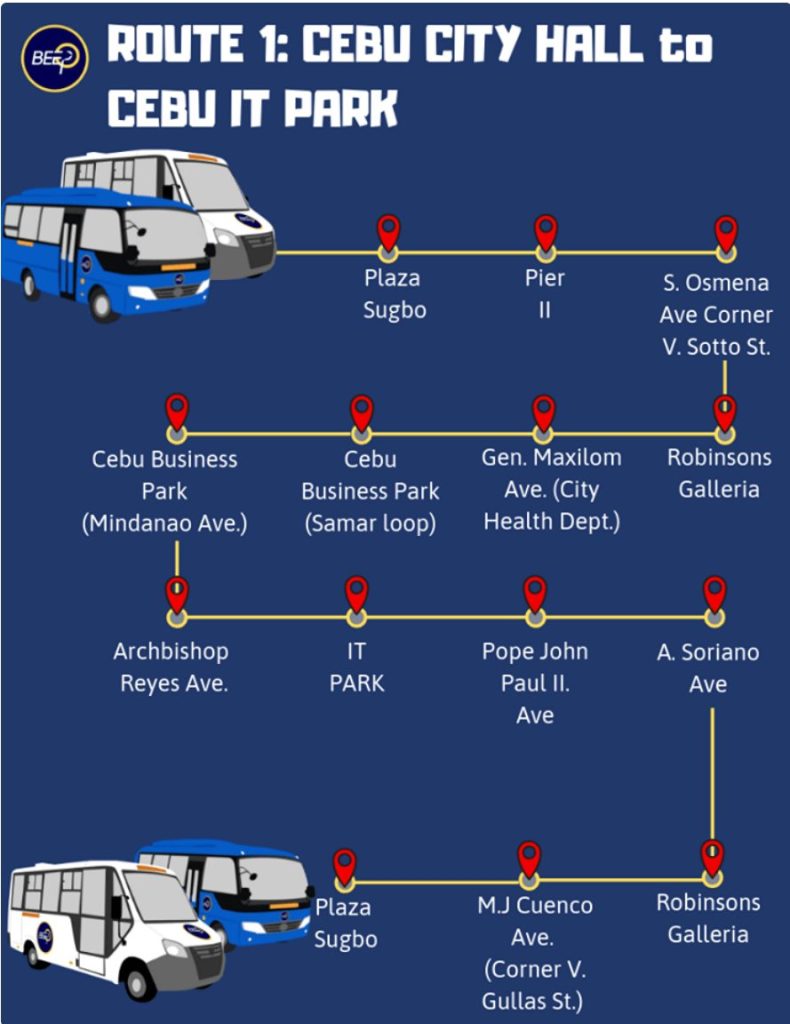
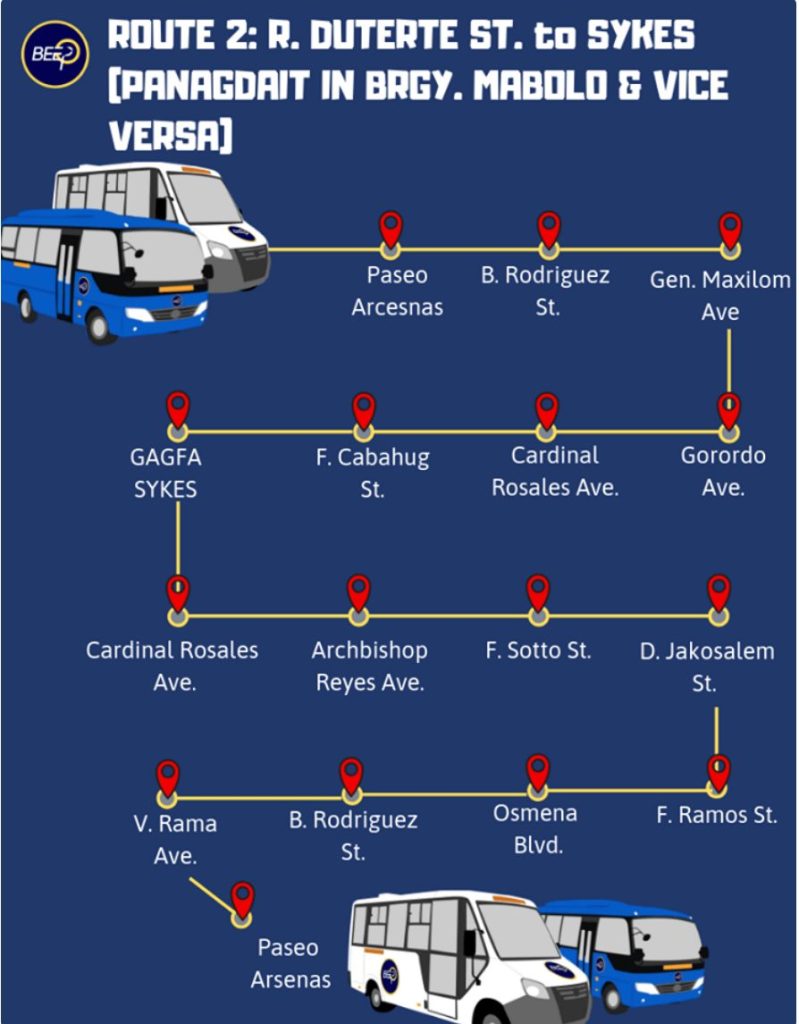
    As of November 2019, there are only three routes available:

    1. Cebu City Hall – Asia Town, I.T. Park

    Photo by: BEEP Program

    2. Paseo Arcenas Banawa (R. Duterte St.) – Sykes Panagdait

    Photo by: BEEP Program

    3. Guadalupe to Carbon market

    • Guadalupe -> Capitol -> Jones Ave. -> Downtown Cebu (vice versa)

    PeoplesJeep

    PeoplesJeep is new kid on the block. Launched in 2019, PeoplesJeep are essentially BEEP buses, but with a cooperative ownership model. They feel like those fancy mini-buses you see in airports, shrunk down for Cebuano streets. Same perks as BEEP apply, with possibly more consistent routes since they’re focused on specific areas.

    Currently, PeoplesJeep follow four routes:

    • Talamban – Ayala – Colon
    • Lahug – Ayala – SM
    • Bulacao – Colon – SM
    • Talamban – Colon (following the 13C route)

    Fare: Php 10 minimum

    MyBus

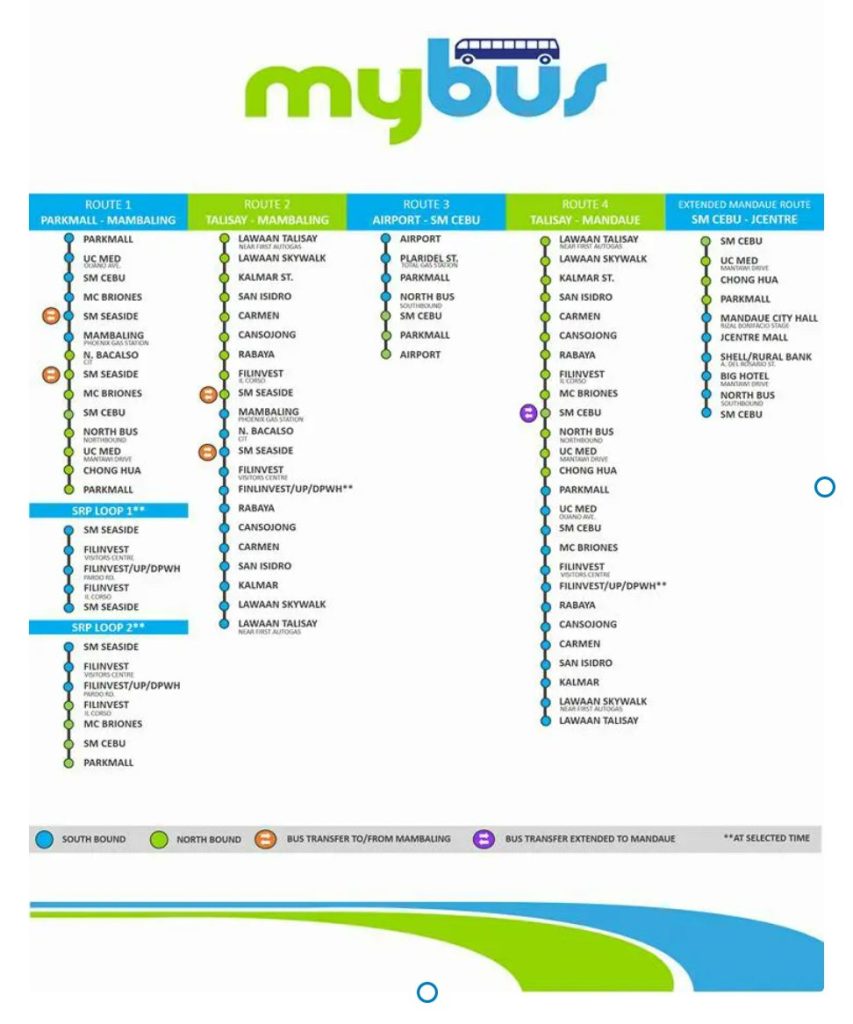
    MyBus serves a slightly different purpose. These bigger guys are best for specific journeys – think airport to SM Seaside mall, or between the major transport terminals. They also have that fancy ePLUS card for cashless payment.

    SM City Cebu – Airport (vice versa)

    Photo by: MyBus

    Fare: Php 25-40 

    Purchase an ePLUS card for Php 200 at any MyBus station or at SM Supermall to pay for your ride. You can use the remaining credit on other MyBus rides.

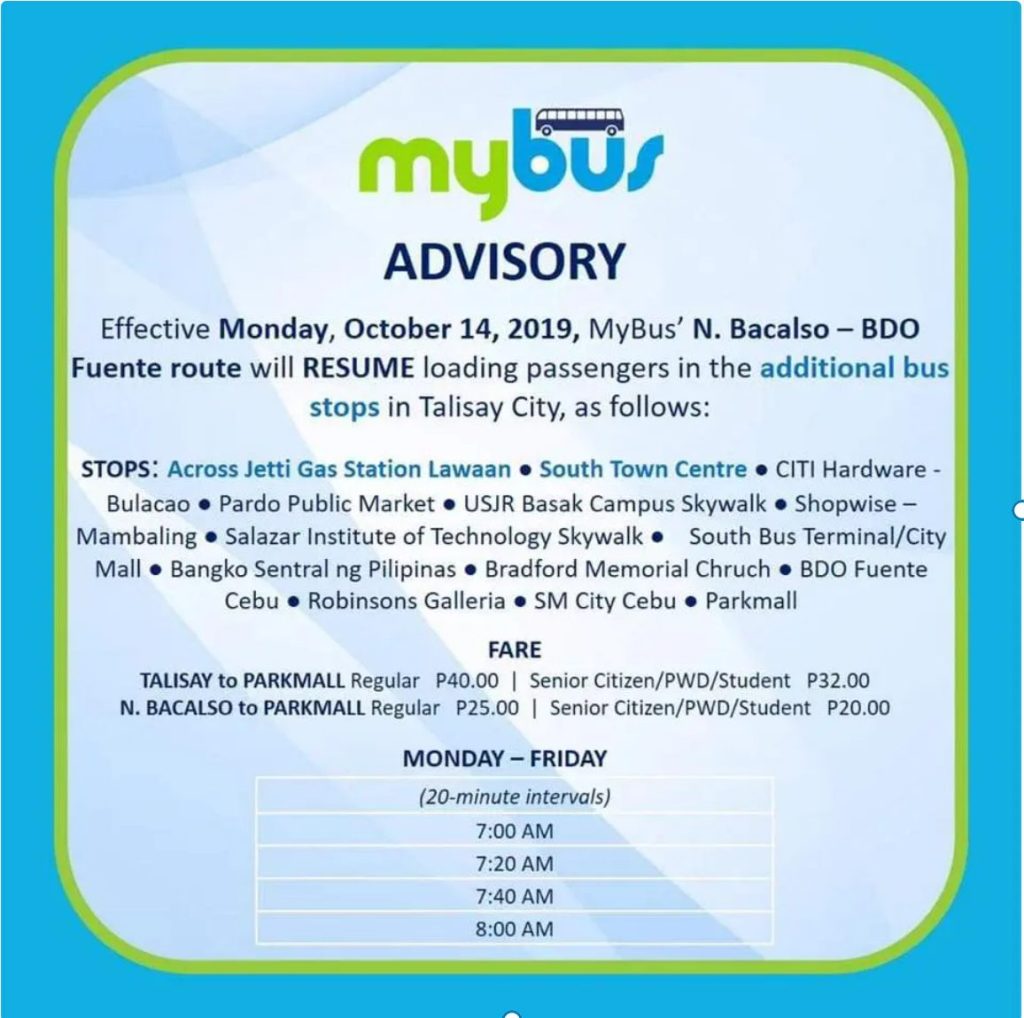
    Recently, MyBus added the N. Bacalso – BDO Fuente route:

    Photo by: MyBus

    If you want to familiarize the streets of Cebu, this is the most convenient means. But if your schedule is tight, choose another conveyance.

    How to Beep (and MyBus) Right

    • Routes are King/Queen. Before hopping on, check the signage for the bus routes. Currently, BEEPs have limited routes compared to jeepneys, so they won’t take you everywhere in Cebu City. Think of them as a step up in comfort when your route happens to match.
    • Stations, Not Hailing. Unlike jeepneys, these guys have designated stops. Keep an eye out, or you might miss your chance to disembark in a flurry of panicked button-pressing.
    • Fares. Beep fares start at around PHP 9.50, which is a bit steeper than a jeepney. MyBus has varying fees depending on the route. Think of it like paying for that aircon privilege, okay?

    My Verdict

    Want to sightsee and soak in the Cebu street vibe? MyBus on the N. Bacalso – BDO Fuente route is a good bet. Tight schedule and desperately need to NOT arrive a sweaty mess? Opt for a taxi or ride-hailing app. But when you want that middle ground between colorful jeepney chaos and the convenience of Grab, the BEEP network can be your jam. 

    Taxis and Ride-Hailing: Trading Chaos for Convenience

    Sometimes, a girl just needs a comfy seat and working AC. Especially after braving a few jeepney rides, the familiar world of taxis and ride-hailing apps offers a comforting hit of predictability when getting around Cebu City. Of course, they come with their quirks.

    White Taxi Cabs

    Similar to the yellow taxis, but sometimes operate on a fixed price rather than a meter. Do your homework beforehand if you have a specific destination in mind. You can bargain, but it takes practice and a little bit of Cebuano wouldn’t hurt.

    White taxi fare: Php 40 (USD .77) flag-down rate + Php 13.50 for every succeeding kilometre and Php 2 per minute of waiting time in traffic

    Grab is Your Friend

    Think of the Grab app as your personal chauffeur service on demand. Sure, “surge pricing” during rush hour can sting, but sometimes paying a bit extra for that sweet air conditioning and the knowledge of exactly where you’re going is downright priceless. Bonus? You can track your ride, minimizing those awkward “Where are you now?” calls on unfamiliar streets.

    Yellow Cabs: When They Work, They’re Fine

    Yellow cabs are the OG Cebu transport option. They’re plentiful, and hailing one gives you that classic “I’m in a movie!” moment. The catch? Not all drivers are created equal. Some are honest, while others might try to “creatively” interpret the meter (remember those language skills!). It’s a bit of a gamble, but asking locals or your hotel for reliable cab companies can up your odds of a smooth ride.

    Yellow taxi fare: Php 70 (USD 1.35) + P4 for every succeeding 300 meters

    Women-Driven Options

    There’s debate around this, and it touches on bigger issues of safety in public transport (a whole other blog post!). Some companies or smaller networks do offer women-driven options, aimed at providing a bit more peace of mind for solo female travelers. I’m digging into finding reputable services right now because that extra layer of comfort matters. 

    My Verdict

    Taxis and ride-hailing won’t replace the cultural experience of jeepneys, and they’re not the most sustainable choice. But hey, we work hard – sometimes a private, climate-controlled ride with a dash of WiFi is the best form of self-care. 

    Safety tips: Always lock the door once you’ve boarded. There have been incidents when robbers would randomly open taxi doors when traffic is at standstill. Also, check that the meter is running. There’s also a newly reported scam where the driver intentionally forgets to turn on the meter so they can charge a higher than usual fare later.

    Getting Off The Beaten Path: Sustainable-ish Escapes

    Alright, let’s dive into the wild side of Cebuano transport! Think less luxury coach tour, and more “Indiana Jones with a latte” vibes. Because when that wanderlust kicks in and Cebu City starts feeling a little *too* urban, we nomads crave those off-the-grid adventures. Luckily, options abound – though “sustainable-ish” is the key phrase here.

    Habal-Habal Adventures: Embrace the Adrenaline (and Sketchiness)

    Imagine clinging to the back of a motorcycle, whipping through mountain roads, views that’ll hijack your Instagram feed. That’s the habal-habal experience. It’s fast, it’s cheap-ish (if you’re a haggling pro), and exhilarating… with a side of safety concerns. It’s the transport equivalent of that street food that’s SO good, but you might regret it later.

    These guys are lifesavers for getting to waterfalls, remote beaches, etc. But know this: no helmets (usually), your driver might be 16, and the ‘road rules’ are… flexible. Think of it as a calculated risk for that epic photo-op.

    As written in our habal-habal guide, here are the fares for the usual routes within Metro Cebu:

    • Ayala to I.T. Park – P30 ($0.57)
    •  Maria Luisa Road to I.T. Park – P70 ($1.33)
    • I.T. Park to SM City – P70 ($1.33)
    • Ayala to SM Seaside – P120 – P150 ($2.3 – $2.8)

    V-Hire Vans: Cultural Immersion, Sardine-Style

    Craving a dose of authentic Cebuano life? Hop on a V-hire! These shared vans cram in as many passengers as humanly possible. You’ll be elbow-to-elbow with locals, groceries, and maybe a live chicken… it’s loud, sweaty, and an experience you won’t forget.

    Bonus points: It’s dirt cheap for longer hauls to nearby towns. But bring snacks, because stopping is unpredictable. Like that overstuffed suitcase you should’ve unpacked, it’s all part of the journey.

    Bike Rentals: Cebu’s (Questionable) Cycling Scene

    Cebu has bike rentals… but the city itself? Not ideal. Traffic is chaotic, and bike lanes are rare. Think twice before pedaling through downtown. However, there ARE quieter areas for scenic rides (check out online cycling groups for tips).

    So, it’s not like bike-friendly Copenhagen, but doable if you’re smart about routes. A mountain bike opens up more remote possibilities, too.

    Angkas: The ‘Grab’ of Motorcycle Taxis

    If habal-habal bargaining stresses you out, Angkas is your friend. This app lets you hail a motorcycle ride (with a helmet, yay for safety!), and fares are fixed upfront. Think of it as Uber but with more wind-in-your-hair excitement.

    Ferries: Your Scenic Sea Shortcut

    Need a Mactan Island escape? Ferries across the channel are fast, and breezy, and offer stunning skyline views. Way more charming than a taxi in traffic, and eco-friendlier too. 

    A ferry departs every 10-20 minutes in Pier 3 bound for Lapu-lapu City.

    If you’re coming from Mactan Island, here’s where you can take a ferry boat:

    Topline Express Ferry

    At Mactan Marina Mall, walk towards Island City Mactan where the ferry terminal is located. The Island Ferry 1 that will take you to Pier 3 in downtown Cebu City. It’s a 30-minute ride coast-to-coast – add to that the time spent buying tickets. Daily route is from 5 am to 9 pm.

    Fare: Php 25-30 ($0.48 to $0.57)

    Metro Ferry

    Go to the Muelle Osmena port near Opon Mercado. Buy your ticket and pay the terminal fee. Metro Ferry will take you to Pier 3 in just 15-20 minutes.

    Fare: Php 14 ($0.27) + Php 2 (terminal fee).

    Sea Jeepney

    From southern Cebu, commuters can now travel to Cebu City onboard the MyBoat “sea jeepney.” The vessel sails from Naga City port to Pier 1 and vice versa for a total of 10 trips daily. Each trip takes 45-60 minutes coast to coast.

    MyBoat schedule is as follows:

    • Heading to Cebu City:
      • 5:30 am
      • 7:50 am
      • 10:10 am
      • 2:10 pm
      • 4:30 pm
    • From Cebu City:
      • 6:40 am
      • 9 am
      • 1 pm
      • 3:20 pm
      • 5:40 pm.

    Fare: Php 60

    Beyond the Basics: Niche Transport Wins

    • Tricycles. Cebu’s version of a tuk-tuk, these covered trikes are perfect for short hops within neighborhoods. Unlike habal-habals, tricycles have a roof which makes them useful on extremely hot or rainy days. You can get one to take you to the nearest bus/jeep station or to rural locations. Tricycles can carry up to 4 passengers at a time. They usually wait for other passengers to ensure full capacity, but you can offer to pay the full-capacity price (pakyaw) if you’re in a rush.
    • Renting Your Ride. If driving doesn’t scare you, motorbike or car rentals unlock serious freedom. Proceed with caution – think of it as playing Frogger with real-life consequences. There are peer-to-peer motorbike sharing services like Book2wheel and Rentmotorcebu.com that let you rent on a daily, weekly, monthly basis. They usually offer delivery and pick-up for free. Rental prices start at Php 350 (daily), Php 2450 (weekly), and Php 6500 (monthly). You can find a lot of car rentals with a quick Facebook or Google search. Be sure to check the reviews to get the best possible service. Hourly rates within Cebu average Php 850 + Php 300 for every succeeding hour, while daily rates average Php 4500. 

    Getting around Cebu City is an adventure in itself. Embrace the chaos a little, trust your gut, and always have backup caffeine on hand. That ‘lost and kinda loving it’ moment? That’s where the best stories start. 

    Tech to the Rescue: Apps That Save Your Sanity

    Time to unleash your inner tech goddess! I know navigating a new city can feel overwhelming, especially in Cebu City where the streets sometimes seem to have a mind of their own. But fear not, because I’m about to arm you with digital tools that’ll help you conquer this urban maze.

    Google Maps, Your Trusty Sidekick

    Okay, we all know Google Maps. It’s like the trusty compass of our digital age. But here’s the thing: Google Maps in Cebu deserves its masterclass. Let’s unlock those lesser-known superpowers:

    • Offline Savior. Spotty internet is the bane of every nomad. Before venturing out, download offline maps of Cebu. Trust me, this is your lifeline when the wifi gods betray you. It’s like a cached treasure map for navigating those moments of signal darkness. 
    • Hidden Gems. Google Maps isn’t just about routes. Search cafes, coworking spaces, and even those hole-in-the-wall eateries your fellow nomads rave about. Tap the “Explore” tab and unleash your inner digital Magellan!

    Waze for the Traffic Win?

    Think of Waze as your personal traffic whisperer. It taps into the wisdom (and occasional grumbling) of fellow drivers to paint a real-time picture of traffic jams, accidents, and those sneaky shortcuts. Here’s how to use Waze with the savviness of a local:

    • Eyes on the Prize. Waze is meant for pre-trip intel, not while driving (safety first!). Plan your route before you hit the road, keeping those little Waze icons in mind (they could mean potholes, speed traps, or even a random mango stand).
    • Rush Hour Radar. Cebu traffic worsens at predictable times. Waze helps you outsmart the gridlock during peak periods, suggesting alternative routes even if they seem circuitous at first.  

    Like with any crowdsourced app, Waze relies on user input. Sometimes it’s incredibly accurate, other times a little less so. It’s a fantastic tool, but not an infallible oracle. Pair it with your gut instincts, and you’ll be dodging those traffic jams with ninja-like reflexes. 

    Extra Credit: Leveling Up Your Cebu Street Cred

    Okay, you’ve mastered the jeepney, survived a Grab price surge, and (mostly) know where you’re going. Now, let’s go from a newbie digital nomad to a seasoned Cebuana traveler. Because getting around Cebu City is one thing, but thriving in it? That’s a whole different skill set.

    Rainy Day Retreats: Because It WILL Rain

    Cebu’s got that tropical charm, which means sun…and sometimes a whole lotta downpour. Here’s your wet-weather survival kit:

    • Coffee + Wifi Havens. Bo’s Coffee (local chain, everywhere!), Abaca Baking Company (those pastries, tho), and Coffee Factory (if you’re in IT Park). 
    • When Only AC Will Do. Malls are your overly chilled sanctuary. Ayala Center Cebu and SM City Cebu are classics, SM Seaside is the fancy schmancy option. 

    Cebuano 101: Transport Edition

    Knowing a few keywords makes all the difference. No, you won’t be fluent overnight (unless you’re secretly a linguistic genius), but these get you by:

    • “Para!” (Stop!). Yell this LOUDLY when you want the jeepney to pull over.
    • “Bayad!” (Payment!). Hand this to the driver along with your fare, with a smile if you can manage.  
    • “Asa dapit and…?” (Where is…?). Best followed by pointing and looking hopeful.
    • “Tabang!” (Help!). When things get real. A last resort, but good to know.

    Lost in Translation: What To Do When Panic Sets In

    It happens to the best of us. Maps fail, batteries die, and suddenly you’re on a street corner feeling VERY far from home. Let’s troubleshoot:

    • Who to Ask. Security guards (they’re everywhere), friendly-looking shop staff, or fellow young people (better chance of English). 
    • Breathe. Panic makes things worse. Remember, Cebuanos are generally kind folks, willing to help if they can.
    • Power Bank = Lifeline. Dying phone + being lost is a recipe for a meltdown. Your backup battery saves the day.
    • Embrace the Detour. Sometimes, getting lost is the BEST way to find hidden gems and unexpected adventures.

    Think of this like a language-learning game, an upgraded version of charades with a Cebuano twist.

    FAQs

    Is Cebu safe for a solo female traveler?

    It’s generally safe, but like any city, awareness is key. I stick to well-lit, populated areas at night, and I’ve learned a bit of self-defense… just in case a stray mango decides to challenge me.

    How much money do I need to survive as a digital nomad here?

    I budget more for comforts than bare-bones backpacking, since good coffee and reliable WiFi are survival gear for me. Expect to spend more than Southeast Asia hotspots, but less than Western cities.

    Is it walkable?

    Depends on your heat tolerance and shoe choice! I walk short distances, but Cebu rewards those prepared for uneven sidewalks and the occasional tropical downpour.

    Do people speak English?

    Widely! Filipinos are amazing at English, even with that charming Cebuano accent. But I suggest learning basic Bisaya phrases – it breaks the ice and will help you navigate better.

    Can I live a sustainable lifestyle in Cebu?

    It takes effort. I seek out refill stores, carry my reusables, and love exploring markets. But single-use plastic is still a reality here, so it’s about finding your balance.

    Can I work from cute cafes?

    Absolutely! Cebu’s cafe scene is booming. In a separate post, I’ll share my favorite work-friendly spots, where the coffee is strong and the WiFi is stronger. My go-to is Abaca Baking Company on the top floor of Ayala Center.

    Must-have apps?

    Grab for transport, Google Maps for life, and Gcash for cashless payments. Language apps are fun, but a smile and “salamat” (thank you) go a long way.

    How do I meet people?

    Coworking spaces, expat groups, even striking up conversations in cafes! Cebuanos are friendly, and if you’re like me, a slightly awkward introvert, a little effort goes a long way.

    What about island hopping?

    Cebu’s your launchpad for amazing beaches! I’ll cover ferry logistics, and how to find eco-conscious stays for those weekend escapes in the future.

    Best tips for a newbie?

    Patience is key, as is a sense of humor. Things WILL go wrong, but that’s half the adventure, right? Besides, there’s always a strong coffee waiting around the corner.

    Takeaway Message

    So, did I conquer all your Cebu transit fears? Probably not. But hey, half the fun is in the figuring it out, right? Getting around Cebu City will always have some chaotic charm thrown in, no matter how much tech you try to throw at it. But that’s also what makes it memorable. I guarantee those near-misses with jeepneys and frantic moments of lost-in-translation will make the best stories later, told over a fantastic cup of Cebuano coffee.

    And remember, as digital nomad women, we got this. We’re adaptable, resourceful, and caffeinated to the max. Cebu might throw some unexpected routes our way, but who says we have to follow a perfect map anyway? Sometimes the best adventures start when we ditch the itinerary and embrace the unknown.

    And speaking of adventures, if you’re ready to ditch the tourist hotspots and dive deep into Cebu on a seriously shoestring budget, check out my guide on the Ultimate Cebu Itinerary: The Really Frugal Solo Traveler’s Guide.

    Until then, maayong adlaw (that’s Cebuano for “good day”), and happy wandering!

  • Philippine Textiles and Fabrics that are More Sustainable than Cotton

    Upgrading my travel wardrobe with Philippine textiles and fabrics. Because mindful living > mindless shopping. Get inspired.

    I’m no Carrie Bradshaw. My idea of a fashion emergency is realizing all my socks have holes. But after a few years tucked away in my Cebu apartment, surrounded by unread books and half-finished Netflix series, I’ve had an epiphany. It wasn’t some spiritual awakening amidst the banana trees; it was a deep dive into the dark side of my closet – that black hole of fast fashion where forgotten t-shirts and impulse-buy dresses go to die.

    Turns out, my wardrobe is a crime scene. Cheap fabrics, unethical production, a devastating environmental impact… Suddenly, my cozy introverted existence felt a whole lot less comfortable. You might think, as a digital nomad in the Philippines, I’m worlds away from the sweatshops and polluted rivers that fuel the fashion industry, right? Wrong.

    The truth is, what we wear matters. Our choices ripple outwards, impacting communities here in the Philippines and the health of the planet. And that’s where Philippine textiles and fabrics come in. They’re not just beautiful – they’re a lifeline to a different way of making and consuming clothing. Think intricate weaves, natural fibers, and a history that makes those $5 tees look painfully shallow. This isn’t just about ditching cotton (although we’ll get to why that’s a good idea too). It’s about discovering fabrics with stories as rich as your morning coffee, and a style that’s as mindful as your travel itinerary.

    So, if you’re ready to trade your worn-out leggings for something more meaningful, to travel with a lighter footprint, and maybe even feel a little more fabulous in the process, stick around. As someone who seriously considered wearing the same muumuu for a week straight, I’m here to tell you that sustainable style is possible.

    The Problem with Cotton

    Despite my love affair with linen and Philippine textiles, I haven’t fully banished cotton from my life. My closet still harbors a few relics from my H&M-loving days. See, even the most mindful digital nomad can stumble. But before you judge, let’s unpack the whole tangled mess that is cotton. It’s not just about trendy tote bags; there’s a dark underbelly to that soft white boll.

    What’s the Environmental Cost of Cotton?

    Turns out, my comfy t-shirt is a thirsty, thirsty beast. Growing conventional cotton is like throwing a water-guzzling party for your clothes. Did you know something like 2,700 liters of water go into producing a single t-shirt? That’s enough to keep a person hydrated for two and a half years. Kinda puts your morning coffee habit in perspective, huh? Cotton fields are also notorious pesticide guzzlers. It’s a vicious cycle – the more pesticides you use, the more you damage the soil, the more water you need.

    Why Cotton Production is a Major Water Polluter

    Remember that time an entire sea dried up? Yep, I’m talking about the Aral Sea disaster – largely blamed on water diversion for cotton irrigation. Ecosystems have been devastated, all in the name of cheap denim.

    Then there’s the pesticide problem. Remember Rachel Carson’s “Silent Spring”? The gist is: chemicals bad. Cotton fields get doused in ’em. Those toxins seep into the soil, the waterways, and eventually, into the whole darn ecosystem. Reminds me of that scene in The Matrix when Agent Smith talks about humans being a virus… not wrong when it comes to our impact on the planet.

    What’s more? Sometimes farmers would pull out cotton plants to get rid of any eggs or spores from the field. When soil is exposed to the air, it loses nutrients. So fertilizers are added to the soil. Nitrogen is the most common ingredient in synthetic fertilizer. The problem is that nitrogen fertilizers are a major contributor to greenhouse gas emissions.

    How Ethical is Your Cotton T-Shirt? Labor Practices in the Cotton Industry

    Shopping sustainably is a head-scratcher sometimes. You find a “Made in Bangladesh” tag and your conscience starts whispering about forced labor, poverty wages, and sweatshop conditions. It’s the fashion world’s dirty little secret. And guess who’s paying the ultimate price? Workers trapped in a system designed to keep those t-shirts dirt cheap.

    Remember when everyone got up in arms about sweatshops? Turns out, the cotton industry in Southeast Asia has its share of shady labor practices. We’re talking long hours, low wages, and maybe even child labor in some places. Suddenly, that five-dollar tee seems less of a bargain and more like a complicity badge. Yikes.

    Philippine Textile Traditions: A Sustainable Legacy

    When I first arrived in Cebu, my idea of “local textiles” meant brightly-colored souvenir tees and cheap sarongs from beachside stalls. I was all about that easy, breezy, digital nomad uniform. But then, like any good introvert forced to leave her apartment, I stumbled into a rabbit hole – a world of fabrics, colors, and stories I never knew existed.

    Who are the Indigenous Weavers of the Philippines?

    Forget what you think you know about weavers as little old ladies hunched over looms. The textile traditions here are passed down through vibrant communities across the islands. We’re talking the T’Boli women of Lake Sebu, the Mangyans of Mindoro, the skilled artisans of Ilocos… these are cultures where weaving isn’t a hobby, it’s an integral part of their identity and their connection to the land.

    What are the Unique Qualities of Traditional Filipino Fabrics?

    Okay, here’s where the geek in me gets excited. Piña fiber, scraped from pineapple leaves? Abaca, strong enough for ships’ ropes but also woven into delicate fabrics? It’s the science of taking what nature provides and transforming it through sheer skill.

    The colors are often from natural dyes, with rich browns, deep blues, and vibrant reds that speak of earth and sky. Forget the idea of pristine perfection. Traditional textiles often have minor irregularities that betray the human hand, the slight slubs and variations that make mass-produced fabrics look soulless in comparison.  

    Why Filipino Textiles Embody Mindful, Slow Fashion Principles

    In a world drowning in fast fashion waste, these weavers are the antithesis. They work with natural fibers, often locally sourced. Their dyes come from plants and minerals. The process might be slow, but it’s incredibly low-impact. Plus, buying traditional textiles supports whole communities, not faceless corporations. 

    My journey into the world of Philippine textiles is just beginning. But like Jane Goodall discovering gorillas, or maybe more like Carrie Bradshaw stumbling into a Manolo Blahnik sale, I’m hooked. It’s not just about the fabric; it’s about the connection, the history, the guilt-free satisfaction of knowing my wardrobe choices matter…even for an anti-fashionista like me.

    Weaving is an ancient craft in the Philippines—learn more about local weaving patterns.

    Where to Buy Sustainable Philippine Textiles and Fabrics

    Finding clothes that fit both my values and my suitcase is harder than getting a decent WiFi signal in some of these tropical hideaways. I’m not about to turn into a hemp-wearing, patchouli-soaked cliche, but neither can I live with the guilt of fueling the fashion industry’s eco-sins. So, my fellow nomads, let’s get real about how to hunt for sustainable style in the Philippines – and pull it off without looking like an off-duty archaeologist.

    What to Look For: Labels Aren’t Perfect, But Here’s How to Spot Real vs. Greenwashing

    It’s a jungle out there, sisters. Not every “eco-friendly” label is legit. Like a bad date, some are just greenwashing to get your attention. First, ditch the idea of perfect. Aim for better, not flawless. Look for natural fibers like piña or abaca – bonus points if they’re handwoven and naturally dyed. Check for transparency – does the brand share where their fabrics come from? How about the makers’ stories? If they’re vague, that’s a red flag.

    Where to Find the Good Stuff: Markets, Boutiques, and Online Shops with a Conscience

    Abaca Bag with Palm Leaf Flatlay

    Forget the generic mall chains; we’re talking about concept stores. Think of those teeming with color, not tourists.

    Top of my list is ANTHILL Fabric Gallery, established way back in 2010 (which makes me feel old, but that’s a separate issue). They get bonus points for their name: Alternative Nest and Trading/Training Hub for Indigenous/Ingenious Little Livelihood seekers. It’s got a clunky charm that appeals to my word-nerd side. Expect loads of handwoven, hand-loomed fabrics that give your closet some serious soul. And yes, they have printed fabrics too, if you crave a dash of pattern.

    Beyond that, Cebu’s got these cottage industries in places like Argao. They churn out gems like kinarnero (a wool-like fabric that sounds way cooler than it probably looks on me). Catch their wares at events like Gabii sa Kabilin or old-school heritage places like Casa Gorordo Museum – perfect for channeling that faded colonial elegance.

    Outside Cebu, local textiles and fabrics can be sourced from the following manufacturers and brands:

    • La Hermina Piña Weaving Industry
    • Reycon’s Piña Cloth and Industry
    • Malabon Piña Producers and Weavers Association
    • Rurungan sa Tubod Foundation
    • Creative Definitions
    • Filip+Inna
    • Casa Mercedes
    • Manila Collectible
    • Gifts & Graces Foundation
    • Yakang Yaka
    • Interweave
    • Good Luck
    • Humans

    There isn’t one single fabric that can sustainably meet the needs of over 7 billion people. But we can change our consumer habits to help the environment.

    FAQs

    Isn’t slow fashion just a trend?

    Maybe. But trends I can get behind don’t end up in landfills, unlike my 2005 skinny jeans.

    Can I really make a difference?

    One less t-shirt won’t save the planet. But small choices add up, and feeling good about those matters.

    Will locals think I’m appropriating?

    Wear with respect, not like a costume. Appreciation beats imitation, especially for textiles with meaning.

    Are they expensive?

    More than fast fashion, less than designer duds. Think: investment in quality, not a Zara impulse buy.

    Can I wash them in my Airbnb’s sink?

    Depends. Piña is delicate. Abaca can handle adventure. Read the tags like I should with skincare labels.

    Parting Thoughts

    I’m not going to trade my comfy leggings and ironic Star Wars t-shirts for a wardrobe full of handwoven wonders. A girl’s gotta maintain a baseline level of geek chic, after all. But even a reluctant fashionista like me can see the appeal of Philippine textiles and fabrics. They’re beautiful, and unique, and carry stories far more interesting than whatever I last binged on Netflix.

    You don’t have to overhaul your entire wardrobe like I did during that minimalist phase inspired by Marie Kondo (which, let’s be real, sparked zero joy). A statement scarf, an abaca bag – even small shifts support Filipino weavers and reduce your impact. Plus, imagine sipping your third flat white of the day, knowing you look stylish and made a conscious choice. 

  • Abaca Baking Company in Crossroads: Why I Love It

    If home is where the WiFi is strong (and the pastries are flaky), Abaca Baking Company in Crossroads, Cebu might be mine.

    I’m not one for crowds. The endless churn of big cities, the forced small talk – it leaves me rattled. That’s why I keep coming back to Cebu. It has the energy of somewhere on the rise, the thrum of possibility, without the claustrophobia. I can get lost in the colors of the SM Seaside, then disappear into a quiet cove on some neighboring island with nothing but a good book and the rhythmic beat of the waves. I can work, tucked away on my laptop in a beachside cafe, or hit the road, chasing waterfalls and hidden temples.

    I embraced the digital nomad life in my late thirties. It means untethering from one fixed address, and it means figuring out how to live lightly, and consciously. Sustainable isn’t just a buzzword for me, it’s a guiding principle. I seek experiences over possessions and businesses that have a soul beyond their bottom line.

    That’s why I have a soft spot for places like Abaca Baking Company in Crossroads. It’s become a ritual – my little slice of comfort in this ever-changing world. There’s something about their approach, the quality of their ingredients, that speaks to the kind of conscious consumption that I value. I want to know where my coffee comes from, that the farmers get a fair price, and that the pastries weren’t pumped full of chemicals. It’s the little things, the choices we make every day, that add up to a life lived on our terms. And for me, sometimes that life involves a perfect cappuccino and a buttery, flaky croissant.

    About Abaca Baking Company

    I first stumbled upon Abaca Baking Company in Crossroads almost by accident. I was exploring Cebu City, trying to reconcile the chaos and charm that seems to be the signature of every Southeast Asian metropolis. Crossroads, this open-air mall in the Banilad neighborhood, felt like a refuge – a bit upscale, sure, but filled with that lush kind of greenery that reminds you this is still the tropics. And there, nestled amidst the shops, was Abaca Baking Company.

    It’s not just a bakery, and it’s not just a cafe, though the words are in the name. It’s a full-on restaurant, somehow managing to pull off an elevated yet inviting atmosphere that immediately struck me as the perfect spot for digital nomads. They serve everything from hearty breakfasts to Cuban sandwiches, but the bakery counter, filled with tempting croissants and pastries, is what initially drew me in. Let’s face it, sometimes we need a taste of something familiar alongside our daily dose of adventure, and Abaca delivers.

    Abaca Baking Company in Crossroads is strategically located – near enough to Cebu’s action to stay connected, but far enough out to offer a touch of sanctuary. You can find it in the Crossroads Mall in Banilad, Cebu City. They keep generous hours, usually open from about 7 am to 11 pm. Now, those times can fluctuate a bit, especially around holidays (something about which Filipinos know a thing or two). So, before you get your heart set on a late-night pastry binge, it might be wise to check their socials.

    Where is it?

    Abaca Baking Company is located in the Crossroads strip mall in Banilad, right next to IT Park.

    Abaca Baking Company’s Atmosphere

    Stepping into Abaca Baking Company in Crossroads feels like walking into a thoughtfully curated page from a design magazine – but with the tantalizing bonus aroma of coffee and freshly baked bread. It’s got this bright, minimalist airiness that I adore. The high ceilings and generous use of natural light create a sense of spaciousness that puts my mind at ease. There are pops of warm wood and splashes of greenery, bringing in an organic touch that’s very welcome amidst the concrete of Cebu. Everything feels clean, uncluttered, and intentionally designed – appealing to that nomadic craving for a serene workspace.

    You’ll spot plenty of fellow expats here, drawn to the familiar brunch fare and comfortable atmosphere. It’s got that ‘treat yourself’ vibe, whether it’s a carefully assembled bakery benedict or a slice of something sinful from the pastry counter. However, as much as I adore their coffee and could happily spend all day nibbling on their croissants, I wouldn’t call Abaca my primary work hub. The tables are just a bit too close together for long sessions on my laptop, and there’s a certain weekend brunch energy that might be distracting if you’re chasing a deadline. 

    For dedicated work sessions, there are better options than just a short jaunt away. The Company in IT Park offers that dedicated co-working feel. Or Drip and Draft in Streetscape is cozy if you prefer a more intimate cafe environment. If you’re willing to venture further, there’s Workplace Cafe Mactan and Mandaue that cater specifically to the remote working crowd. 

    Menu, Coffee, and Sustainable Practices

    I’m not going to pretend to be some espresso connoisseur with a palate refined enough to detect the “notes of dark chocolate and toasted hazelnut” the menu describes. My coffee order’s simple: brewed coffee, maybe a cappuccino if I’m feeling adventurous. What I love about Abaca Baking Company in Crossroads is their consistency. I know I’ll get a decent, strong cup that powers me through a morning of writing without any pretentious fuss. On especially sweltering Cebu days, their pure fruit smoothies hit the spot. I’ve even grown fond of their tea selection – a little nod towards that elusive “wellness” we digital nomads chase between continents. 

    Their pastries are my guilty pleasure, and thankfully, ideal for my somewhat erratic schedule. Many mornings, I’m too immersed in edits or research to remember breakfast. Abaca’s croissants, both savory and sweet, save the day. Flaky, buttery, just the thing to grab and munch between emails or while stuck on a particularly difficult paragraph. Sustainability-wise, I appreciate that Abaca uses real ingredients. It’s a shift from the overly processed snacks I defaulted to when perpetually on the move. This feels less…transitory, and more grounded.  

    Speaking of grounded, Abaca’s dedication to sourcing matters to me. It’s one thing to slap “organic” on a label – the hollow trendiness of that makes me roll my eyes like something out of a Bret Easton Ellis novel. It’s another to truly prioritize ethical suppliers, minimizing waste, the whole spiel. My work often delves into risk assessment and supply chain exploitation…it can be grim. Supporting a business actively trying to do better lightens that mental load, even in a small way.  

    As for meals, I’m partial to their eggs Benedict for a late weekend brunch, and that ABC Skillet Breakfast is killer if I need serious sustenance. It’s comfort food, done well, which after years of chasing the exotic around the globe, has its unique appeal. 

    Why It’s a Digital Nomad Haven

    I’m not here to make friends, exactly. Cebu has been the base, the safe harbor – familiar enough to breed routine, foreign enough to still feel like an escape. I work alone. Solitude is the currency of focus, and most cafes understand this. But then there are the times when a shift, a different kind of energy, becomes necessary. You realize the internet connection is down at your apartment, or the drone of construction next door has rattled loose the last coherent thought. That’s when I find myself navigating those chaotic Mandaue streets toward Abaca Baking Company in Crossroads. 

    WiFi, naturally, is paramount. The signal at Abaca is reliable, the tables wide and forgiving of notebooks, powerbanks, and tangled cords. The lack of an abundance of outlets does force a certain level of discipline – arriving with a well-charged machine becomes non-negotiable. It’s a trade-off I’m willing to make. 

    It’s location, too, that makes Abaca a reliable port in a storm. Nestled within larger complexes, it offers a sanctuary from the sensory overload of the city. A quick dash for groceries, a pause to browse the carefully curated shelves of a neighboring shop – you can tick off errands and then retreat to your corner with a latte. 

    Parting Thoughts

    As a digital nomad who favors a good book over boisterous crowds, timing is everything. I’ve learned that Abaca Baking Company in Crossroads has its rhythms. Mornings are a delightful hum, the smell of coffee and fresh-baked bread a promise against the tropical heat. Early afternoons offer pockets of tranquility – grab a window seat if you can. But as the sun dips lower, the place transforms. Laptop warriors descend, families drop in, and the energy shifts. If solitude is your jam, avoid peak hours on the weekend and stick to the quiet charm of midweek visits.

    Price-wise, Abaca isn’t your budget-friendly hole-in-the-wall. You’re paying for the ambiance, the carefully sourced ingredients, and the fact that, yes, their air conditioning reliably combats Cebu’s humidity. Plus, their portions are generous. Consider it an investment in your nomad work-life balance. 

    So, who’s going to dig Abaca? If you’re the type who craves a sense of place even when you’re thousands of miles from home, this is your spot. Extroverts will thrive on the buzz, fellow introverts can find their quiet corners. Abaca attracts a diverse mix – a microcosm of the wider Cebu expat scene. There’s a comforting familiarity to it, especially if you’re a solo traveler like me. 

    As for me, I’ll keep coming back. It’s become my third space – that essential in-between place that’s not quite home, not quite the office. I trust Abaca for decent coffee, tasty food made with care, and a sliver of community in my otherwise solitary life. I’ve come to appreciate the subtle textures of a place I once considered temporary. Turns out, even a digital nomad can grow roots, one croissant at a time.