Digital nomad’s guide to the best outfit for island-hopping in Cebu! Find style, comfort, and sustainable choices for an amazing adventure.
The excitement around Cebu island-hopping is real. But trying to see everything in a whirlwind weekend can lead to burnout. I suggest savoring heartfelt moments, not just snapping Instagram-worthy spots.
Now, for us tech-loving travelers, packing presents a challenge. How do we fit in laptops, cameras, swimsuits, and comfy clothes?
Choosing the ideal attire is about more than comfort. The best island-hopping outfit enhances island adventure. It promotes wellness and stokes wanderlust.
Choosing the Right Fabrics for Cebu’s Climate
Island-hopping in the Philippines isn’t always glamorous. You’ll likely end up sweaty, sunburned, and salty. So, picking the right clothes is the cardinal rule.
Choose Breathable and Quick-Drying Fabrics
Lightweight linen, airy cotton, and quick-drying synthetics are great options. Quick-drying fabrics mean you won’t stay wet and chilly after a swim.
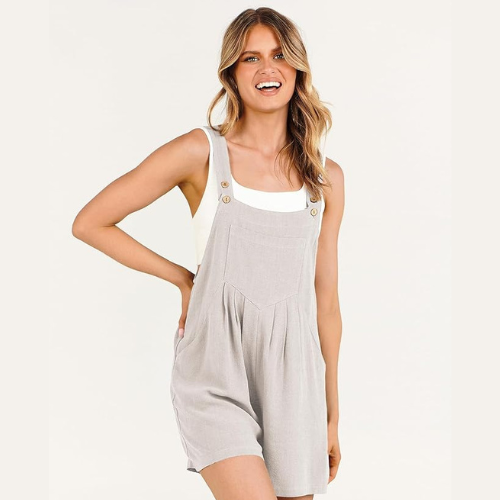
Loose Linen Jumpsuit
This jumpsuit is great for island-hopping in Cebu because it’s lightweight, breathable, versatile for both beaches and exploring, and offers pockets for carrying those island adventure essentials.
Linen and cotton are island favorites for good reason. They’re comfy, breathable, and often more eco-friendly than 100% synthetic choices. Look for blends that mix both for coolness and durability.
Cotton Halter Top
This cotton halter top is great for island hopping in Cebu because it offers a blend of style, versatility, and comfort, allowing you to transition easily from exploring beaches to dining out, all while staying cool in the tropical heat.
Sunscreen is a must (and reef-safe, please!), but clothes with UPF protection add a layer of defense against the intense tropical sun. Find garments with built-in sun protection to shield yourself from those sneaky afternoon rays that can lead to a not-so-pretty lobster look.
UPF 50+ UV Long Sleeve Shirt
This long-sleeved shirt is ideal for island hopping in Cebu because it offers sun protection, breathability, quick-drying fabric, and versatility for both water and land activities – all essential for Cebu’s tropical climate.
Here’s your guide to island style. Picture yourself transitioning from boat to beachside café without worrying about swimsuit mishaps or sunburn.
Versatile Swimsuits for Every Adventure
Your swimsuit is the cornerstone of your island-hopping attire. Choose classic styles in solid colors or subtle patterns that mix and match like a dream. Look for a one-piece with adjustable straps for support and a hint of retro charm.
Ruffled One-Piece Swimsuit
This Ruffled One-Piece Swimsuit is great for Cebu island hopping because its adjustable lace-up back provides a secure fit for swimming and exploring. The ruffled design adds a touch of style while the one-piece coverage offers sun protection and comfort.
Pack a gauzy linen dress or a lightweight sarong for those sunny island days. These versatile pieces shield you from the sun but can transform into a trendy skirt or top for a sunset dinner. Think effortless elegance with a touch of boho – a la a modern-day Jane Birkin exploring the tropics.
Sarong Coverup
This Sarong Coverup is great for island-hopping in Cebu because it’s lightweight, breathable, quick-drying, and versatile. It offers sun protection, a touch of style, and can be transformed from a cover-up into a skirt or top.
Embrace the laid-back island vibe with a wide-brimmed sunhat that’s practical and stylish. Opt for breathable natural fibers like straw or raffia. Oversized sunglasses add an air of mystery to your look. And don’t forget a few simple jewelry pieces—think delicate gold chains or a woven bracelet—to elevate your outfit with no trouble.
Polarized Sunglasses
These polarized sunglasses are ideal for Cebu island-hopping. Their classic design goes with anything, while the polarized lenses cut glare off the water, letting you see stunning underwater views and protecting your eyes from the bright Philippine sun.
The best outfit for island-hopping in Cebu is simple, with neutral colors like white, beige, navy, and olive green as your base. Add pops of color and subtle prints with lightweight tops and bottoms. Invest in quality pieces that last, such as linen shorts or a chambray jumpsuit.
Keep your tech safe from sand and sea with waterproof dry bags in various sizes. Use a microfiber cloth in your tote to keep your sunglasses and phone screen clean. If you plan to work by the beach, consider a hard-shell case for your tablet.
For wrinkle-free outfits during your travels, choose fabrics like linen, rayon, or jersey blends that resist creasing naturally. Rolling your clothes instead of folding them will also help minimize wrinkles. And don’t forget a travel-sized stain remover pen in your bag—it’ll save the day if a splash of mango juice threatens your favorite top.
Food & Exploration Essentials
The joy of slow travel in Cebu is about embracing surprises – taking your time over lunch, discovering hidden coves, or following a jungle trail. Let’s get you ready for tasty island meals and the adventures they inspire.
Sustainable Beach Bags for Snacks and Gear. You’ll want a sturdy, eco-friendly tote to carry your essentials. Look for spacious options made from natural materials, like a woven straw bag.
Comfortable and Stylish Footwear for Every Terrain. Choose sandals that can handle diverse landscapes – like Tevas or KEENs – for sandy beaches, rocky coves, and jungle paths. Opt for a neutral color that goes with everything.
Dress for Delicious Island Meals. Wear a loose-fitting maxi dress in breathable fabric, like breezy linen or soft cotton. Add a light cardigan for cooler evenings.
Beyond the Basics: Island Adventure Must-Haves
We’ve covered the basics of the best island-hopping outfit. Now, let’s talk about what you need to stay protected.
A rash guard. It prevents those weird tan lines and shields you from jellyfish stings, coral scrapes, and the blazing sun. If you plan on lots of snorkeling or waterfall chasing, get a long-sleeved one like the Kanu Surf Rash Guard. Pick pretty patterns or bright colors that flaunt your style, even underwater.
Eco-friendly sunscreen. Keeping Cebu’s waters clean is a job for everyone. Try mineral-based sunscreens such as Babo Botanicals Clear Zinc.
Mini first-aid kit. Scrapes and bug bites happen, so be ready with something like the Welly Mini First Aid Kit. You might also want antihistamine cream for bug bites and electrolyte tabs to stay hydrated in the heat.
Conclusion
Cebu’s island-hopping magic doesn’t lie in checking off destinations but in savoring fleeting moments – chasing a school of vibrant fish, sharing laughter with locals over a grilled seafood platter, or simply feeling the warm sand between your toes. With the best outfit for island-hopping, nothing stands between you and these experiences. If you’re eager to make every island photo count, check out my guide “What To Wear In Cebu For Beautiful, Stunning Photos.”
Embrace the unexpected detours that slow travel encourages. A canceled ferry or a sudden downpour might feel disruptive at first, but they often lead to hidden gems and the most memorable stories. After all, as a wise traveler (or was it a mischievous hobbit?) once said, “It’s the job that’s never started as takes longest to finish.”
Packing for the Philippines? This comprehensive guide reveals what to bring and what to leave behind for a seamless and enjoyable trip.
The first time I made the rookie mistake of bringing a suitcase the size of a small refrigerator was when I went to Bohol in 2016. Stuffed inside was everything from a dozen sundresses I never wore to hiking shoes for trails I never found. As I lugged the monstrosity down unpaved roads and onto crowded buses, I swore it was plotting my demise.
Packing for the Philippines isn’t about squeezing a month’s worth of belongings into a carry-on. It’s about understanding what genuinely serves you in these 7,000+ islands, and ruthlessly editing out the rest.
Backpack vs. Suitcase: Choosing Your Travel Companion
I understand the packing paradox all too well. I’ve called Cebu home for a few years now, and even with a fixed base, the lure of slow travel throughout the Philippines is irresistible. But that first critical decision – backpack or suitcase – always gives me pause. It’s a battle between the romantic freedom of the backpacker and the grounded practicality of wheels on cobblestones. Here’s how I break it down:
Where are you going in the Philippines?
The terrain, length of stay, and type of travel dictate my luggage choice for exploring the Philippines. A backpack might be awesome for short island-hopping stints. But when you’re relocating for a month of writing and remote work with occasional side adventures, a suitcase starts to feel far more sensible.
The Right Suitcase for Travel in the Philippines
If, like me, you sometimes opt for a suitcase, here’s the deal:
Hard-Shell: Those flimsy fabric ones get beat up quickly on Philippine roads. Invest in a sturdy hard-shell suitcase.
Medium Sized: Too big, and it’s unwieldy. Too small, and you’ll regret it during a longer stay. A medium-sized suitcase strikes that balance.
Four-Wheel Spinners: This is non-negotiable. Dragging a two-wheeler is a recipe for achy shoulders and general annoyance.
The Right Backpack
The freedom of a backpack during those first few island-hopping adventures was exhilarating. But remember, you are not trekking the Himalayas (though that would be epic). A 40-60L backpack designed for multiple climates is more than enough for packing for the Philippines.
The Art of Packing Light: Travel Like a Minimalist
For quick-trip tourists, “packing light” might just mean squeezing everything into a carry-on. But for us nomads, it’s adopting a whole mindset shift. We don’t need ten outfits for an eight-day trip – that’s laundry day once, and that’s doable! It’s about curating the essentials, the pieces that work for multiple occasions, that take up minimal space but still allow for personal expression.
How can you optimize your luggage space?
Here’s where those packing cubes and compression bags become your best friends. Think of them like a Tetris game for your luggage. Packing cubes force me to compartmentalize and see how little I truly need, and those compression bags? I swear they suck out extra air to give you back precious inches inside your bag. They make the limited feel limitless!
The Capsule Wardrobe: Benefits of Packing Light
This concept is a lifesaver for minimalist travel. It’s the idea of creating a compact wardrobe where everything coordinates, allowing you to mix and match dozens of outfits with just a few key pieces. With a capsule wardrobe, you keep pieces that feel authentically YOU. It’s freeing, stylish, and takes the packing stress out of the equation. Think of it as your adventure uniform, ready to adapt to island-hopping days or cafe-hopping afternoons in Cebu.
And, if your travels extend beyond Cebu, or you find yourself needing temporary storage for souvenirs or bulkier items, don’t forget to check out my article on “Luggage Storage and Self-Storage Facilities in Cebu.”
Sustainable Packing: Leaving a Light Footprint in the Philippines
I’ve seen the impact of careless tourism on these beautiful islands. Fragile ecosystems struggle under the weight of plastic waste, while rapid development erodes traditional ways of life.
Choosing luggage is the first step towards a more ethical approach. Companies like Patagonia, Cotopaxi, and Paravel prioritize recycled materials, fair labor practices, and give back to communities.
Invest in a portable water filter and avoid endless plastic water bottles. Lifestraw and Grayl are reliable options. Pack shampoo bars, and refillable bottles for your go-to products, and stash snacks in silicone bags.
Not only are you reducing your impact, but you’re likely to spark conversations with curious locals and have unique encounters that wouldn’t happen if you relied solely on convenience.
Conclusion
Traveling light is key to fully experiencing the beauty of the Philippines. Shedding physical and mental weight opens you up to spontaneous adventures, like impromptu fiestas or island hopping. Leave room for the unexpected and pack your adaptability and curiosity. Remember, the most transformative adventures can be sparked by simple questions like “What happens if I leave this behind?”
This Cebu to Siquijor travel guide is perfect for first-time solo women travelers hoping to enjoy Siquijor’s hidden charms.
I vividly recall the excitement of disembarking from the ferry and shielding my eyes from the intense Philippine sunlight. I was all set to begin my adventure on the small island of Siquijor. The water at Siquijor Port immediately caught my attention with its crystal-clear appearance. A shimmering turquoise that was so enticing, I nearly wanted to dive in! It was unlike the usual murky brown found at so many ports around the Philippines!
Siquijor is ideal for women in their 30s and 40s looking to experience the magic of solo travel. This location stands out as a hidden gem, offering a peaceful escape from the bustling tourist spots in the Philippines. This Cebu to Siquijor travel guide is perfect for you if you want to explore this magical place.
I’m here to reveal the mysteries of this captivating tropical haven. Imagine incredibly vibrant scenery, powerful waterfalls tucked away in the jungle, and deserted beaches. The island also has a fascinating mystical side, with traditions of folk healing that have captivated travelers for generations. I’ll help you understand everything so you can organize the ideal trip, tailored for the adventurous and independent woman.
How Do I Get From Cebu to Siquijor?
Traveling from buzzing Cebu to the enchanting island of Siquijor takes some careful preparation. Let’s explore the details in this Cebu to Siquijor travel guide so you can embark on this adventure ASAP!
To start with, I should warn you that the ferry ride is anything but a quick jaunt. You’ll start your journey in Cebu and make a quick stop at Tagbilaran in Bohol before reaching Siquijor. The whole trip can last over 5-6 hours, depending on the sea conditions and ferry schedules. Even if you have to exercise some patience, the destination is well worth it!
There are several ferry companies available, and OceanJet is a well-known choice. I opted for the OceanJet route and secured a tourist class seat for ₱1,600.00 (approximately US$30). The ferries are quite practical. You’ll enjoy air conditioning to combat the tropical heat, and the seats are reasonably comfortable, though not overly luxurious. Here’s a tip: consider bringing a book or loading up some podcasts, as gazing at the ocean can become monotonous after some time.
For a smooth journey, it’s crucial to stay updated on the schedules for your departure and arrival points. Usually, Pier 1 is where you’ll take off if you’re leaving Cebu City. To optimize your travel time, think about which port, Larena or Siquijor Town, is nearer to your accommodation. If it’s in San Juan, it’s best to hop on a ferry that will bring you to Siquijor Town. On the other hand, if you’d rather get off at Larena Port, you have the choice of Lite Shipping, which is a more budget-friendly alternative. But the travel time will be longer, approximately 10 hours.
Also, remember to account for the terminal fees by adding an extra ₱25 (US$0.45) to your budget.
Siquijor Transportation: Your Ultimate Guide to Island Adventures
Alright, let’s explore how to navigate Siquijor with the expertise of a seasoned wanderer! This place is all about adventure, so let’s explore ways to fully enjoy the stunning views passing by.
Having choices is great when you’re exploring on your own! Here’s the scoop:
Tricycles. These omnipresent three-wheelers are essential for getting around. For short trips within towns, you can expect to pay around 20–30 pesos. The fare increases for longer distances, sometimes reaching upwards of 300 pesos depending on your destination. Negotiating is a key aspect; maintain a respectful yet assertive approach. For solo female travelers, it’s a good idea to negotiate the price in advance and seek recommendations from your hotel for reliable drivers if you’re feeling wary.
Motorcycles. This is the true essence of Siquijor’s magic. Expect to pay around 350–400 pesos per day for renting a motorbike. Safety is crucial when traveling alone, especially on remote roads. Strap on a helmet and practice defensive driving. What’s the payoff? Imagine a morning journey by the sea, feeling the breeze in your hair, with no one else in sight. Discovering hidden waterfalls that many people overlook is truly invaluable.
Multicabs. Imagine them as communal jeepneys on a fixed route. Great for those on a tight budget, but may have limited options for schedules and destinations.
Private Car Rental. For those seeking ultimate comfort and convenience, there is an option available at a price. If you’re in the mood for a luxurious road trip, simply ask your hotel to help you arrange it.
The book “Zen and the Art of Motorcycle Maintenance” by Robert Pirsig, contains a powerful quote: “Sometimes it’s a little better to travel than to arrive.” That sentiment is particularly relevant in a location such as Siquijor. Embrace the leisurely pace, the outdoor breeze, and the unexpected paths your preferred mode of transportation may lead you to.
Where Should I Stay in Siquijor?
Siquijor provides a delightful combination of affordable accommodations, trendy boutique hotels, and choices that offer a good balance. For those looking to save money, consider places such as Tori’s Backpacker’s Paradise in San Juan for affordable, no-frills accommodations. Longing for a taste of luxurious island chic? Coco Grove Beach Resort offers luxurious beachfront relaxation, varied dining choices, and a welcoming atmosphere perfect for solo adventurers seeking a mix of tranquility and social connection. For a delightful compromise, check out Salamangka Beach and Dive Resort, known for its beautiful rooms, a breathtaking infinity pool, and a relaxed, upscale atmosphere. You might also want to consider Kawayan Holiday Resort for its private villas, luxurious amenities, and a tranquil setting
Where you choose to stay matters as much as how much you’re willing to spend! For those who love spending time at the beach, San Juan is the perfect destination with its expansive sandy shores and numerous lodging choices along the coastline. Enjoy being near the action? Larena is the heart of the island, offering convenient access to restaurants, shops, beaches, and attractions. Larena also boasts hidden treasures, such as Thornton’s Sea View Cafe for a stunning view of Siquijor. For those seeking a unique and social island experience with a touch of luxury, Siquijor Sunset Glamping Village offers a truly magical stay with its cozy glamping tents perfect for solo adventurers.
And remember, solo travel doesn’t have to be all about isolating yourself! Choosing a location that offers both privacy and opportunities for social interaction is crucial. Many resorts offer a combination of private rooms and shared spaces, ideal for connecting with fellow travelers who share similar interests (imagine relaxing in hammocks by the pool!). Doing some research can be very beneficial, and that’s where this travel guide from Cebu to Siquijor proves to be useful. Make sure to look up online reviews from other solo female travelers to gauge the safety, friendliness, and ease of navigation of a place.
Activities You Can’t Miss in Siquijor: Exploring, Relaxing, and a Touch of Magic
Discover the must-see attractions, hidden treasures, and mystical experiences in this Cebu to Siquijor travel guide. Let’s explore all the thrilling experiences waiting for you in Siquijor! Exploring waterfalls and immersing in local culture, this island guarantees a memorable adventure.
Let’s start with these must-visit landmarks:
Cambugahay Falls. Picture a sequence of cascading turquoise pools in a vibrant jungle environment. That is Cambugahay Falls! Arrive conveniently by tricycle or motorbike. Prepare for a small crowd, but the experience is worthwhile. Make sure to experience the Tarzan swing for an incredible rush of excitement before you leave!
Salagdoong Beach. A beautiful beach with crystal-clear waters and stunning cliffs. It also provides a thrilling cliff jump for adventurous souls (offering various heights, so no need to fret!). An enjoyable place to swim, sunbathe, and soak up that vacation atmosphere.
Paliton Beach. If you’re looking for a “picture-perfect tropical beach,” Paliton is the place to be! The serene setting with coconut palms, white sand, and tranquil waters creates the perfect environment for a peaceful afternoon. Bring along a book, some snacks, and refreshments, and enjoy the peaceful atmosphere.
Hold on, there’s an additional surprise! Siquijor is brimming with undiscovered treasures just waiting to be found.
Lagaan Falls. Located further into the jungle of the island, these waterfalls provide a secluded and magical experience.
The Best Places to Watch the Sunset. Consult with the locals to discover the best spots to watch the sunset; some might require a brief walk or just locating a quieter area on the beach. The golden hour on this island is enchanting.
Community Markets. One of the best ways to truly immerse yourself in the essence of Siquijor is by visiting a local market. Visit San Juan or Lazi markets for fresh produce, colorful souvenirs, and a glimpse of everyday life.
Now, let’s talk about the big issue here—or should I say, the mythical creature in the room! Siquijor is known for its rich history of folklore and mysticism, especially the practice of healers and tales of the aswang, a mythical creature that can change its form. This reputation contributes a distinctive element to the island’s charm.
If you’re interested in delving deeper, approach it with care and consideration. Keep in mind that tales of the aswang have been circulating for centuries. In the book “Revisiting Usog, Pasma, Kulam” by anthropologist Michael Tan, it is mentioned that the Spaniards in the 1500s were the first to document encounters with aswang, which played a role in shaping these stories over time.
Avoid actively pursuing supernatural encounters. Instead of striking up conversations with locals or even joining a guided tour that explains the island’s culture and folklore. Always prioritize the respectful sharing of information over sensationalism.
Is Siquijor a Safe Destination for Women Traveling Alone?
Let’s be honest… You’ve probably come across the stunning images of Siquijor, felt its enchanting atmosphere, and are now pondering, “Can I explore this island alone as a female traveler?” This is a completely valid question! I’m certain you’ve encountered plenty of thrillers where enigmatic islands are far from being “Paradise Found” and more of a “Wrong Turn.”
I’m here to alleviate those concerns. Siquijor is known for its welcoming and secure environment, boasting minimal crime rates. Indeed, many female travelers who have visited this island alone share stories of friendly receptions and trouble-free experiences.
Being a smart, independent traveler is always a good idea, so here’s the scoop:
Remember to stay mindful of your surroundings, as it is crucial no matter where you are. Listen to your instincts; if a location or circumstance seems wrong, don’t hesitate to distance yourself.
Choose guesthouses or resorts with high ratings and positive reviews, especially those that highlight their friendliness towards solo female travelers. Opt for locations that are not too remote and offer some security measures.
Every corner of the globe has its fair share of overly enthusiastic admirers. A resolute “no thanks” typically gets the job done. If situations become intense, do not hesitate to speak up and confidently move towards a public area or other individuals.
Embrace the tropical sunshine and stay sun-savvy! Don’t forget to always wear sunscreen. For the best protection, you may want to try Women’s UV Sun Protective Clothing. Seek out wide-brimmed hats and sunglasses, and keep in mind that the shady areas are the best spots to relax—in more ways than one!
Siquijor has a relaxed vibe; just be cautious of secluded spots after dark. Opt for well-lit streets or take a tricycle for very affordable transportation back to your place.
Always keep in mind that a little bit of common sense can take you far. If you have experience with solo travel, your instincts will come in handy for this as well. Without a doubt, Siquijor is a much safer destination compared to the bustling cities I’ve explored on my own!
Exploring the Culinary Delights of Siquijor
Alright, time to indulge in some delicious food! Let’s explore Siquijor’s delectable food scene. This island, though small in size, offers a burst of flavors that cater to those with adventurous palates.
You’re not interested in chain restaurants and generic hotel buffets, are you? Great! Siquijor’s culinary scene is filled with local charm and flavors that will surely make your taste buds dance with joy.
Local Cuisine
Avoid the crowded tourist attractions and explore the places favored by the residents. You can discover small eateries similar to Filipino “carinderias” that offer home-style dishes. Keep an eye out for delicious sisig, seafood, and the classic chicken adobo. Make sure to visit Baha Ba’r for breathtaking sunset views and delicious meals, or explore the humble yet charming Dagsa for genuine flavors. Keep in mind that there are times when the more humble a place appears, the more delicious the food!
Seaside Snacks
Time to kick back with your feet in the sand and a refreshing coconut drink in hand—island snacking at its finest! Make sure to check out the row of small bars on Paliton Beach, including the well-known one and a more peaceful option to the north. It’s a great way to casually immerse yourself in the Siquijor atmosphere.
Cafes
Looking for a refreshing break with some delicious coffee and perhaps a slice of cake? Experience SEE-KEE-HOR Cafe‘s artsy and relaxed vibe, ideal for enjoying some “me time.” If you’re seeking a bit more social interaction, Monkey Business frequently attracts a welcoming blend of locals and tourists.
Vegan/Vegetarian Options
Although it’s not a vegetarian paradise, there are choices available if you know where to search. Luca Loko provides a variety of delicious vegetarian wraps and salads. Plenty of nearby restaurants are more than willing to prepare a delicious vegetarian dish for you; just inquire!
Keep in mind that life on the island moves at a leisurely pace, and online updates may not always be immediate. Being adaptable is crucial while traveling, particularly when it comes to meeting specific dietary requirements. The most exciting finds, whether it’s about food or something else, come when you let go of strict schedules and don’t stick too closely to any Cebu to Siquijor travel guide, but instead, welcome some spontaneity.
Siquijor Souvenirs: What Should I Bring Home?
Let’s now discuss how you can bring a piece of the mystique of Siquijor back with you! Souvenirs serve as tangible reminders of your incredible solo adventure. Let’s move away from the ordinary keychains and explore the distinctive treasures this island has in store.
First off, Siquijor is renowned for its talented craftsmen and locally made products. Look for woven bags and baskets crafted from local materials, ideal for achieving a boho-chic beach look back home. You can discover exquisitely crafted wooden pieces and stunning shell accessories. If you enjoy a touch of mystical charm, consider exploring handmade amulets and talismans with a curious and open-minded perspective.
When it comes to mysticism, Siquijor is well-known for its traditional healers and their herbal potions. These potions and concoctions make for intriguing souvenirs, but caution is advised when making a purchase! There is minimal scientific evidence supporting their effectiveness, so it’s more appropriate to consider them as cultural artifacts or potential conversation pieces when you return. Don’t expect to suddenly develop magical powers after a couple of sips, okay?
And for food enthusiasts, Siquijor offers a wide array of delectable snacks. Discover local bakeries known for their delicious pan bisaya, or visit the market for dried mangoes and other tropical delicacies. You may come across homemade peanut kisses, a specialty from Siquijor that could be considered a superior version of the popular American chocolate-peanut butter cups.
When it comes to shopping, local markets are always a treasure trove. The San Juan Public Market is an excellent place to begin exploring. Smaller shops and stalls are scattered throughout the island. Feel free to engage in conversations with the vendors and inquire about the background of their products. What’s even better? At times, you have the opportunity to buy directly from the artisans, which helps the local community and allows you to own a unique, authentic piece. Negotiating is common practice, so approach it with a cheerful attitude and some wit. It’s all about embracing the whole journey!
Essential Items to Pack for Siquijor
Alright, ladies, it’s time to say goodbye to that habit of overpacking! For your Cebu to Siquijor travel guide, remember that packing light is key. Let’s concentrate on the essentials and fashionable items that will help you feel confident and ready for any adventure.
A Trusty Sarong
This is a woman’s travel essential. You can use it as a beach towel, a cover-up in town, or a breezy scarf on a motorcycle ride. This item is quite lightweight and features attractive patterns.
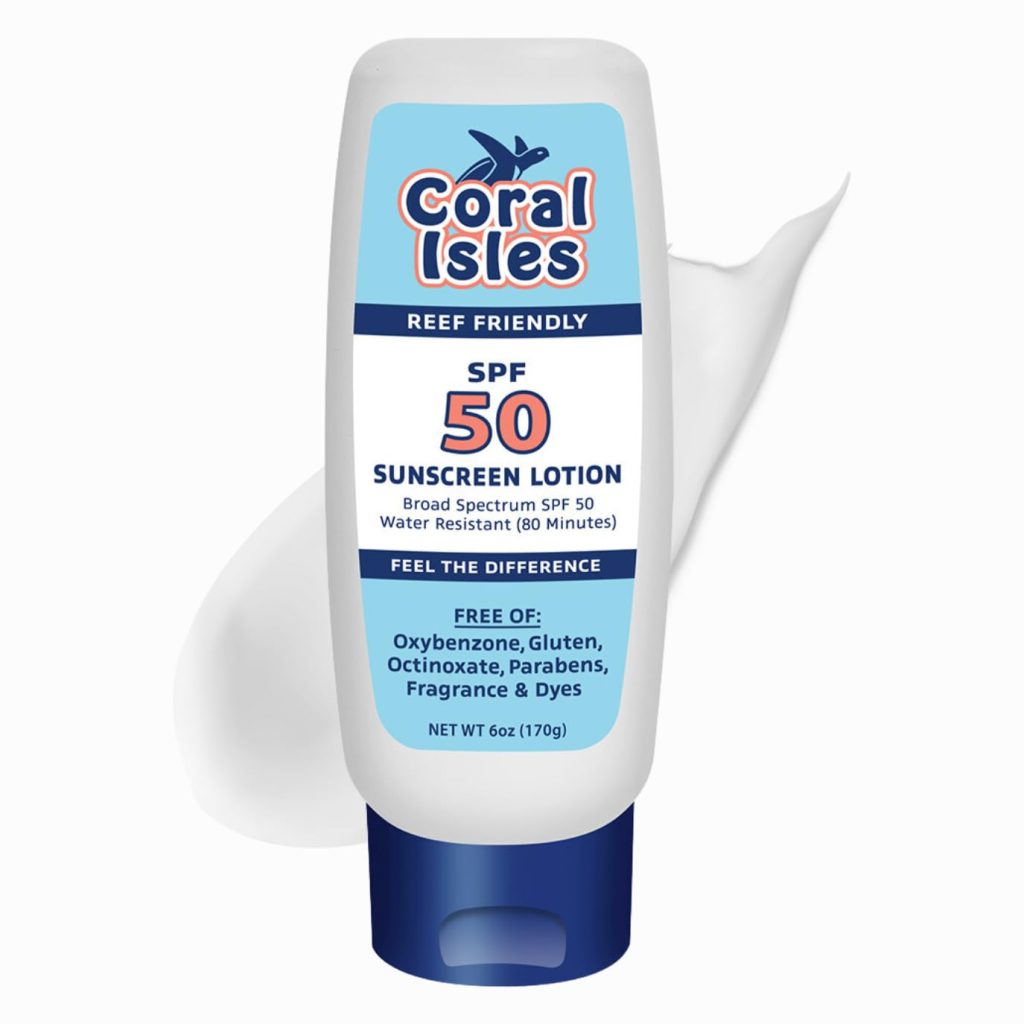
It is essential for protecting both your skin and the reefs! Choose a mineral sunscreen that is safe for coral reefs. This Coral Isles product has become my favorite.
Mosquitoes and other tiny creatures can be quite aggressive, especially after dark. An effective DEET-free alternative with essential oils can get the job done; check out this top-rated option.
Great for boat trips and exploring waterfalls. Toss in your phone, some cash, and sunscreen for stress-free adventures. Check out this product in a variety of vibrant colors.
Having a few essential supplies on hand can be useful for treating minor scrapes or stings. I always put together a small kit with bandages, antiseptic wipes, antihistamine cream, and a few pain relievers.
Siquijor exudes a relaxed atmosphere, so it’s best to pack comfortable footwear and casual outfits. Imagine lightweight materials with a hint of exotic charm.
Flowy Maxi Dress
This is the perfect choice for charming cafes and romantic dinners. This item is compact and can easily go from day to night. This patterned one is just lovely.
When it comes to beach attire, bikinis are suitable for the beach, but one-pieces or a tankini paired with cute shorts are more appropriate for exploring towns or markets. The classic Speedo Women’s Swimsuit One Piece Prolt Super Pro doesn’t disappoint.
A wide-brimmed hat and sunglasses are essential. This is not only sun-smart (think about future wrinkle-free skin!), but it also gives off major vacation vibes.
Now, let me get my geek out for a bit. Have you ever considered how your clothing can affect your body temperature? Opt for light colors and natural fibers, as per thermodynamics. If you’re into it, the book “How to Cool the Planet” by Jeff Goodell presents some unconventional ideas on this subject!
Is it possible to travel to Siquijor on a budget?
Sure thing! Island travel can seem pricey at times, but Siquijor provides the beauty of the Philippines without the high costs of popular tourist destinations. Let’s explore a sample one-week budget breakdown. Keep in mind that these are approximations. Just like Captain Kirk estimating the time needed to repair the warp drive, it’s a helpful reference, but circumstances may alter.
Sample Siquijor Weekly Budget for Female Solo Travelers
Avg. Daily Cost
Weekly Total
Accommodation (Budget-Friendly)
₱600 – ₱1000 ($11 – $18)
₱4200 – ₱7000 ($76 – $127)
Food (Local Eats)
₱300 – ₱500 ($5.50 – $9)
₱2100 – ₱3500 ($38 – $64)
Transport (Tricycle/Motorbike)
₱300 – ₱500 ($5.50 – $9)
₱2100 – ₱3500 ($38 – $64)
Activities/Entrance Fees
₱100 – ₱300 ($2 – $5.50)
₱700 – ₱2100 ($13 – $38)
Total
₱1300 – ₱2300 ($24 – $41.50)
₱9100 – ₱16100 ($165 – $292)
Note: It’s important to keep an eye on exchange rates, as they can change frequently, especially before your trip!
Just a few more budget tips:
Choose local living. Forget about fancy resorts and go for charming guesthouses or homestays. Dine at the same spots as the locals for tasty meals at a lower cost.
Master the art of haggling. Tricycle fares can usually be negotiated, so feel free to politely haggle a bit.
Embrace DIY opportunities. Renting a motorbike can help you save money and enjoy unparalleled freedom.
Skip some of the popular tourist attractions. Certain popular locations may have expensive entrance fees and large crowds. Discover those lesser-known treasures instead!
Just a heads up: this Cebu to Siquijor travel guide focuses on solo adventures, and making smart budget choices can help you savor your trip! Whoever claims that traveling alone on a budget isn’t enjoyable hasn’t experienced it firsthand! 😉
Conclusion
Alright, let’s conclude this Cebu to Siquijor travel guide.
Embarking on a solo adventure can be both exciting and daunting. However, let me tell you, Siquijor is an excellent option for easing into solo travel. It strikes a perfect balance between convenience and the thrill of exploring new places. The people are friendly, the scenery is stunning, and there’s a touch of magic that makes the entire adventure more enchanting.
Tap into your adventurous spirit, and go ahead and book those tickets! Explore the enchanting island and uncover its wonders!
Discover why starting a mindful travel blog focused on ecotourism is a powerful way to inspire change and support responsible travel.
If you share my love for the thrill of a passport stamp while also feeling a deep concern for the well-being of our planet, then this mindful travel blog is the perfect place for us to gather and find solace. For those of us who have witnessed numerous sunsets and accumulated impressive amounts of frequent flyer miles, we understand that our style of travel has a profound impact on the world we leave in our wake.
Allow me to regale you with tales of Singapore. One might envision towering skyscrapers, far from being the epitome of eco-friendly tourism. But then there was that unexpected layover that completely altered the course of events. Amid the vibrant glow, I stumbled upon a city with a resolute commitment to embracing a more sustainable future. It’s in the refreshing taste of the recycled water straight from the tap (kudos to their innovative NEWater initiative!), and the magnificent Supertrees of Gardens by the Bay, a marvel created with a commitment to sustainability. Changi Airport, even in its grandeur, sets a new standard for eco-luxury.
That journey ignited a certain spark within me: the exhilaration of discovering how even the most unforeseen destinations can astonish us.
This blog doesn’t focus on tedious checklists; instead, it delves into the delicate balance between embracing our wanderlust and responsibly caring for our surroundings. We’ll explore lesser-known ecotourism spots, dispel misconceptions, and discover how to make mindful choices that express gratitude for the awe-inspiring destinations we love.
Travel, when approached with care, is not merely a means of escape, but a powerful catalyst for positive change.
What Exactly is Ecotourism?
Let’s delve into the question that’s likely on your mind: what exactly is ecotourism? If you find yourself envisioning mosquito nets and accommodations with zero stars, it’s about time you face the facts.
Ecotourism is not about compromising on comfort or glorifying discomfort as a form of prestige. It’s all about changing your perspective, adopting a travel approach that prioritizes the planet and its people as much as your own pleasure. Consider it as a refined and compassionate alternative to conventional tourism.
Well, let me break it down for you: ecotourism is all about traveling responsibly to untouched destinations. It’s all about making choices that have a positive impact on the environment and the local communities you visit. And above all, it’s about departing those places slightly improved from how you discovered them.
Now we have a little issue to discuss: greenwashing. Isn’t it just fascinating how certain companies love to talk about being eco-friendly, but fail to actually follow through with their actions? That’s the complete opposite of ecotourism. Genuine ecotourism values openness – if they are making a positive impact, they are eager to demonstrate how and why.
And you know what? Ecotourism adventures come in many forms to cater to different preferences. Here’s a small selection:
An exhilarating escapade. Exploring the depths of vibrant rainforests, gliding through untouched waterways, or conquering towering peaks, all while prioritizing our planet’s well-being. Extra credit for championing local guides!
A dive into culture. Instead of falling into the typical tourist traps, consider immersing yourself in the local culture by staying with families, learning traditional crafts, or getting involved in community projects.
Responsible wildlife experiences. Opt for safaris or expeditions led by experts in conservation, where the well-being of the animals is the top priority.
In essence, if you desire your mindful travel blog to center around ecotourism, it’s all about possibilities. It’s all about broadening your options. It’s about exchanging the temporary sense of “been there, done that” for the lasting fulfillment of “helped a little, learned a lot”. Now, doesn’t that sound much more enticing than a rough sleeping bag?
Why Women in Their 30s and 40s Should Care
Let’s debunk the myth of ‘roughing it.’ Ecotourism goes beyond the typical accommodations and nibbles, embracing a more sustainable and conscious approach. Consider it the perfect remedy for those fast-paced, cookie-cutter tours that leave you feeling disoriented and overwhelmed. For those of us in our 30s and 40s, there is a yearning for something beyond the ordinary – and that’s where ecotourism truly shines.
Rather than simply going through a list of popular IG-worthy spots, you have the opportunity to immerse yourself in the art of traditional weaving, taught by a women’s cooperative in a charming Guatemalan village. Perhaps you’re out there, in the depths of Borneo, diligently monitoring the movements of orangutans, fully aware that your noble efforts contribute to the crucial funding for their conservation. That’s the level of connection ecotourism provides – the kind that truly speaks to us in this phase of life.
Now, let’s not avoid discussing the weighty concept: Responsibility. Consider how we allocate our funds in our hometown – we prioritize supporting local businesses and ethically-produced goods, among other commendable practices. Shouldn’t travel be a reflection of our core principles? Our tourism dollars wield significant influence. Opting for the family-run lodge with its breathtaking view of the Costa Rican rainforest instead of the generic chain resort is a powerful statement of our values.
Furthermore, haven’t we worked hard enough to deserve travel that is, dare I say, meaningful? That’s where your mindful travel blog comes in. Curiosity is the antidote to boredom. Ecotourism satisfies that curiosity. It opens the door to discovering fascinating wildlife, diverse cultures, and our potential to make a positive impact on the world. Your travel blog can be a source of inspiration for others, igniting their wanderlust with every adventure you share.
What Makes a Great Mindful Travel Blog?
If you believe that creating a mindful travel blog centered around ecotourism is as easy as putting a “sustainable!” label on every beach house and nature lodge, then you’re in for a rude awakening, my dear. A truly exceptional ecotourism blog delves into the depths. It’s not a guidebook for the holier-than-thou, but rather a glimpse into destinations and moments that enrich both the world and your spirit.
Imagine the contrast between perusing a mundane hotel brochure and being completely captivated by a beautifully crafted novel that takes place in a mesmerizing location. That’s where the art of storytelling comes into play. A truly remarkable mindful travel blog captures the essence of the experience. It beautifully captures the essence of the rainforest at daybreak, the haunting melodies of endangered gibbons resonating through the mist, or the heartfelt grin of a seasoned local guide whose ancestors have coexisted with sea turtles for centuries. It’s all about revealing the passion that lies within the destination.
It’s great to write inspiring stuff, but it’s meaningless if your readers can’t put it into action. That’s where practicality comes in. So, you went on a journey to a secluded eco-retreat? That’s amazing! Can you tell me about those miraculous boots that saved you from getting blisters? Also, did you have any trouble finding vegan options on the island? I think an ecotourism blog should blend practical guidance with exciting adventures. Do you have any advice for tackling that obstacle? A mindful travel blog flourishes by blending practical guidance with exhilarating escapades.
It’s reminiscent of that famous quote, often attributed to Maya Angelou, about the lasting impact of how we make others feel. People may forget our words and actions, but the way we make them feel is something they’ll always remember. Invite readers to forge a deep connection with the places you describe, and the yearning to visit with a sense of responsibility will effortlessly flourish.
Your Journey as an Ecotourism Blogger
The thought of becoming an “ecotourism blogger” can be quite daunting. Is a degree in environmental science necessary? Should I have already embarked on a solo backpacking adventure through the Amazon? Nope! Embracing our true selves is far more important than striving for perfection, particularly for women in their 30s and 40s. We possess a certain wisdom that those in their twenties have yet to acquire – a unique perspective that combines wonder with a clever and biting sense of humor.
Consider your mindful travel blog as a delightful chat with your gal pals over some fancy drinks. You generously recount the breathtaking waterfall you stumbled upon, along with the amusing anecdote of your trailblazing misadventure and the thought-provoking conversation you engaged in with a talented local craftsman. Your authentic voice will truly resonate.
Fortunately, discovering responsible tourism options is not as perplexing as unraveling ancient hieroglyphs. There are plenty of excellent resources available:
Ethical Travel Guides. Websites such as “Responsible Travel” or publications like Lonely Planet’s “Global Sustainable Tourism” provide carefully selected lists of approved operators.
Certifications. Seek out certifications such as Green Globe or Travelife – while not infallible, they can serve as useful indicators.
Listen to your instincts: Take the time to read reviews and explore company websites. Does their mission statement come across as genuine and sincere, or does it sound like generic corporate jargon?
Now, let’s talk about transforming your passion into real impact. This is where discovering your unique niche truly stands out. Do you possess an uncanny ability to unearth secret havens for wildlife? Are you a fan of community-based tourism? Perhaps you have a taste for culinary experiences that celebrate locally sourced ingredients. Embrace the essence of your adventures, and watch as your audience becomes captivated.
Benefits of Mindful Travel Beyond the Obvious
Alright, let’s explore the lesser-known wonders of ecotourism, the kind of advantages that extend far beyond a passing trend!
Contributing to the growth and empowerment of women-owned businesses and local communities.
This is the place where enchantment unfolds. Ecotourism typically involves accommodations in cozy guesthouses, dining at local family-run eateries, and enlisting the services of guides from the surrounding community. Imagine a scene: a weaving cooperative where women of all ages come together to share their skills, a bustling village market adorned with colorful textiles and filled with the sound of joyful laughter. Your travel blog takes on a whole new dimension as it becomes a platform to showcase these remarkable women, their captivating stories, and their thriving businesses. It goes beyond fair trade, it’s about forging a real connection that stays with you long after you’ve settled in.
Embracing the art of slow travel, finding solace in escaping the chaos.
Ecotourism provides a way to escape the feeling of constantly chasing after life as it passes by in a blur. It compels one to embrace a slower pace, aligning with the cadence of a rainforest expedition or the ebb and flow that guides a nearby fisherman. There’s a moment to ponder, to inhale deeply, to just exist. It’s a refreshing act of self-care in a world that idolizes constant activity. Consider it a method to declutter your mind, replacing chaos with tranquility.
Embracing the wonders of education through every journey – the beauty of wildlife, the importance of conservation, and the richness of new cultures.
Ecotourism transports you back to a time of childlike curiosity. All of a sudden, a butterfly takes on a whole new meaning as it becomes an integral part of a fragile ecosystem that your knowledgeable guide enlightens you about. You venture into a sanctuary, fully grasping the passionate devotion fueling wildlife conservation endeavors. Perhaps you fumble through your initial attempts at speaking the local language, discovering a charming custom that brings a smile to your face. It’s a truly humbling experience that fills you with joy and serves as a reminder that age is no barrier to personal growth.
Imagine your travel blog filled with valuable insights that not only benefit you but also inspire countless other women to explore new experiences with the same enthusiasm as they do when getting their passports stamped.
Is Ecotourism the Sole Path to Ethical Travel?
Life is far from being a simple dichotomy, especially when it comes to the moral complexities of traveling the world. Now, I firmly believe that ecotourism should always be our guiding principle. However, in this chaotic and extraordinary world, there are inevitably moments when alternative options present themselves.
Imagine it as that beloved vintage store you once thought was your go-to for sustainable fashion… until your best friend’s destination wedding demanded a new dress that couldn’t possibly be found secondhand. Occasionally, the most thoughtful choice in the present isn’t flawless.
You might find yourself having to take a long flight for a family reunion or discover that the only available accommodation in your dream destination isn’t a trendy bamboo eco-lodge. Does this make you a phony? No way. It implies an understanding that this voyage of conscious exploration is a continuum, rather than an inflexible boundary.
Our goal is to make progress, not chase after perfection. In the spirit of sharp-tongued literary heroines, who never hesitated to speak their minds (ahem, Elizabeth Bennet), we can embody both our principles and practicality.
When faced with that familiar wave of guilt, remember this: “While an eco-retreat would be perfect, the world won’t collapse if I have to endure a chain hotel for a night. Why don’t we reserve our indignation for the genuinely shocking transgressions, shall we?
It’s all about making thoughtful decisions, finding a middle ground, and appreciating each small progress that brings us towards a more responsible way of traveling. And that, my dear companions, is a goal worthy of toasting with a (ideally locally sourced) cocktail.
Takeaway Message
Like the pages of well-worn guidebooks, every decision sends ripples through the world. An evening spent in a charming family-run homestay rather than a generic chain hotel, accompanied by a knowledgeable local guide instead of being herded around in a crowded tour bus… and let’s not forget the small act of bringing along a reusable water bottle to demonstrate our concern for the environment.
If you have an insatiable curiosity, here are a few destinations to embark upon. These suggestions barely scratch the surface, but they offer a marvelous opportunity to explore the realm of mindful travel:
Responsible Tour Operators. Seek out companies that have been certified by reputable organizations such as the Global Sustainable Tourism Council.
We don’t have to strive for perfection, but we must remain alert and aware. Imagine a world where every woman in our generation, filled with a burning desire for adventure and a strong sense of responsibility, began to inquire about important matters.
Are you set to begin exploring the world of ecotourism? Siquijor is a haven for nature lovers, with its pristine landscapes, commitment to sustainable practices, and vibrant biodiversity. The island also offers unique opportunities for cultural immersion, allowing visitors to truly experience the local way of life. Learn more by reading my Cebu To Siquijor Travel Guide today!
Let’s streamline your getting around Cebu City game with tech hacks, safety tips, and a side of Cebuano survival phrases.
I’m not Adèle Blanc-Sec.
I’m that slightly disheveled woman juggling a laptop bag, travel mug, and a confused look that screams “I thought Google Maps said turn left?” I’m also a digital nomad, which means Cebu City is both my office and my playground.
Getting around Cebu City isn’t always as smooth as a flat white, but hey, mishaps make for good stories, right? (And sometimes, for finding the coolest hidden café). Because here’s the thing: Cebu’s transport system is a glorious, chaotic puzzle. Think jeepneys bursting with color, beeping taxis, and an occasional air-conditioned bus that feels like winning the travel lottery. It’s enough to send your inner control freak into a minor panic attack.
But panic no more, fellow nomad! I’ve navigated this urban jungle fueled by caffeine and sheer stubbornness. Let me be your slightly less lost guide. Consider this your crash course in navigating Cebu like a pro. We’ll cover everything from deciphering jeepney routes to finding those heavenly wifi-equipped oases. Think of it as the digital nomad’s survival kit: part tech-savvy, part practical, with a dash of street smarts.
If you’re ready to ditch the overwhelm and embrace the adventure of Cebu’s streets, buckle up. Let’s make those “lost” moments the start of something cool, one hilariously confusing Angkas ride at a time.
Where the HECK Are We Going? Mapping Out Cebu
Let’s get some bearings before diving into the glorious mess of getting around Cebu City. You’re probably picturing island life – swaying palms, white sand, the whole bit. And yeah, Cebu has that in spades, but for our purposes, we’re focusing on the urban jungle of Cebu City. Day trips to those tropical paradises are on the future itinerary, but for now, it’s about conquering the city streets.
Now, about those neighborhoods. If you’re wired like me, with a constant craving for caffeine and a solid wifi connection, then IT Park is your mecca. This is the tech heart of the city, buzzing with startups, software companies, and enough coffee shops to keep you fueled for a month. Then there’s Fuente Osmeña, the classic downtown, full of history and that energetic “big city” pulse. Uphill, we find Lahug, which offers a slightly more upscale vibe, with views to boot. As to where to base yourself… well, that’s a mix of your work style, budget, and tolerance for karaoke (no judgment here, some nights it just hits the spot).
Speaking of finding your way, let’s talk about Cebuano street names. Think of it like a scavenger hunt designed by a history buff with a flair for the dramatic. You’ll see names of national heroes, Spanish conquistadores, and Catholic saints all tossed together. It’s honestly quite fascinating but about as practical for navigation as trying to read Tolkien’s Elvish on the back of a speeding jeepney. Don’t worry, though; we’ll crack the code together. There’s a method to this organized chaos, I promise.
The OG Transport: Walking, Cebu-Style
Walking is the most sustainable, low-tech way of getting around Cebu City. But before you lace up your sneakers and romanticize those European strolls, we’ve got to talk about Cebu-style pedestrian life.
Safety-wise, it’s like most cities: generally fine during daylight hours, but needs more smarts as the sun goes down. Stick to well-lit, populated routes – think malls connecting to main boulevards, not dimly lit backstreets. Common sense for a solo woman traveler anywhere, right? Daytime Cebu has its quirks though. Those sidewalks…or what passes for them? Expect a slalom course of vendors selling everything from mangoes to phone chargers, the occasional open manhole (watch your step!), and maybe a snoozing stray doggo or two. Think of it as agility training fueled by street food smells.
Speaking of smells, Cebu equals HEAT. And by heat, I mean that sweat-slicked, frizzy-hair-but-still-smiling kind. Breathable fabrics are your BFF. Think linen, not leather. Sunscreen is non-negotiable, and a chic little hand fan brings a touch of old-world glamour while keeping you sane on the sidewalk. Want that Zoom-call-ready look post-walk? A stash of wet wipes and a mini deodorant in your tote will save the day. Remember, it’s not about looking perfect, it’s about rocking that confident “I’ve just navigated Cebu City on foot” glow.
Jeepney Journeys: If You Dare
Strap in, because we’re about to go full-on Cebu with the iconic jeepney. Think of these babies as rolling fiestas on wheels – a riot of colors, chrome, and sometimes even karaoke, crammed with locals, students, and the occasional chicken… you get the picture. But beneath the joyous chaos, there’s a system, and I’m here to help you crack the code so you can ride like a seasoned pro.
First, let’s address the elephant in the room, or rather, the flamboyantly painted mini-bus barreling down the road. Jeepneys are an ingenious Filipino creation, born of necessity when surplus WWII Willys Jeeps were repurposed for public transport. Today, they’re a lifeline of affordable transit, but they’re also a crash course in Cebuano culture if you’re up for a little organized mayhem.
To navigate those swirling routes, look for those destinations painted proudly on the side. Think of it as the ultimate low-tech signage. You’ll need some basic Cebuano like “lugar lang” (just here), or the all-purpose “para!” to signal a stop. Don’t be shy about asking fellow passengers – most Cebuanos are friendly, and might be amused by the adventurous foreigner giving the jeepney a go. Oh, and unspoken jeepney etiquette? Prepare to squeeze in. Those benches are designed for maximum capacity, so get cozy with your neighbor.
Now, the fare. Forget tapping a card – we’re going old-school with coins and small bills. You’ll then embark upon the Olympic sport that is passing your fare along a chain of passengers saying, “Palihug (please)” until it reaches the front. It’s a testament to Cebuano kindness and honesty (mostly!), and let’s be real, kinda fun once you get the hang of it.
Think of a jeepney journey as sustainable travel with a healthy dose of adrenaline. It won’t always be efficient, air-conditioned, or entirely comfortable, but it’s the best way to experience the pulse of Cebu City, and who knows? You might just make some new friends along the way.
Here are some of the jeepney routes within Ayala – SM City – IT Park
04L – IT Park to SM City Mall (passing Ayala Center Mall)
04M – Lahug to JY Square Mall (passing Ayala Center )
17B/ 17D – Apas, IT Park, Lahug to Carbon market
17C – Apas, IT Park to Caron via Gen. Maxilom Ave.
03Q – Mabolo to SM City (passing Ayala Center)
20A/ 20B – Mandaue City to Ayala Center via Mabolo
12L – Labangon to Ayala
12G – Labangon to SM City
14D – Ayala Mall to Colon (via Escario, Fuente, F. Ramos St./ return trip via Fuente Jones to Capitol)
13C – Talamban, Ayala to Colon
13B – Talamban, Ayala to Carbon via Ramos
62B/62C – Pit-os, Ayala to Carbon
Here are some of the jeepney routes within Cebu City:
01K – Urgello to Colon, North Bus Terminal, Park Mall
06B – Guadalupe to Colon via Capitol and Jones Ave.
07B – Banawa to Colon via Capitol and Jones Ave.
02B – South Bus Terminal to Pier area
12D – Labangon to Colon
21A/ 21D – Mandaue City to Manalili to Cebu Cathedral
22I – Mandaue City to Gaisano Country Mall via A.S. Fortuna Street
24 – going to Consolacion
25 – going to Liloan/Danao
Fare: Php 8 minimum
Beep and MyBus: Cebu’s (Kinda) Modern Buses
The sight of a jeepney hurtling down a Cebu street never quite loses its charm (or its ability to induce a bit of heart-pounding terror). But sometimes, a girl needs aircon and a guaranteed seat. That’s where BEEPs and MyBus come in.
BEEP
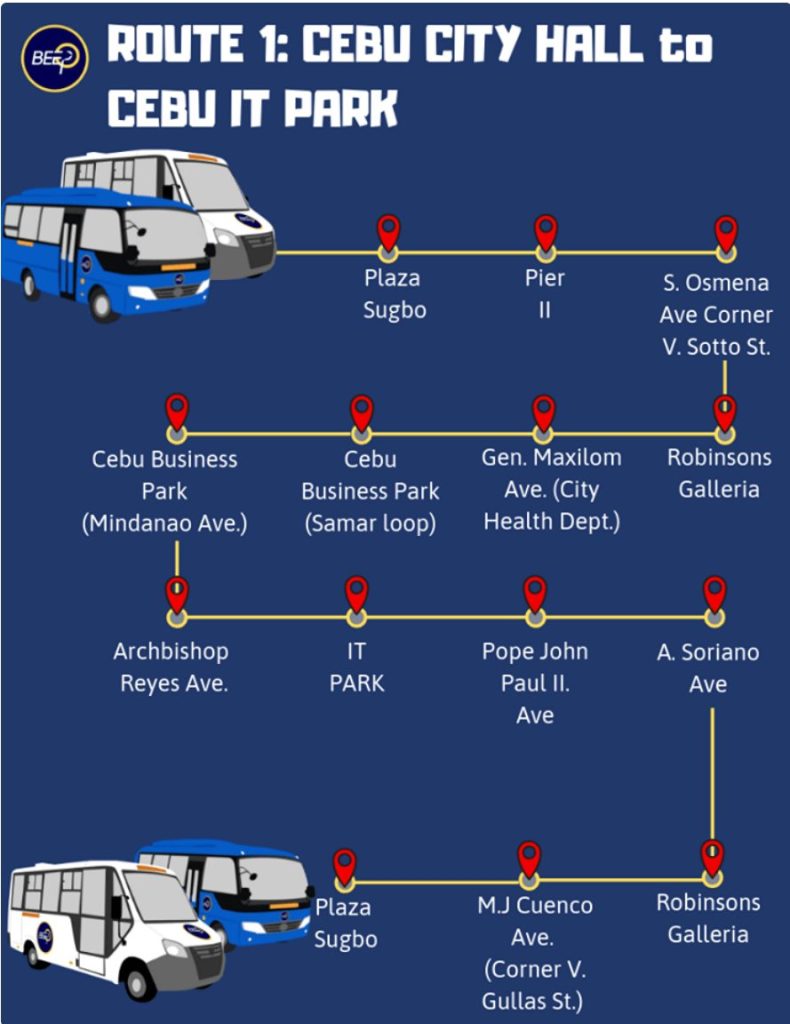
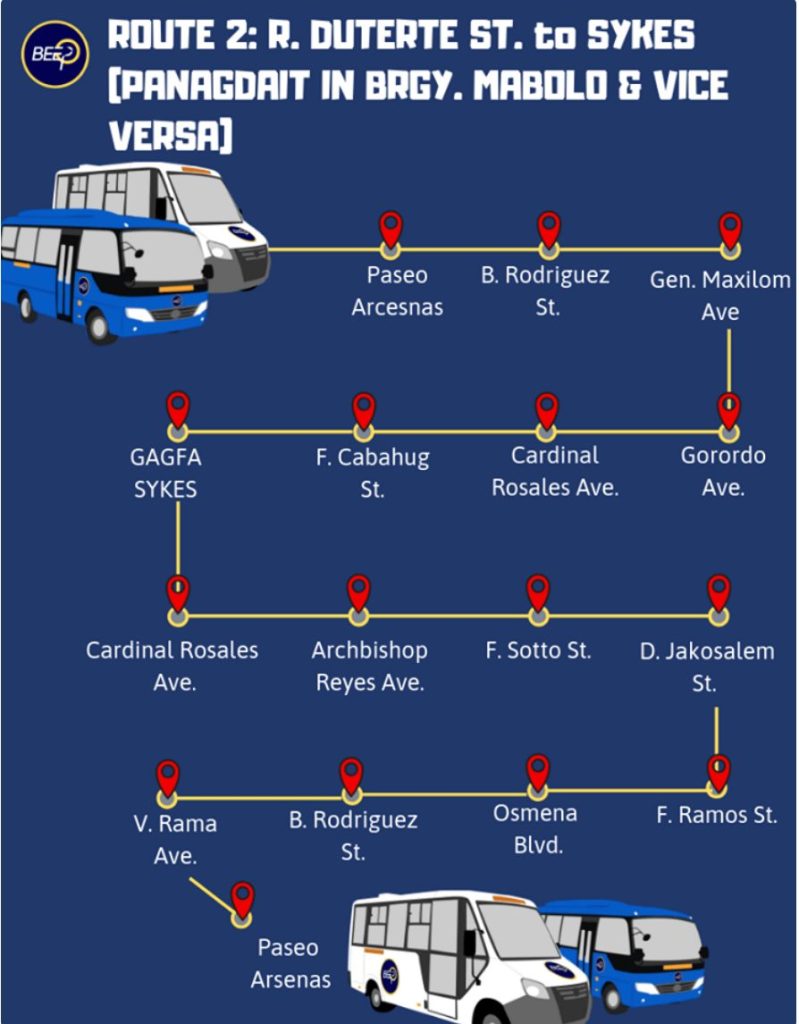
“Beep” is a total double whammy here: it stands for “Bus-Jeep Enhanced Engine Program,” the fancy name for those modernized bus-jeepney hybrids. Plus, it refers to the beep card payment method – goodbye fumbling with coins! There are a bunch of these plying routes around Cebu City, all sleek and blue (or white, depending on their capacity).
The good stuff? Full air conditioning, onboard cameras for a sense of security, and those little TVs that usually blast Filipino game shows. It’s a smoother ride than the jeepney, and a bit more planet-conscious.
As of November 2019, there are only three routes available:
PeoplesJeep is new kid on the block. Launched in 2019, PeoplesJeep are essentially BEEP buses, but with a cooperative ownership model. They feel like those fancy mini-buses you see in airports, shrunk down for Cebuano streets. Same perks as BEEP apply, with possibly more consistent routes since they’re focused on specific areas.
Currently, PeoplesJeep follow four routes:
Talamban – Ayala – Colon
Lahug – Ayala – SM
Bulacao – Colon – SM
Talamban – Colon (following the 13C route)
Fare: Php 10 minimum
MyBus
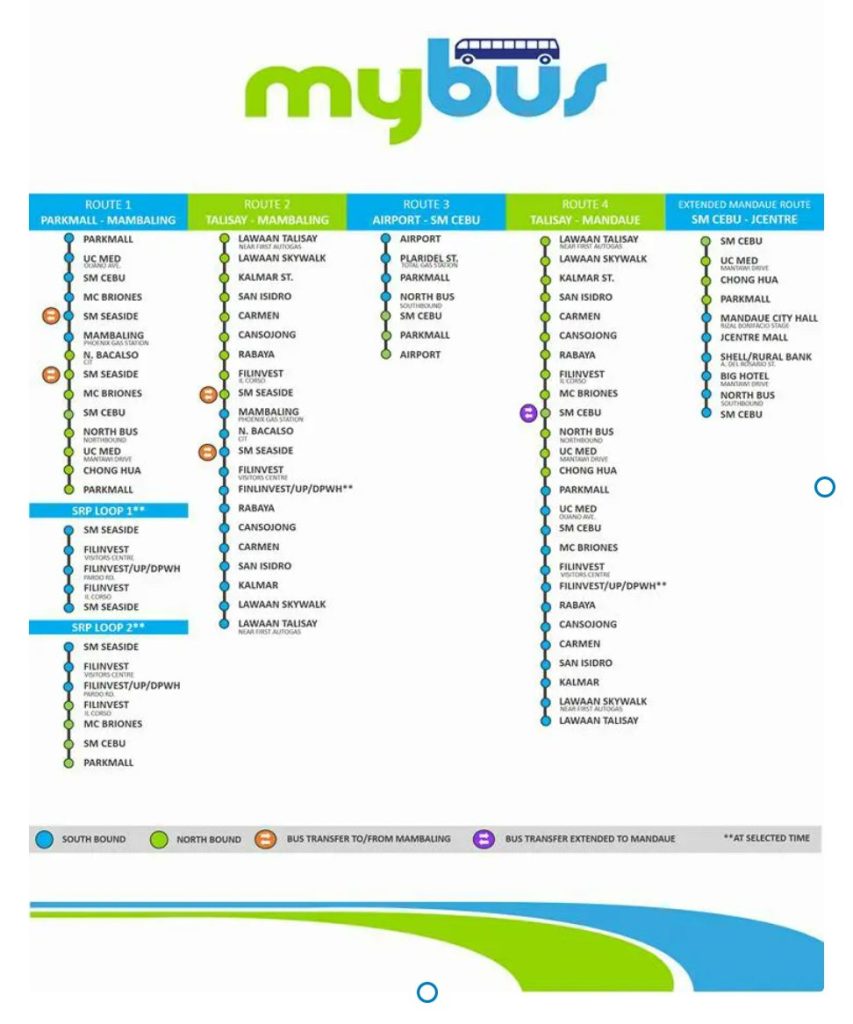
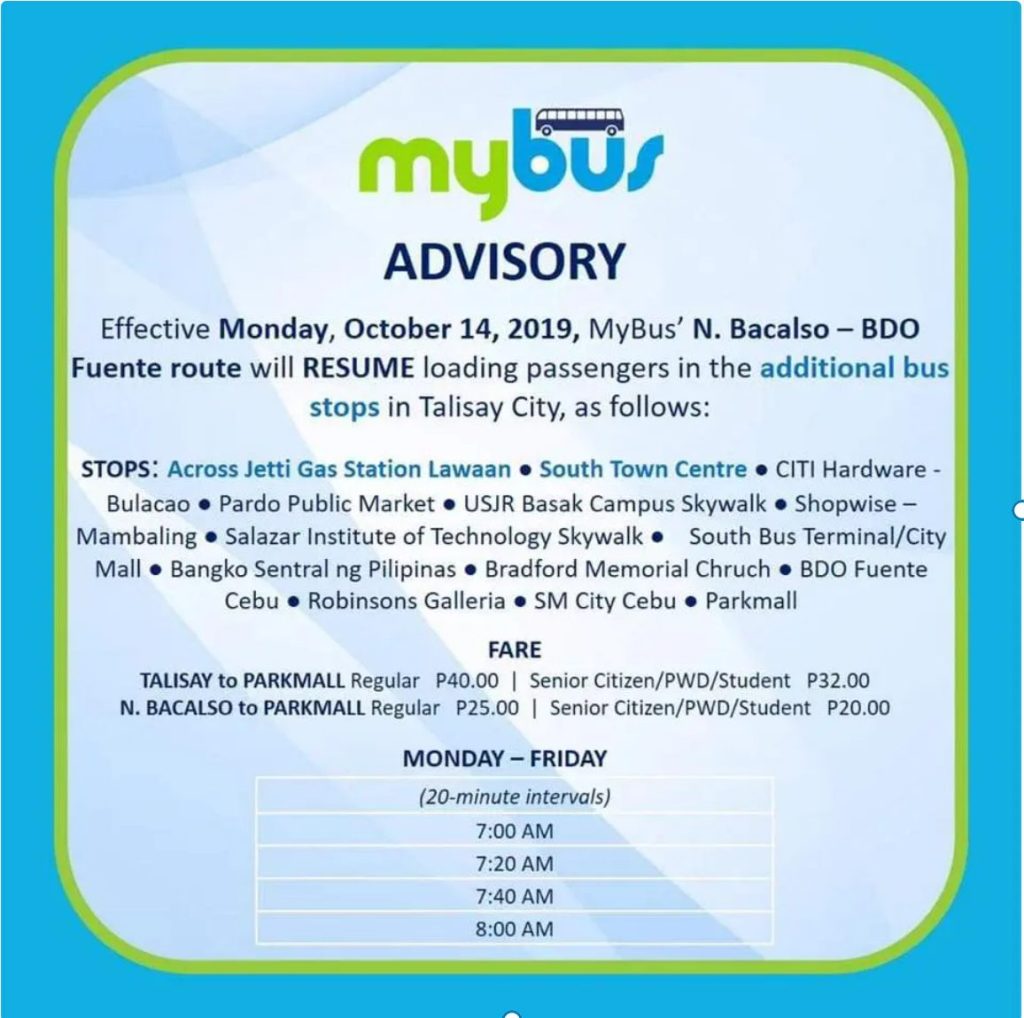
MyBus serves a slightly different purpose. These bigger guys are best for specific journeys – think airport to SM Seaside mall, or between the major transport terminals. They also have that fancy ePLUS card for cashless payment.
SM City Cebu – Airport (vice versa)
Photo by: MyBus
Fare: Php 25-40
Purchase an ePLUS card for Php 200 at any MyBus station or at SM Supermall to pay for your ride. You can use the remaining credit on other MyBus rides.
Recently, MyBus added the N. Bacalso – BDO Fuente route:
Photo by: MyBus
If you want to familiarize the streets of Cebu, this is the most convenient means. But if your schedule is tight, choose another conveyance.
How to Beep (and MyBus) Right
Routes are King/Queen. Before hopping on, check the signage for the bus routes. Currently, BEEPs have limited routes compared to jeepneys, so they won’t take you everywhere in Cebu City. Think of them as a step up in comfort when your route happens to match.
Stations, Not Hailing. Unlike jeepneys, these guys have designated stops. Keep an eye out, or you might miss your chance to disembark in a flurry of panicked button-pressing.
Fares. Beep fares start at around PHP 9.50, which is a bit steeper than a jeepney. MyBus has varying fees depending on the route. Think of it like paying for that aircon privilege, okay?
My Verdict
Want to sightsee and soak in the Cebu street vibe? MyBus on the N. Bacalso – BDO Fuente route is a good bet. Tight schedule and desperately need to NOT arrive a sweaty mess? Opt for a taxi or ride-hailing app. But when you want that middle ground between colorful jeepney chaos and the convenience of Grab, the BEEP network can be your jam.
Taxis and Ride-Hailing: Trading Chaos for Convenience
Sometimes, a girl just needs a comfy seat and working AC. Especially after braving a few jeepney rides, the familiar world of taxis and ride-hailing apps offers a comforting hit of predictability when getting around Cebu City. Of course, they come with their quirks.
White Taxi Cabs
Similar to the yellow taxis, but sometimes operate on a fixed price rather than a meter. Do your homework beforehand if you have a specific destination in mind. You can bargain, but it takes practice and a little bit of Cebuano wouldn’t hurt.
White taxi fare: Php 40 (USD .77) flag-down rate + Php 13.50 for every succeeding kilometre and Php 2 per minute of waiting time in traffic
Grab is Your Friend
Think of the Grab app as your personal chauffeur service on demand. Sure, “surge pricing” during rush hour can sting, but sometimes paying a bit extra for that sweet air conditioning and the knowledge of exactly where you’re going is downright priceless. Bonus? You can track your ride, minimizing those awkward “Where are you now?” calls on unfamiliar streets.
Yellow Cabs: When They Work, They’re Fine
Yellow cabs are the OG Cebu transport option. They’re plentiful, and hailing one gives you that classic “I’m in a movie!” moment. The catch? Not all drivers are created equal. Some are honest, while others might try to “creatively” interpret the meter (remember those language skills!). It’s a bit of a gamble, but asking locals or your hotel for reliable cab companies can up your odds of a smooth ride.
Yellow taxi fare: Php 70 (USD 1.35) + P4 for every succeeding 300 meters
Women-Driven Options
There’s debate around this, and it touches on bigger issues of safety in public transport (a whole other blog post!). Some companies or smaller networks do offer women-driven options, aimed at providing a bit more peace of mind for solo female travelers. I’m digging into finding reputable services right now because that extra layer of comfort matters.
My Verdict
Taxis and ride-hailing won’t replace the cultural experience of jeepneys, and they’re not the most sustainable choice. But hey, we work hard – sometimes a private, climate-controlled ride with a dash of WiFi is the best form of self-care.
Safety tips: Always lock the door once you’ve boarded. There have been incidents when robbers would randomly open taxi doors when traffic is at standstill. Also, check that the meter is running. There’s also a newly reported scam where the driver intentionally forgets to turn on the meter so they can charge a higher than usual fare later.
Getting Off The Beaten Path: Sustainable-ish Escapes
Alright, let’s dive into the wild side of Cebuano transport! Think less luxury coach tour, and more “Indiana Jones with a latte” vibes. Because when that wanderlust kicks in and Cebu City starts feeling a little *too* urban, we nomads crave those off-the-grid adventures. Luckily, options abound – though “sustainable-ish” is the key phrase here.
Habal-Habal Adventures: Embrace the Adrenaline (and Sketchiness)
Imagine clinging to the back of a motorcycle, whipping through mountain roads, views that’ll hijack your Instagram feed. That’s the habal-habal experience. It’s fast, it’s cheap-ish (if you’re a haggling pro), and exhilarating… with a side of safety concerns. It’s the transport equivalent of that street food that’s SO good, but you might regret it later.
These guys are lifesavers for getting to waterfalls, remote beaches, etc. But know this: no helmets (usually), your driver might be 16, and the ‘road rules’ are… flexible. Think of it as a calculated risk for that epic photo-op.
As written in our habal-habal guide, here are the fares for the usual routes within Metro Cebu:
Ayala to I.T. Park – P30 ($0.57)
Maria Luisa Road to I.T. Park – P70 ($1.33)
I.T. Park to SM City – P70 ($1.33)
Ayala to SM Seaside – P120 – P150 ($2.3 – $2.8)
V-Hire Vans: Cultural Immersion, Sardine-Style
Craving a dose of authentic Cebuano life? Hop on a V-hire! These shared vans cram in as many passengers as humanly possible. You’ll be elbow-to-elbow with locals, groceries, and maybe a live chicken… it’s loud, sweaty, and an experience you won’t forget.
Bonus points: It’s dirt cheap for longer hauls to nearby towns. But bring snacks, because stopping is unpredictable. Like that overstuffed suitcase you should’ve unpacked, it’s all part of the journey.
Bike Rentals: Cebu’s (Questionable) Cycling Scene
Cebu has bike rentals… but the city itself? Not ideal. Traffic is chaotic, and bike lanes are rare. Think twice before pedaling through downtown. However, there ARE quieter areas for scenic rides (check out online cycling groups for tips).
So, it’s not like bike-friendly Copenhagen, but doable if you’re smart about routes. A mountain bike opens up more remote possibilities, too.
Angkas: The ‘Grab’ of Motorcycle Taxis
If habal-habal bargaining stresses you out, Angkas is your friend. This app lets you hail a motorcycle ride (with a helmet, yay for safety!), and fares are fixed upfront. Think of it as Uber but with more wind-in-your-hair excitement.
Ferries: Your Scenic Sea Shortcut
Need a Mactan Island escape? Ferries across the channel are fast, and breezy, and offer stunning skyline views. Way more charming than a taxi in traffic, and eco-friendlier too.
A ferry departs every 10-20 minutes in Pier 3 bound for Lapu-lapu City.
If you’re coming from Mactan Island, here’s where you can take a ferry boat:
Topline Express Ferry
At Mactan Marina Mall, walk towards Island City Mactan where the ferry terminal is located. The Island Ferry 1 that will take you to Pier 3 in downtown Cebu City. It’s a 30-minute ride coast-to-coast – add to that the time spent buying tickets. Daily route is from 5 am to 9 pm.
Fare: Php 25-30 ($0.48 to $0.57)
Metro Ferry
Go to the Muelle Osmena port near Opon Mercado. Buy your ticket and pay the terminal fee. Metro Ferry will take you to Pier 3 in just 15-20 minutes.
Fare: Php 14 ($0.27) + Php 2 (terminal fee).
Sea Jeepney
From southern Cebu, commuters can now travel to Cebu City onboard the MyBoat “sea jeepney.” The vessel sails from Naga City port to Pier 1 and vice versa for a total of 10 trips daily. Each trip takes 45-60 minutes coast to coast.
MyBoat schedule is as follows:
Heading to Cebu City:
5:30 am
7:50 am
10:10 am
2:10 pm
4:30 pm
From Cebu City:
6:40 am
9 am
1 pm
3:20 pm
5:40 pm.
Fare: Php 60
Beyond the Basics: Niche Transport Wins
Tricycles. Cebu’s version of a tuk-tuk, these covered trikes are perfect for short hops within neighborhoods. Unlike habal-habals, tricycles have a roof which makes them useful on extremely hot or rainy days. You can get one to take you to the nearest bus/jeep station or to rural locations. Tricycles can carry up to 4 passengers at a time. They usually wait for other passengers to ensure full capacity, but you can offer to pay the full-capacity price (pakyaw) if you’re in a rush.
Renting Your Ride. If driving doesn’t scare you, motorbike or car rentals unlock serious freedom. Proceed with caution – think of it as playing Frogger with real-life consequences. There are peer-to-peer motorbike sharing services like Book2wheel and Rentmotorcebu.com that let you rent on a daily, weekly, monthly basis. They usually offer delivery and pick-up for free. Rental prices start at Php 350 (daily), Php 2450 (weekly), and Php 6500 (monthly). You can find a lot of car rentals with a quick Facebook or Google search. Be sure to check the reviews to get the best possible service. Hourly rates within Cebu average Php 850 + Php 300 for every succeeding hour, while daily rates average Php 4500.
Getting around Cebu City is an adventure in itself. Embrace the chaos a little, trust your gut, and always have backup caffeine on hand. That ‘lost and kinda loving it’ moment? That’s where the best stories start.
Tech to the Rescue: Apps That Save Your Sanity
Time to unleash your inner tech goddess! I know navigating a new city can feel overwhelming, especially in Cebu City where the streets sometimes seem to have a mind of their own. But fear not, because I’m about to arm you with digital tools that’ll help you conquer this urban maze.
Google Maps, Your Trusty Sidekick
Okay, we all know Google Maps. It’s like the trusty compass of our digital age. But here’s the thing: Google Maps in Cebu deserves its masterclass. Let’s unlock those lesser-known superpowers:
Offline Savior. Spotty internet is the bane of every nomad. Before venturing out, download offline maps of Cebu. Trust me, this is your lifeline when the wifi gods betray you. It’s like a cached treasure map for navigating those moments of signal darkness.
Hidden Gems. Google Maps isn’t just about routes. Search cafes, coworking spaces, and even those hole-in-the-wall eateries your fellow nomads rave about. Tap the “Explore” tab and unleash your inner digital Magellan!
Waze for the Traffic Win?
Think of Waze as your personal traffic whisperer. It taps into the wisdom (and occasional grumbling) of fellow drivers to paint a real-time picture of traffic jams, accidents, and those sneaky shortcuts. Here’s how to use Waze with the savviness of a local:
Eyes on the Prize. Waze is meant for pre-trip intel, not while driving (safety first!). Plan your route before you hit the road, keeping those little Waze icons in mind (they could mean potholes, speed traps, or even a random mango stand).
Rush Hour Radar. Cebu traffic worsens at predictable times. Waze helps you outsmart the gridlock during peak periods, suggesting alternative routes even if they seem circuitous at first.
Like with any crowdsourced app, Waze relies on user input. Sometimes it’s incredibly accurate, other times a little less so. It’s a fantastic tool, but not an infallible oracle. Pair it with your gut instincts, and you’ll be dodging those traffic jams with ninja-like reflexes.
Extra Credit: Leveling Up Your Cebu Street Cred
Okay, you’ve mastered the jeepney, survived a Grab price surge, and (mostly) know where you’re going. Now, let’s go from a newbie digital nomad to a seasoned Cebuana traveler. Because getting around Cebu City is one thing, but thriving in it? That’s a whole different skill set.
Rainy Day Retreats: Because It WILL Rain
Cebu’s got that tropical charm, which means sun…and sometimes a whole lotta downpour. Here’s your wet-weather survival kit:
Coffee + Wifi Havens. Bo’s Coffee (local chain, everywhere!), Abaca Baking Company (those pastries, tho), and Coffee Factory (if you’re in IT Park).
When Only AC Will Do. Malls are your overly chilled sanctuary. Ayala Center Cebu and SM City Cebu are classics, SM Seaside is the fancy schmancy option.
Cebuano 101: Transport Edition
Knowing a few keywords makes all the difference. No, you won’t be fluent overnight (unless you’re secretly a linguistic genius), but these get you by:
“Para!” (Stop!). Yell this LOUDLY when you want the jeepney to pull over.
“Bayad!” (Payment!). Hand this to the driver along with your fare, with a smile if you can manage.
“Asa dapit and…?” (Where is…?). Best followed by pointing and looking hopeful.
“Tabang!” (Help!). When things get real. A last resort, but good to know.
Lost in Translation: What To Do When Panic Sets In
It happens to the best of us. Maps fail, batteries die, and suddenly you’re on a street corner feeling VERY far from home. Let’s troubleshoot:
Who to Ask. Security guards (they’re everywhere), friendly-looking shop staff, or fellow young people (better chance of English).
Breathe. Panic makes things worse. Remember, Cebuanos are generally kind folks, willing to help if they can.
Power Bank = Lifeline. Dying phone + being lost is a recipe for a meltdown. Your backup battery saves the day.
Embrace the Detour. Sometimes, getting lost is the BEST way to find hidden gems and unexpected adventures.
Think of this like a language-learning game, an upgraded version of charades with a Cebuano twist.
FAQs
Is Cebu safe for a solo female traveler?
It’s generally safe, but like any city, awareness is key. I stick to well-lit, populated areas at night, and I’ve learned a bit of self-defense… just in case a stray mango decides to challenge me.
How much money do I need to survive as a digital nomad here?
I budget more for comforts than bare-bones backpacking, since good coffee and reliable WiFi are survival gear for me. Expect to spend more than Southeast Asia hotspots, but less than Western cities.
Is it walkable?
Depends on your heat tolerance and shoe choice! I walk short distances, but Cebu rewards those prepared for uneven sidewalks and the occasional tropical downpour.
Do people speak English?
Widely! Filipinos are amazing at English, even with that charming Cebuano accent. But I suggest learning basic Bisaya phrases – it breaks the ice and will help you navigate better.
Can I live a sustainable lifestyle in Cebu?
It takes effort. I seek out refill stores, carry my reusables, and love exploring markets. But single-use plastic is still a reality here, so it’s about finding your balance.
Can I work from cute cafes?
Absolutely! Cebu’s cafe scene is booming. In a separate post, I’ll share my favorite work-friendly spots, where the coffee is strong and the WiFi is stronger. My go-to is Abaca Baking Company on the top floor of Ayala Center.
Must-have apps?
Grab for transport, Google Maps for life, and Gcash for cashless payments. Language apps are fun, but a smile and “salamat” (thank you) go a long way.
How do I meet people?
Coworking spaces, expat groups, even striking up conversations in cafes! Cebuanos are friendly, and if you’re like me, a slightly awkward introvert, a little effort goes a long way.
What about island hopping?
Cebu’s your launchpad for amazing beaches! I’ll cover ferry logistics, and how to find eco-conscious stays for those weekend escapes in the future.
Best tips for a newbie?
Patience is key, as is a sense of humor. Things WILL go wrong, but that’s half the adventure, right? Besides, there’s always a strong coffee waiting around the corner.
Takeaway Message
So, did I conquer all your Cebu transit fears? Probably not. But hey, half the fun is in the figuring it out, right? Getting around Cebu City will always have some chaotic charm thrown in, no matter how much tech you try to throw at it. But that’s also what makes it memorable. I guarantee those near-misses with jeepneys and frantic moments of lost-in-translation will make the best stories later, told over a fantastic cup of Cebuano coffee.
And remember, as digital nomad women, we got this. We’re adaptable, resourceful, and caffeinated to the max. Cebu might throw some unexpected routes our way, but who says we have to follow a perfect map anyway? Sometimes the best adventures start when we ditch the itinerary and embrace the unknown.
Cebu has plenty of world-class resorts and hotels that are perfect for a luxury vacation. Some of the high-end ones like Movenpick Hotel and Bluewater Maribago Beach Resort are a destination of its own. But if you’re going to stay in Cebu for a few weeks or more, chances are you’ll want something more practical. Besides, with all the places to see and things to do in the Queen City of the South, you’ll probably spend more time outside than in your room.
So what are your options?
Short-term rental options in Cebu
Vacation rentals
It’s not uncommon for locals to open up their homes to travellers. It’s a win-win situation – the host makes extra money while the guest gets a good deal and a local’s eye-view of the area.
Most guest homes that are not a primary residence list a lower price for monthly rentals than for weekly bookings. The options range from cosy cabins to beachfront properties. This means that there’s a choice for different types of trips.
Vacation homes usually have more space than hotel rooms. This makes them a good bargain particularly for families and groups who can split the cost. Having a kitchen also helps you save on food expenses.
Private condos
If you want to stay within the city, private condos are worth looking into. Many Cebuanos or expats in Cebu actually buy condos to make them available for short-term stays.
You get a space that feels like your own and you also get access to on-site amenities like swimming pools and gyms. Most condominiums in the city are located within business districts and busy commercial centers, so everything you need from restaurants to laundry services are usually within walking distance. It also means getting transport to and from your rental likely won’t be an issue. As an added bonus, local owners sometimes offer assistance in case you need help getting to places.
You can book one for as low as Php 700/night. With that price, you’ll have a cozy bed and a clean studio space all for yourself – luckily, with a view of the cityscape as well. While condos are often rented out on a daily basis, it’s possible to negotiate a longer-term deal for a cheaper rate.
Serviced apartments
As opposed to condos, serviced apartments are considered commercial complexes. They’re typically attached to shopping malls. So you have commercial amenities at arm’s reach – restaurants, spas, retail shops, cafes, coworking spaces, etc. And you won’t have trouble getting transport services since most are available around malls.
The catch is you have no control of non-residents moving around the area. So if you want some peace and quiet, you’re better off with a private condo space or a serviced condominium complex that isn’t attached to malls.
As for price, the “service” in serviced apartment will cost you more than a private condo. It can be worth it if you’d rather spend your time touring or doing business than cleaning your room.
Pension houses
Pension houses are basically budget hotels. Standard rooms often start at P700, with family rooms (5 pax occupancy) starting at around P1,500. So, for that price, you get a decent room with AC and daily housekeeping. Not at all a bad deal for an extended vacation.
Many pension houses also offer van/car rentals and other concierge services. So if you have a local Cebu tour in the plans, you don’t need to go further than the front desk.
Homestays
If you need something even cheaper, you could try a homestay, i.e. sleeping in someone’s spare bedroom. You could make arrangements with a friend in Cebu or you could use sites like Couchsurfing.com.
Homestays give you the chance to meet interesting people and get a taste of local life. Choosing this requires a lot of trust and willingness to adapt. But it can be a worthwhile experience.
Cebuanos aren’t shy to the idea of couchsurfing. So if you’re already part of the community, just find and connect with local hosts through Couchsurfing.com. On the site, you’ll be able to check the profile and personal background of potential hosts.
If you’re going to be sleeping on someone’s couch, then it’s nice to be able to choose someone you’ll likely get along with. As for safety, it helps that both hosts and guests are verified on different levels and given reviews by other travellers.
Hostels/Guesthouses
If all you want is bed to crash at night, hostels and guesthouses are an option. They’re pocket friendly, too. Often, you can get a basic room for less than the cost of a low-end hotel. The cheapest we can find cost P355 – P550 a night, which includes a bunk bed in a shared room, communal bath, and free WiFi.
Some guesthouses offer bed and breakfast deals, while others provide a communal kitchen.
Hostels and guesthouses are okay if you want to meet a lot of people. They attract mostly backpackers, unscheduled travellers, and adventure seekers.
How to find a place in Cebu
If money is not tight and your time is worth a lot, simply make a quick Google search and book anything you like. But if you want a decent place to stay for a reasonable price, you’ll have to put in some effort.
Vacation rental and accommodation websites
From luxury resorts to budget hotels, you can find popular places to rent via these sites:
Airbnb – Vacation homes, condos, and places to stay
Tip: Properties listed by private owners are often priced on a daily basis. But, you can always negotiate a deal for a longer-term stay. You could end up paying less than the listed price – some owners would rather agree to a lower price than have their place sitting empty. If you want to stay in hotels, it might be worth asking the management about special deals for long-term guests.
Agent
Browsing through vacation rental and hotel booking sites can take some time, especially if you’re hunting for the best price. But if you can afford it, you can always hire an agent to get it done for you. Sometimes, you even get a better deal this way as agents may know of properties that aren’t listed online.
You just need to set your budget and describe your ideal accommodation, i.e. location-wise, nearby amenities, on-site facilities, rental agreement, etc. Then your agent will do the rest.
Or that’s the idea. The quality of agents varies widely. It’s not uncommon that someone uses half a dozen agents, following up with them regularly and rejects half their “matches” because they actually don’t match one of the basic criteria. The upside of agents is that many properties are in fact not listed online, and the only way to find them is as so often in the Philippines: know someone that knows someone.
If you know someone in Cebu, you could ask for references. Otherwise, you can find some of Cebu’s well-known real estate agencies and brokers here.
FB groups (Cebu Foreigners Club)
If you want recommendations on the best places to stay in Cebu from fellow expats, try joining Facebook groups like the Cebu Foreigners Club and the Cebu Underground Club for Expats and Foreigners. It’s a community of foreigners who offer each other advice and share their experiences. It’s also common to find real estate listings on these pages.
You can get the word out once you’ve been accepted as a member. If none of the members have a place to rent, chances are they will have a friend who knows a friend who does. It actually works!
Outside of groups, you can search Facebook for local pages that offer vacation stays, guest homes, and rental deals. The best deals don’t always make it to Google’s top search results, so Facebook sometimes come in handy.
Walking around a neighborhood
If you find yourself in Cebu without a place to crash, try walking around the neighbourhood and watch for signs or talk to people.
If budget is a major concern, you can always book a cheap hotel on arrival, and look for a longer-term place after. Apartments near schools are often cheap since they target mostly students and young workers.
Do a home exchange
Fancy trading places with a Cebu home owner? It’s possible via a home exchange website. It may take a while to find the perfect match, but it’s usually easier if you own a vacation home. Once you find a place you like, you can always contact the owner and work out a “non-simultaneous exchange” so your travel dates don’t have to match.
Searching a place to stay in Cebu can be a daunting task. The best way to deal with that is to see it as an opportunity to explore and discover the many gems Cebu has to offer. Have fun! 🙂
Hey, it’s Chenzi! A writer made in Cebu. Stringing words is my bread and butter, but baking and mothering my 3-year-old are what feed my soul. I have an insatiable thirst for learning.
The Queen City of the South has many charms. From pristine beaches and awesome mountainscapes to its vibrant nightlife and thrilling food scene, Cebu doesn’t disappoint.
Chances are you’ll end up wanting to stay longer than planned. To do that, you’ll need to request for a visa extension ideally at least a week before your visa expires. This guide explains how and what to expect.
Staying long in the Philippines or working? You may have to file an Annual Report with immigration. The deadline is end of Feb. Read more:Guide to Annual Report
Visa and entry formalities in the Philippines
Citizens of over 150 countries can enter the Philippines and stay up to 30 days without a visa. Specifically, Brazilians and Israelis are allowed to stay visa-free for up to 59 days.
For a longer stay, you may apply for a visa waiver which will grant extension for another 29 days. And after that, it can be renewed for periods of one (1) month, two (2) months, or six (6) months.
If you know beforehand that your trip to the Philippines will exceed 30 days, then you should apply for a tourist visa (9A) prior to your visit. The single-entry tourist visa is valid for 59 days – no need to exit the Philippines within that period.
You can apply for a 9A visa at any Philippines Embassy or Consulate in your country of origin. This visa can be extended for up to 36 months (for non-visa nationals) and 24 months (for visa-required nationals) through a series of renewals. The extension period will be counted from the date of your latest recorded arrival.
If you are a foreign national legally married to a Filipino citizen, you can ask for the Balikbayan Stamp upon arrival at the airport. This stamp is valid for a year and can be extended once for another six months for no charge at all. Just make sure you have with you your spouse and your marriage certificate in English.
Habal2 are swarming the streets of Cebu! What does the name even mean? Read that and more in our article on Habal2.
What do you need?
To receive your visa waiver or entry permit, you need to present the following documents at the immigration desk at your port of arrival:
your original passport (must be valid for at least six months beyond your departure date)
your return flight ticket or ticket to your next port of destination. Few airlines will allow you to board without proof of onward travel.
Where can you extend your visa in Cebu?
The Bureau of Immigration (BI) has two locations in Cebu:
2nd Level, J Centre Mall, A.S. Fortuna St., Mandaue City – (032) 345 6442
1st Level, Gaisano Mactan Island Mall, M.L. Quezon National Highway, Lapu-lapu City – (032) 495 2852
Office hours are 8:00 a.m. to 5:00 p.m., Monday thru Friday. Make sure to hand in your application before 3:00 p.m. and pay the fee before 4:00 p.m. For groups, the cut-off time for visa application submissions and payments is 2:00 p.m.
At J Centre Mall main entrance, go up the escalator after clearing the security check. Keep to the right and walk straight. Turn right from the Samsung store – the BI is the last office to the left. If you go before the mall opens, turn right from the mall entrance and follow the signs. Basically, the signage will lead you around the building.
Step-by-Step Guide
The application process is pretty straightforward, but it’s always best to plan ahead. Here’s a step-by-step guide for a first-time renewal:
1. At Gaisano Mactan, you’ll find the BI office at the north end near Jollibee.
2. Once at the immigration, go to the desk on the far right and sign in on the notebook ledger.
3. Tell the official you are extending your visa. He will give you the visa extension application form TVS-C-VE-2016 (Immigration page with forms, direct link to the form). If you already have the duly accomplished form, you can skip to step 5.
4. Fill out the form. Be sure you know the name and address of your hotel or place of residence, as this is required information.
5. Hand your duly accomplished application form back to the official for stamping.
6. Submit your passport and application form to Window #1. Find a seat and wait for your name to be called. This might take a long while, 10 minutes to an hour or more.
7. Pick up your documents when your name is called, then pay the immigration fees (cash payment only). The cashier is at Window #4.
8. Once again, take a seat and wait for you name to be called. Your receipt will be released at Window #1. This is the only document you’ll have with you when you leave the office. The receipt will indicate when you can retrieve your passport. If you opt for the express service, you will get your visa extended within the day.
9. Otherwise, go back to the BI on or after the specified date.
10. Show your receipt to the official. You will be directed to Window #6 (Releasing), where you’ll sign in another notebook ledger as well as your original application form. The immigration officer will then hand back your passport and receipt together with the certification stating that you’re not on any watch list.
Here is how much you’ll have to pay currently, Oct 2019, as per BI website.
We’re only listing the total—if you’re interested in the details (Sticker fee, legal research fee, …), check out the respective page on the BI website.
Visa Waiver for another 29 days (after the first visa-free 30 days)
The Philippines is an awesome country for slow travelers: If you keep extending your visa, you can stay a very long time before you have to leave the country.
36 months for Visa-Non Required Nationals
24 months for Visa Required Nationals
What to expect
To be honest, the process can be frustrating. But setting your expectations will make it less so. A few tips for a relatively smooth experience:
Come prepared. Bring the form filled out. You’ll complete the application faster this way.
Go early. The BI in J Centre Mall is usually packed from mid-morning ‘til around 3 P.M. There’s seating for only 25 people, so you may find yourself standing in a crowd for a while. The other office in Mactan is often less crowded, but that’s because it is quite far from downtown Cebu. If you don’t mind the commute, definitely go there instead.
With express fee, you’ll get your extension and your passport back the same day. Without express fee, the visa extension processing will take 3 to 5 working days. This means it will take longer if you process it in the middle of the week, since weekends aren’t counted. If you need your passport back stat, Monday (before mall hours) is the best time to go.
Based on experience, transactions are faster in Mactan BI than in J Centre.
Although the BI offers express processing for a fee, it doesn’t guarantee that you will get your passport sooner. You may or may not choose to pay this.
Get your visa extension done at least a week prior to the expiration of your current visa to avoid overstay. Otherwise, you’ll pay a fine. It’s just a few hundred pesos but still a hassle you can avoid.
If you are sending a representative or using a travel agent to secure your extension, get a Special Power of Attorney (SPA) for them to act on your behalf.
If you are travelling with minors, additional information on the children may be needed.
Dress comfortably, especially if you’re planning to have your application done in J Centre. The place can get hot, too, because the AC can’t keep up.
Have patience or find ways to kill time. After dropping your documents at Window #1, find yourself a cozy café outside or explore the mall to kill time. The processing can take anywhere between 10 minutes to up to 4 hours. The service really depends on the load, your behavior and possibly the mood of whoever processes your extension.
Really, all you need is to go there prepared. Even if slow, it surely gets done.
ACR I-Card for staying beyond 59 days
The ACR I-Card (Alien Certification of Registration I-Card) is a microchip based identification card with biometric security features. It is a mandatory requirement for long-term stay (beyond 59 days).
It allows you to enjoy other privileges such as opening a local bank account, registering a vehicle, or getting a driver’s license without permanent residency.
What happens if I overstay?
It depends. We know people who overstayed a few days and apart from paying fines it was not a big deal. But, if caught staying on an expired visa, you might not only face hefty fines but also the risk of getting deported or blacklisted from entering the Philippines.
The fine for overstaying is at P500 per month, plus all applicable visa fees that should have been paid to stay legally. If you overstayed beyond the maximum allowable period (6 months), you’ll pay an additional P500 to get a Motion for Reconsideration on Updating and Extension of authorized Stay.
Don’t let an expired visa spoil the fun. Hope this helps!
Hey, it’s Chenzi! A writer made in Cebu. Stringing words is my bread and butter, but baking and mothering my 3-year-old are what feed my soul. I have an insatiable thirst for learning.
So you’ve packed your bags way too full and need a place to keep your excess belongings for a week in Cebu. Or, perhaps the early 2PM checkout from the hotel has left you heaps of time before your trip home. While there are plenty of sights and scenes to beat that annoying time gap, it’s not fun when you have suitcases to drag along.
Well, worry not, bai. Cebu has facilities where you can drop off your nonessentials for a few hours or days.
Check out your options should you need to part ways with your luggage.
Ibales Luggage Depository
If you want to sleep in at the airport before you next flight or need to leave behind some excess luggage, you can deposit your stuff at Ibales for safekeeping. It’s conveniently located in T1 Domestic Arrival Area of Mactan Cebu International Airport (MCIA), just a few feet away from the domestic transfer check-in desk.
Other than backpacks and suitcases, Ibales also accepts golf equipment, surfboards, bikes, and balikbayan boxes. I heard they may even keep your moving boxes until you settle in to your new place (you should verify this, though).
The left-luggage facility is open 24 hours. Staff members are friendly, and the prices are reasonable. It comes out to P175 ($3.4) for 2 hours or under P500 ($9.6) per day per backpack/suitcase. Here’s the complete price list:
A few reminders:
Only items that passed through the airport security system will be accepted.
You’re not allowed to leave valuables like jewellery, electronics and cash.
Hotel check-in time is usually between 10AM and 12 noon, so I find this facility extremely helpful whenever I’m on an early flight or boat trip to Cebu. Their doors open at 6AM and close at 8PM.
If you’re attending a business meeting in the city and heading out the same day, you can skip the hotel and just leave your things here. However, you can’t leave your bags overnight or check in your valuables.
While waiting for the mall to open, you can relax in the fully air conditioned seating area or check your social channels using their free WiFi. You can charge your electronics for a small fee. They also have shower rooms, though they’re still under renovation as of writing.
Currency exchange and plane and ferry tickets are available here as well. Right outside the lounge is a taxi bay and nearby is the MyBus terminal, where you can ride the shuttle to the airport.
Here are the fees and how-to’s for using SM Travellers’ Lounge:
This one’s just a couple of blocks away from SM City Cebu and much nearer to the seaport. I like it better because it’s newer, cleaner, more spacious and has better customer service than SM’s. The mall itself is preferable for people wanting a less crowded, more relaxed place to while away.
I love that the lounge has a back door leading straight to several cafes inside of the mall and that there’s a free shuttle going to the pier (until 4PM only).
The facility used to be free for travellers with valid tickets for the same day, but they now charge a minimal fee for storing your things. A concierge is available to help with your travel needs: from booking plane and boat tickets (except for Roble tickets) to requesting taxi service and availing tour packages.
All other facilities are free – internet access, charging stations, TV, wheelchair service and comfort rooms. Shower rentals are available for a small fee, but this doesn’t include toiletries.
The lounge is open from 8Am to 9PM. No overnight storage allowed.
Self-Storage
Luggage storage facilities provide much-needed respite for travellers and a way to stay out of trouble during holidays. But what if your belongings needs more time away from you or vice versa? What if you have bigger stuff or personal treasures to lock away?
Cebu has an answer for this as well: self-storage facilities. They are cropping up all over the city, and here are the ones we know of so far
ExtraSpace Self Storage Solutions
Store your valuables for a month or up to a year at ExtraSpace, located at 163 Don Mariano Cui St. in the Capitol area.
Their unit sizes range from small to extra large, which you can rent for a month or up to a year. For comparison, their small unit is about the size of an extra large closet, medium unit is the size of an elevator, large unit is the size of a freight elevator, and extra large unit the size of a 10-foot shipping container.
Source: ExtraSpace FB Page
Amenities:
PWD access
Cargo elevator, trolleys, push carts and a few helping hands
Smoke and fire alarms
They close at 6PM. If you want to check out the units, set an appointment via 09954862768 or their FB page.
This three-level self storage facility on Sacris Road, Barangay Cabancalan, Mandaue City will start operation in November 2019.
All of its 10,000 square meters are leasable for as low as P1,000 ($19) per month. The smallest unit is 2m2 which will easily fit about eight balikbayan boxes. The biggest units (90m2) will set you back P45,000 ($865) a month.
Some cool features:
24/7 onsite security with 100 CCTV cameras all over the place
Pin code and RFID access
Text alerts every time your unit is opened
24/7 access
Make sure to exclude perishable, flammable or illegal items from your packing list, or you’ll forfeit your chances of using StorageTown.
Hypercube is another option is you need more space at home or in the office but can’t throw away the clutter. They’re located at Escario Central, N. Escario St., Barangay Camputhaw, near the Capitol Site and Ayala Center Cebu.
They have 10- and 20-footer units for rent for as short as a month. Here are their current rates:
Source: Hypercube FB Page
CCM Storage Services
From locker spaces to 40-foot container vans, this company has some cool storage solutions to offer. Though, their services lean more towards commercial needs where their extra services (i.e. shelving, racking and decking systems) make sense.
Rental period can be as short as a month monthly at affordable rates.
Source: CCM Storage Services
Container Conversions and Modifications (CCM) Inc. can be found at Mabugat Road, Lower Tabunok, Mandaue City.
Read my full guide on how to packing for the Philippines. In it, I detail the essentials for a trouble-free and enjoyable trip, including what to pack and what to leave at home.
About the author
Hey, it’s Chenzi! A writer made in Cebu. Stringing words is my bread and butter, but baking and mothering my 3-year-old are what feed my soul. I have an insatiable thirst for learning.
March 16, 2020: Angkas and Habal-Habal (motorcycle taxis) temporarily suspended due to the implementation of social distancing as preventive measure of Covid-19.
January 21, 2020: Angkas stays in Cebu, for now. The TWG overseeing the pilot run decides to continue studying the safety of the motorcycle-for-hires after several lawmakers urged them to continue the pilot run during the Senate hearing.
Habal-habal or motorcycle taxis are ubiquitous in Cebu. They’re the new ‘King of the Road,’ a title long held by jeepneys. People new to Cebu and Habal-habal motorcycles also find them confusing, and have lots of questions. How do you hail one? How much do you pay per ride? Do you negotiate and when? Is it dangerous? Do they always have a helmet? Is it legal? Read that and more in our guide!
A reason for the popularity of Habal-habal motorcycles is Cebu’s grave traffic condition. Habal-habal rides allow you to side-step the traffic problem as the driver will easily weave through the flood of slow-moving cars and find faster routes that no four-wheeled vehicle can take. That way you both beat the traffic and you usually pay a cheaper price than with taxi.
Whether you’re coming in to Cebu for a short visit or for a long-term stay, you’ll be acquainted with habal2 soon enough. For example, if you’re visiting during tent-pole events like the Sinulog Festival, getting a taxi in the city or hitching on a jeepney is close to impossible. If you have to go to work or school on regular hours, you’ll find there’s no better conveyance.
What’s the Meaning of Habal-Habal?
“Habal” is a Visayan term for the mating act of animals. But how does that relate to the motorcycle taxi?
Until recently, habal-habals are used to transport people and goods over rough terrains or areas unserviceable to public transport vehicles. You won’t see them in and around the city. These motorcycles have an extended rear or wooden plank seats attached to accommodate as many as six passengers at a time (yes, that makes seven including the driver!).
The crammed sitting position of the riders somewhat resembles a bunch of animals copulating (*snort*), and with the Visayans’ knack for doubling a word to diminish its meaning, the term “habal-habal” is coined. And in the best Filipino tradition of shortening words, you sometimes see “habal2”, too.
Most habal-habals in the city no longer sport the odd rear contraption, so they look like any other motorcycle navigating the streets. In fact, city habal-habals are allowed to carry only one passenger at a time. But at night when there are no traffic enforcers in sight, some drivers take advantage and carry at least two passengers at once. It makes sense because there are fewer taxis and jeepneys plying past midnight, so more passengers are in need of a ride.
How to Hail a Habal-habal and when to negotiate a price
Habal-habals don’t have designated terminals, but you’ll usually find them near or in front of schools, churches, wet markets, malls and business centers like I.T. Park and Cebu Business Park. Some cruise the major streets in search of passengers.
The drivers are required to wear a helmet and provide one for their passenger, so you can tell a motorcycle taxi just by that extra helmet dangling on the handlebar or the driver’s arm.
To get a ride, simply wave at a driver and tell them where you’re headed. Sometimes drivers will approach you instead, asking if you need a ride. You’ll be greeted with “Habal-habal, ma’am/sir?”
It’s customary to figure out the price before getting on. It helps when you’re familiar with your destination and the going rate because this gives you a chance to haggle. Generally, though, foreigners are charged more than locals.
What’s a fair fare and what’s not?
Habal-habals are generally unregulated, so the fares can be pretty inconsistent. Different drivers may charge differently for the same route. Fares also increase with demand. So on rainy days and rush hours, drivers tend to charge more because they know a lot of passengers are desperate for a quick way to get home or go to work.
Basically, a 2-kilometer ride will cost around P50. But since there are no standard rates to speak of, let’s discuss the average prices for the usual routes instead:
Ayala to I.T. Park – P30 ($0.57)
Maria Luisa Road to I.T. Park – P70 ($1.33)
I.T. Park to SM City – P70 ($1.33)
Ayala to SM Seaside – P120 – P150 ($2.3 – $2.8)
Some drivers, who have organized themselves to appear more ‘professional’, have their own terminal and ply a specific route. They also have standardized rates and follow a code of conduct. An example of this is the 2k15 Cebu Riders Association Inc. members have the Cemobahada sticker on their motorcycles to show that they’re registered. From their terminal, they charge P15 to SM Seaside, P50 to downtown Cebu, P100 to I.T. Park, and P300 to Mactan-Cebu International Airport.
If you’re a tourist visiting a far-flung attraction, you can book a habal-habal ride for a round trip and pay additional hourly rate for the waiting time. Here’s an example scenario: If you’re going to popular tourist attractions in the Busay Transcentral Highway like TOPS Lookout, Temple of Leah or Sirao Flower Garden, the price from JY Centre Mall is P400 roundtrip + P100-200 hourly waiting fee (for 2 persons).
Are Habal-Habal Safe?
This isn’t meant to scare you but to inform you. Without sugar-coating the facts, habal-habals are unsafe. You’ll likely hear or read cautionary tales against riding them – from passengers getting thrown off, to stories of assault and gruesome accidents. Although these tales needn’t generalize the trade, they tell of the dangers involved.
Let’s spell out the risks:
Unregulated and illegal. The Land Transportation and Traffic Code actually prohibits the use of a motorcycle for public transport.
No insurance for passengers. Since the trade is illegal, you will not be covered by a passenger personal accident insurance in case of injury or death. Sometimes, the motorcycles used aren’t even registered and do not have the mandatory third-party liability insurance. Some drivers also don’t have a license.
No safety seminars for drivers. Many are notorious speeders. They precariously breeze through stationary and slow-moving traffic. Some drivers even try to compete with and overtake SUVs, buses and huge ten-wheelers. In other words, your safety depends on your driver’s driving abilities as much as his conscience.
Based on the Cebu City Traffic Office (CTTO) data, 300 out of the roughly 1,000 vehicular accidents each month involve motorcycles.
To be fair, there are plenty of honest and reliable drivers out there who care about their safety as much as their passengers’. Passengers should just take precautions. If you are uncomfortable about speeding, you can just communicate with your driver openly. Drivers easily assume you’re in a rush, so they speed off unnecessarily.
What is Angkas and how does it Work?
Angkas solves most, if not all, of the safety and pricing concerns about the trade. Drivers are cautious and courteous. They have full protective gear and proper documentation.
The ride-hailing app works pretty much like Grab and Uber, but for motorcycles.
To book a ride, just enter your location and destination, then wait for a driver to accept your booking request. You can add notes for landmarks, pick-up arrangements or other specifics. Once a driver accepts, you’ll be able to see his photo, name and vehicle registration number.
A fixed price is shown right after you enter your pick-up location and destination, so no haggling necessary.
Since the start of its six-month pilot run in May 2019, Angkas follows the prescribed fare matrix:
Particulars
Charge
First kilometre
P20
Additional fare up to 8 km
P16/km
Additional fare from 8 km above
P20/km
Surge cap
1.5x
Unlike your regular habal-habal drivers, Angkas operators are trained on road safety, hygiene and customer relations. They’ll provide not only a helmet but a face mask and a hairnet as well. On rainy conditions, they’ll even have a raincoat ready for you.
More importantly, every Angkas ride comes with a P200,000 insurance cover for both biker and passenger.
The future of habal-habal
There are currently around 6,500 motorcycle taxis listed in operation in the 80 barangays of Cebu, among which 3,000-4,000 operate within the city. Until the city is able to provide an efficient mass transport system, habal-habals will continue to flourish.
Here’s why:
a) Motorcycles are sold cheap here.
b) The trade has garnered support from the local government due to its contribution to the local economy. Majority of habal-habal patrons are workers in the BPO industry, which brings in P7-billion monthly revenue for the city.
c) It’s a viable money-making venture. With just a motorcycle and basic driving skills, anyone can operate a habal-habal. In addition to the agreed price, sometimes passengers give tips if they’re happy with the ride. The average driver makes P400-P700 a day or more, or P12,000 – P21,000 a month. That’s good enough considering habal-habal drivers don’t pay taxes.
Part of the future for motorcycle taxis is regulation of their operation.
Talks of regulating habals started in 2018. The previous mayor of Cebu City considered this solution to protecting the welfare of both the riding public and the drivers. However, the ordinance did not have the number in the council then.
The City Government of Cebu will be involved in the issuance of franchises of habal habal, but the Land Transportation Office will retain authority over registration of vehicles.
Habal habal drivers will need to register in their area of operation. To do so, they need a driver’s license with official receipt and certificate of vehicle registration. In that way, they become legit and easy to monitor.
Barangays will coordinate with Cebu City Transportation Office (CCTO) for the issuance of plate number stickers to registered habal2.
Drivers are now required to carry third-party insurance coverage and two helmets.
Drivers will have to wear a uniform and undergo training.
Drivers and operators must be members of an accredited Transport Network Vehicle service or company.
Fares will be standardized
Drivers and operators are to pay annual registration fees of P250 and vehicle registration as a motorcycle-for-hire for P500.
There will be fines for any lacking requirements (e.g. license, ID, plate number) and traffic offenses.
Section 9 of the proposed ordinance states that the Office of the City Mayor shall formulate the Implementing Rules and Regulations through the CCTO together with the LTO, habal-habal operators, and barangay officials.
Problem is the new ordinance faces the same conflicting legal opinion that trashed the previous one.
For some context: House Bill 8959, otherwise known as the “Act Allowing and Regulating the Use of Motorcycles as Public Utility Vehicles, otherwise known as the Land Transportation and Traffic Code, and for other purposes,” received a disappointing 181-0 vote. Ergo, it’s impossible to regulate something that is still considered illegal.
For the local government to successfully have the authority to regulate local motorcycle taxi operations, the law must first be amended. At the moment, the new legislation is still being referred for further review by the Committee on Laws.
Some drivers welcome the ordinance but with conditions. For one, John Rey Aparicio of Ermita-based Freedom Riders wants the fare metric system to be in kilometers and slightly higher than that of Angkas. He reasons that Angkas drivers don’t need to wait for hours to get passengers.
Riders associations in Cebu
Long before the city government took notice of the plight of habal-habal riders and passengers, some drivers have already took steps to “professionalize” the practice. Two riders association, the SRP Motorjack Riders Association and the Mambalinganon, have merged into the now 2k15 Cebu Riders Association Inc. They have their own terminal and ply a specific route. They also have standardized rates and follow a code of conduct. This was even before Angkas entered the picture. Members of the RA have the Cemobahada sticker on their motorcycles to show that they are registered with the Securities and Exchange Commission. From their terminal, they charge P15 to SM Seaside, P50 to downtown Cebu, P100 to I.T. Park, and P300 to Mactan-Cebu International Airport. After the first ordinance was passed, the CTTO started working on programs to organize the motorcycle riders and create riders associations in some of the barangays in Cebu City. They started with riders from Lahug, Banilad, Apas and Mabolo – the areas near I.T. Park where BPO companies are located. The riders were oriented on the benefits and responsibilities once they are part of the barangay habal-habal associations. There is currently no definite list of RAs in Cebu, but here are some of the recognized ones:
Cebu City Riders – 3000 members in 49 barangays in north and south districts of Cebu City
Talisay Motor Riders Association (TMRA) – 154 members
Osmeña Fuente Habal-Habal Drivers Association
Tungasan-Guadalaraja Riders Association in Guadalupe
The RA will organize the routes, fares, and identification (i.e. uniform, vehicle registration, stickers, etc.) of drivers. It will also clean out the ranks on riders that do not have the proper licenses, drug testing, and road safety training. Whether the drivers will start paying taxes once regulated remains unclear.
It’s really a matter of ensuring passenger safety, reasonable rates, and accountability of these habal-habal drivers. Plus, there’s a need to ensure their terminals don’t hog road space and aggravate traffic.
It is not uncommon for RA members to also be registered on Angkas. The platform simply offers a better deal for the drivers at the moment. The daily salary of an Angkas Driver averages at P1,100, which is something other drivers won’t earn just by waiting or looking for passengers on their own.
Apart from RAs, there are groups on Facebook that work pretty much like Angkas, though the company has nothing to do with it. One of these is the ANGKAS CEBU Riders and Passengers GROUP, wherein passengers can post their pickup/destination, pickup time and a set fare and Angkas drivers can send private messages to seal the deal. The group members also post events, traffic updates, services, activities, alerts, forums or other Angkas-related happenings.
A final word
For many Cebuanos, like school children in the mountain barangays and business process outsourcing (BPO) employees working on Western time, patronizing habal-habals is a matter of survival as much as convenience. Even you might find it indispensable. Even with plans for a bus rapid transit (BRT) on the way, the city acknowledges that habal-habals are needed to provide the first and last mile – that is, door-to-door mobility and rural-urban connectivity. It’s certainly become a way of life in Cebu.
First time in Cebu? Check our dedicated article for
Hey, it’s Chenzi! A writer made in Cebu. Stringing words is my bread and butter, but baking and mothering my 3-year-old are what feed my soul. I have an insatiable thirst for learning.
First time in Cebu? You’re probably wondering what the best way is to get from Mactan airport to Cebu City or other places in Metro Cebu.
The driving distance from Mactan-Cebu International Airport (MCIA) to downtown Cebu is about 15 km. On normal traffic, you’ll get to your destination in 30-40 minutes. On peak traffic, normally in the late afternoon and early evening, this can stretch to well over an hour.
So what are your transport options from Mactan Airport to Cebu City?
1. MyBus: Cheap travel to SM City Cebu
You can catch a bus right across the Taxi Bay of T1 Domestic Arrival or at the Bus Bay of T2 International Arrival. The bus leaves every 20 minutes, from 7AM to 10PM daily.
As soon as you walk out of the arrival hall, turn right and walk some 100 meters to the bus lane. It’s hard to miss since there’s an overhead sign indicating where the ‘Taxi & Bus Bay’ is.
MyBus requires a tap card, which you can get at the MyBus Cashiers in T1 and T2. Fare is from P25 to P40 ($0.46 – $0.77) depending on where you get off. Listed below are the designated stops of the Airport-Cebu MyBus route:
If your hotel is nowhere near the drop-off points of MyBus, taking a taxi from Mactan airport to Cebu City is going to be more convenient because you won’t have to transfer. Also, taxis operate 24/7 so you don’t have to worry about the timing of your arrival.
The taxi bays are located just across the MyBus station at the Terminal 1 Domestic Arrival and Terminal 2 International Arrival areas. Again, exit the arrival hall, turn right and simply follow the overhead signs for “Taxi & Bus Bay.” There you’ll find two types of taxis:
They’re your regular city taxis authorized to work at Cebu airport. Fares start at P40 ($0.77) with additional P13.50 for every kilometre and P2 per minute of waiting time in traffic.
Yellow taxis are airport-only taxis with a more expensive fee structure than white taxis. Flag down rate is P70 ($1.35) with additional P4 for every succeeding 300 meters. Yellow taxis are arguably safer for tourists because the driver’s information is easier to retrieve if you need to complain. So take one if you have a lot of luggage and valuables with you. Generally, though, a white taxi is fine and the airport staff manning the taxi bay will hand you your taxi’s driver and company information on a piece of paper anyway. So you know where to call if you have complaints.
Some tourists have reported being scammed by taxi drivers, so it’s a good idea to check the meter and make sure it’s running as soon as your trip starts. Both white and yellow taxis must be metered, so don’t accept a flat rate no matter what your driver says.
Expect to pay around P200-250 in a white taxi, which is about $4-5 at today’s exchange rate of $1 to P52. A yellow taxi usually costs P250-300 ($4.8-$5.8).
Payment is by cash only (no debit or credit cards accepted).
3. Grab (Taxi or Private car)
Grab is currently the most popular ridesharing service app in Southeast Asia. You can use it to book a taxi or a private car and pay a fixed fare. You also have the option to specifically book a 6-seater if you’re travelling with a group.
Fares are similar to a white taxi’s, around 200 pesos ($4) or exorbitantly higher on peak hours.
If you don’t already have it, simply download and install the app on your mobile. Create an account and link a credit card (optional). Set this up before your flight because you’ll need an active phone number for the verification code, which will be sent via SMS.
As soon as you arrive at Mactan Cebu International Airport, connect to the free Wi-Fi in the terminal to book your ride. Once you get a car, you can contact your driver to coordinate the meeting point. No scams here since the fare is preset. Everything is transparent.
If you don’t have the app, you can approach a Grab kiosk in the terminal, where a friendly staff will book your ride for you.
4. Angkas: Uber for Motorcycles
This is another ridesharing app, but you use it to book a motorcycle ride rather than a car/taxi ride.
Like Grab, the app is convenient and transparent. All the information you need is provided in the app – your driver’s photo, name, contact number, vehicle registration number, and the price.
Angkas drivers are generally polite, reliable and cautious. They’re easy to spot at the airport, since Angkas drivers wear a blue jacket and helmet bearing the Angkas logo. But you can certainly use the app to communicate with your driver about your meeting point.
Angkas will take you to your destination in a relatively shorter time than a taxi ride. It’s cheaper, too. So if you’re in a rush and have no big luggage to tug around, this option may be worth the try.
Sugbo Transit serves Cebu South Bus Terminal to MCIA and vice versa. If you are heading for uptown Cebu City or the southern parts of the island, this is an ideal option.
There are no fixed departures, but a bus leaves every hour from 5AM to 6PM daily.
Like MyBus, Sugbo Transit has PWD access, Wi-Fi and GPS. However, the bus goes on a different route than MyBus, with different stops:
Cebu South Bus Terminal
Fuente Osmena (Robinson’s Fuente)
Robinson’s Galleria
Cebu North Bus Terminal
Pacific Mall Mandaue
Mactan Marina Mall / Island City Mactan
Fare is P40. Cash basis only.
6. Car rental
If you’re travelling with a group, a car rental is pretty convenient and practical. Best to book this before your trip so you can have your car waiting at the airport when you land. Pre-booking means you get to select your car and you know the fees involved.
There will be touts for on-the-spot car hire right outside the terminal building. These can be pricey, and you won’t have much of a choice with the car. So again, shop before you commit.
Important: Traffic in some areas is literally bumper-to-bumper, and some drivers occasionally perform surprise maneuvers. That’s a normal scenario on the streets, which is why a self-drive car isn’t usually recommended for foreigners. Car rental Make sense if you’re travelling to the remote towns of Cebu island, but not towards the city center.
7. Ferry
Did we already mention traffic can get really crazy during rush hours? There’s another way to beat that. You can escape the gridlocks of the city by taking a ferry.
Ferries are cheap and they will take you on a scenic cruise along Opon Channel. If traffic is bad and you want to go near where the ferries arrive, this option can save you a bunch of time—and it gives you more of a local experience than sitting in a taxi.
There are two vessels plying the Mactan-Cebu route:
Topline Express Ferry
At the South Wing Entrance of T1, take the Opon Mercado yellow multicab and ask the driver to drop you off at Mactan Marina Mall. Walk towards Island City Mactan, where you can board the Island Ferry 1 that will take you to Pier 3 in downtown Cebu City. It’s a 30-minute ride coast-to-coast.
Fares are set from P25 to P30 ($0.48 to $0.57). Daily route is from 5Am to 9PM.
Metro Ferry
Take the Opon Mercado multicab and get off at Muelle Osmena port. The multicab ride costs more or less P10. Sometimes, the multicab doesn’t go all the way to Muelle Osmena but stops at Opon Mercado. You can walk to the ferry terminal from there. The easiest way is to ask locals where the port is (they’ll be happy to help).
The Cebu-Mactan Ferry will take you on a 15-20 minute journey to Pier 3, for P14 ($0.27).
From Pier 3, you can take a taxi to your hotel or a jeepney for downtown Cebu.
Fair warning: The lines at the ferry terminal can be long during peak hours. If you want to take a jeepney all the way to the city center, expect multiple transfers before reaching your destination. Going to SM City, take the airport yellow multicab to Marina Mall, then take the jeepney going to Parkmall. In Parkmall, transfer to a jeepney with the code O1K or sign “Urgello” – this will pass by SM City Cebu. At the SM City jeepney terminal, you can take another jeepney going to different parts of the downtown area.
Which option is right for you?
The first 3 options are most preferable to first-timers in Cebu. You just don’t want too much hassle after a flight. That said, it’s good to have plenty of options to get around this beautiful island.