Discovering Cebu

Category: Living in Cebu

  • Keeping Cash Safe In Cebu: Easy and Sure Fire Ways

    Learn about keeping cash safe & explore the growing cashless options for a worry-free, tech-savvy slow travel experience.

    You’ve carefully planned your trip to Cebu, a place where you can slow down and enjoy the scenery. There are history walks, beautiful beaches, and enough mangoes to last you a year of writing sprints. Your brow gets a familiar wrinkle as you pack your Kindle and noise-canceling headphones.  Keeping cash safe in a new city can be like figuring out a challenging crossword puzzle. 

    The good news is that Cebu has a great mix of old-fashioned charm and innovative new technology.  Let’s walk through the cute streets and talk about how you can use both cash and card payments to make sure your slow travel experience is not only enriching but also incredibly convenient.

    Why is cash important in Cebu?

    As a self-proclaimed Cebu enthusiast who has lived on this lively island paradise for four years and counting, I learned an important lesson: keeping cash safe is an important part of slow travel. But it’s often forgotten. Black Mirror shows a world with a lot of connections, but Cebu, especially outside of the big towns, still has a lovely, analog charm.  

    Not all vendors and restaurants accept cards, especially in smaller towns.

    Picture yourself spending a calm morning exploring a secret spot with turquoise water that begs for a swim. Your stomach is growling from the swim, and you happen upon a roadside stand brimming with brightly colored mangoes and shiny lumpia.  The smell is enticing, and your stomach starts to growl in anticipation. Shamefully, the seller smiles and shakes his head, saying, “No cards accepted.”  This happens all the time in Cebu’s cute towns and villages. 

    Cash allows you to experience local markets and street food with ease.

    There are a lot of small businesses in the area that only take cash. These include mom-and-pop shops and the common sari-sari stores.  It’s a warning that the Philippines isn’t completely digitalized yet, which is part of what makes the island so appealing.  

    The famous Cebu food markets are a sensory overload of sights, sounds, and smells.  There are huge piles of fresh food and bowls of hot local treats here, but cash is still the only accepted form of payment.  One of the best ways to fully experience the culture is to carry a handful of pesos with you while haggling for the ripest bananas or pineapples.  

    It offers a buffer in case of unexpected ATM downtimes.

    Lastly, don’t forget the unexpected. Even though technology is great, it can break down sometimes.  ATMS can stop working, and in some remote places, internet access can be spotty.  Having extra cash on hand in case of an emergency keeps you from getting stuck and unable to buy coconut water or pay for a tricycle ride back to your cozy hostel.  You can think of it as a safety net, something to protect you from potential issues that can happen while traveling.

    When might you need cash in Cebu?

    There is a fine line I’ve learned to walk between being a digital nomad and keeping my cash safe in Cebu. Credit cards and mobile apps are becoming more and more popular, but sometimes crisp Philippine pesos are the best way to pay for things while traveling.

    Paying for jeepney rides, tricycles, and habal-habal transport.

    Imagine taking a jeepney, the Philippines’ most famous form of public transportation.  These fancy buses, which are often covered in pop culture references, are a fun way to see the city.  The catch is that you can only pay for jeepney rides with cash. Each trip usually costs only a few dollars.

    The same goes for tricycles, which are motorized pedicabs that can move through the streets very quickly.  And for the truly daring, there are the habal-habal, which are motorbikes with extra seats for people to sit on.  These are an exciting (and sometimes a little scary) way to find the island’s secret gems.

    Entering temples, historical sites, and local attractions with small entrance fees.

    Cebu is full of interesting culture and historical sites.  You could find a peaceful Buddhist temple tucked away on a side street or a Spanish fort that has been there for hundreds of years watching over the coast.  These hidden gems usually don’t charge much to get in, but having cash on hand will make sure you don’t miss out on these tourist spots.

    Bargaining at flea markets and independent shops.

    It’s almost an art to haggle here, and a few well-placed pesos can get you amazing things like handwoven textiles, handmade crafts, or weird gifts.  You can take part in this lively cultural exchange and leave with a one-of-a-kind piece of Cebu in your bag if you have cash on hand.

    Tipping at restaurants and for excellent service.

    Many small businesses in Cebu, which are very important to the local economy, don’t have the technology to accept credit cards.  If you have cash on hand, you can support local artists and businesses while also finding secret gems like that weird bookstore full of travel books or the family-run cafe with the best mango shakes in town.

    Even though Cebu is moving into the digital age, making sure you have pesos on hand will allow you to fully enjoy this breathtaking island paradise. 

    Where to get cash in Cebu?

    Having been a slow traveler for many years, I now know how important it is to have extra cash on hand. It lets you into lively local markets, makes it easy to haggle at a cute flea market, and lets you enjoy the joy of street food sellers who might not have card readers. Where can one obtain cash in Cebu, particularly considering the importance of keeping cash safe?

    Using ATMs with international network compatibility. 

    First, let’s talk about the most common: ATMs. What’s great about ATMs is how easy they are to get to. They’re spread out in Cebu City, tourist spots, and even smaller towns. Look for machines with logos for foreign networks like Plus or Cirrus. These will make sure that your card works. A word of warning, though: there are fees for withdrawals. Include these in your budget so that you don’t get caught off guard.

    Exchanging foreign currency at reputable money changers.

    You could also exchange foreign currency at a reliable money exchanger.  You are on a quest for the best exchange rate.  This is where some research helps. Licensed money changers usually put their rates in a clear place for everyone to see.  Stay away from companies that offer rates that are much higher than the competition. The deal may be too good to be true.  For extra peace of mind, look for businesses that are in well-lit places and have security staff.

    Withdrawing cash advances from credit cards.

    When you need cash quickly, it can be tempting to take out a cash advance on your credit card. But most of the time, the interest rates on cash advances are much higher than the rates on normal purchases.  Think of it like Han Solo reluctantly taking a bounty—only do it if you have no other choice.

    Read my piece “ATM Withdrawal Limits in Cebu” to learn more about how to use different networks and how much money you can take out of an ATM in Cebu.  With this information, you should be able to keep your cash safe and get the most out of your adventures in Cebu.

    How to Identify Safe Money Changers

    For slow travelers, changing crisp foreign bills into colorful Philippine pesos can save their lives. This way, you can buy mango sticky rice or take a ride on a cutely chaotic jeepney. But there are so many choices on the streets. How do we know which businesses we can trust and which ones might leave us with less money and a heavy heart?  Keeping cash safe is important, and a little detective work can go a long way.

    Look for establishments with government licenses displayed prominently.

    Imagine Dr Temperance Brennan carefully checking a dusty bone.  Bring that same energy with you when you go up to a money changer.  Look for a government license that is easy to see.  It is generally given out by the Bangko Sentral ng Pilipinas (BSP), which is the country’s central bank.  Having a license on display shows that they’ve followed the rules, which gives you some peace of mind.

    Do you remember the “blink test” that Malcolm Gladwell talked about in his book “Blink: The Power of Thinking Without Thinking”?  Often, our gut feelings are surprisingly right.  Use the same gut feeling here.  Does the person who changes money look clean and professional? Are there any warning signs, like lights that flash or a place that seems empty? Trust your instincts.

    Compare rates and avoid changers offering significantly higher exchange rates.

    Before you leave the safety of your hotel Wi-Fi, use a reputable website or app that converts currencies to get a feel for the level of exchange rate.  There will always be some changes in the exchange rate, but if a money changer offers a rate that is much higher than the average, they are probably trying to get you to buy something by hiding a fee or trying to trick you.

    Choose changers located in well-lit, populated areas with security personnel.

    As a female tourist who likes to go off the beaten path, I know how appealing hidden gems can be. If you want to keep your cash safe, though, you should go to well-lit, busy places with security guards. Minimizing the chance of small theft and making the deal feel safe are the main goals.

    Cash-Carrying Strategies for Slow Travelers

    As a chronic planner (some might even say bordering on Monica Geller levels of organization), I need two ways to keep my cash safe in Cebu. Imagine you are in a hot market on a sunny afternoon, looking for handmade goods from the area. You come across a booth that is full of handmade tapestries in a wide range of colors. You have to have it, but does the seller take cards? In this case, cash is probably king.

    Divide your cash into separate stashes for daily expenses and emergencies.

    Think of your money as an army you’re carefully sending out into battle.  I set aside a certain amount of money every day to pay for things like jeepney rides, small meals, and admission fees. This is my “frontline cash,” and it’s easy to access because it’s in a safe zip pocket on my shoulder bag.  The rest of my money, which I call my “emergency reserve,” goes into a hidden money belt that I wear under my clothes.  This division makes sure I have enough for daily needs and a safety net in case something comes up that I didn’t plan for.  

    Consider Malcolm Gladwell’s idea of “tipping points” – something small, like losing your wallet, can throw off your whole schedule.  A hidden reserve makes sure that a small problem won’t ruin your well-thought-out slow travel journey.

    Use a money belt or a secure crossbody bag for discreet carrying.

    Big fanny packs scream “tourist with valuables!” My favorite weapon? A stylish shoulder bag that is safe and has many pockets.  The important thing is to put utility over style.  For extra security, look for bags with straps that you can change, strong zippers, and, if possible, a material that can’t be cut.
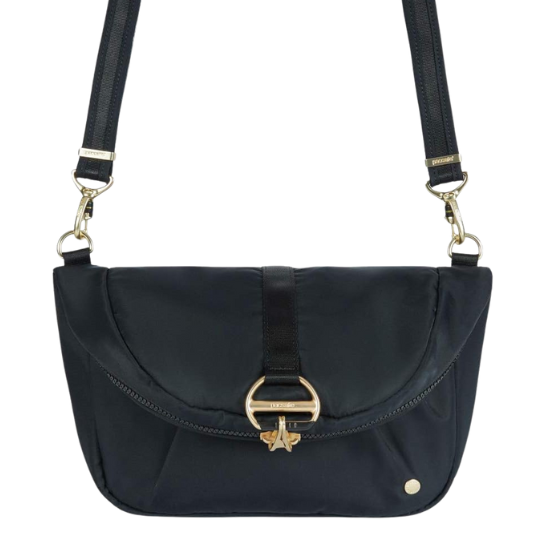
    Pacsafe Women's Citysafe Cx Anti Theft Convertible Backpack

    Pacsafe Women’s Citysafe Cx Anti-Theft Convertible Backpack

    Being able to carry cash safely in Cebu is easy with the Pacsafe Women’s Citysafe Cx Anti-Theft Convertible Backpack. Its slash-proof fabrics and lockable zippers thwart pickpockets, and RFID-blocking pockets protect your credit cards from electronic theft. Keeping your belongings near and your worries at bay, this multipurpose bag makes for easy, hands-free exploring.

    Avoid carrying large amounts of cash when exploring crowded areas.

    Imagine walking through the lively Sinulog Festival parade, which is full of people and energy.  During these times, it’s better to take less cash.  Stick to the money you need for daily purchases and keep the extra money in your money belt for emergencies.  This lowers the amount of money you could lose if you run into pickpockets or bag snatchers, which is always a risk in crowded places.

    Using Your Hotel Safe Effectively

    After traveling a lot, I’ve learned how to balance enjoying the lively local scene with keeping my things safe.  Hotel safes are often used as temporary vaults, but using them effectively takes planning.

    When is it the best option for storing cash?

    Imagine that you’ve found a secret gem: a cute local market full of unique items that were made by hand. The hand-painted tote and unique silver necklace you found are just itching to be a part of your travel story. Carrying a substantial sum of cash back to the hotel feels unsafe, especially with your purse stowed away for safekeeping. When this happens, you’ll appreciate the hotel’s safe.  Keep your day’s leftover cash here, so you can fully enjoy the market without any worries.

    Important safety measures to take before depositing valuables

    When taking things out of your hotel safe, think of the famous question “Does it spark joy?” Here’s the version that works for travel: “Do I absolutely NEED this on every adventure?”  “Need” items include cash, IDs, credit cards (with copies kept separately!), and medicine that you need to live.  However, you should leave your expensive jewelry, large amounts of cash for future trips, and your whole laptop (more on that later) somewhere else.

    My habit is to double-check the safe’s functionality (sometimes a simple reset is all it needs) before putting valuables in it.  I also use my phone to snap a picture of the inside of the safe, making sure to capture any unique codes or numbers. This small step might not seem important, but it could save your life if something goes wrong or you forget something.

    What items should never be kept in a hotel safe?

    In “Wild,” Cheryl Strayed wrote very well about how getting lost is sometimes the only way to find yourself.  But losing all of your data files because your laptop was stolen? Not part of the adventure.  Consider putting laptops, portable hard drives with important data, and photography equipment in a safe, lockable drawer in your room, if one is available. Remember that a hotel safe is meant to stop small thefts, not serious thieves.

    By doing these easy things, you can turn your hotel safe from a boring metal box into a trustworthy protector for your valuable travel items. This will let you fully accept the slow travel philosophy and explore with peace of mind and safety.

    Tech Hacks for Managing Cash in Cebu

    I call myself a digital nomad, but I’ve grown to love slow travel. I’ve also learned how to balance the benefits of technology with keeping cash safe while traveling. I’ve found the following tech tips to be very helpful:

    Downloading offline currency converter apps for quick calculations.

    Imagine getting lost in the maze-like charm of a local Cebu market, filled with bright fabrics and unique items. There’s a handmade bamboo basket that interests you, but the price is written in pesos. One of the best things you can do is download an offline currency converter, such as My Currencies or XE Currency. You can quickly change prices to make sure you don’t pay too much for that perfect souvenir.

    Using budgeting apps to track cash spending and stick to your plan.

    Remember the days before smartphones, when you spent hours each day carefully recording on spreadsheets every dollar you spent? There’s an easier way. With the help of budgeting apps like Mint or YNAB, you can keep track of your spending, create spending targets, and—most importantly—stick to your plan.  These apps give you a sense of control and help you be more aware of your spending, so you can experience Cebuano culture without worrying about going over budget.

    Can mobile payment apps be used for everyday transactions in Cebu?

    Are you ready for the good news? Cebu is joining the march toward cashless transactions! Smaller stores and street sellers may still only take pesos, but more and more restaurants, cafes, and even public transportation services now accept GCash or PayMaya as modes of payment.  You don’t have to carry around large amounts of cash because these apps make it easy and safe to pay.  Read my piece “Best Free Online Payment Methods in the Philippines” to learn more about Filipino FinTech. It’s a must-read for any tech-savvy traveler who wants to avoid carrying cash.

    It’s still sometimes a good idea to have a small amount of cash on hand, even though more and more things can be done without cash. But if you know these tech hacks, you can feel safe walking around Cebu.

    Keeping Cash Safe: Practices for Mindful Travelers

    As an introvert who finds great joy in exploring the world, it’s exciting to embrace the unknown. Still, safety must take precedence even in the middle of new discoveries. I’ve learned over the years that these habits help me feel more at ease, and keeping cash safe is just one of them.

    Informing your bank about your travel dates to avoid transaction blocks.

    Imagine you’re at a cute cafe on Malapascua Island, tucked away in a quiet spot, ready to enjoy a treat after a dive. When you go to use your card, you see the awful sign “Transaction declined.” Fear sets in.  This made-up situation shows how important it is to let your bank know about your travel plans.  You can save needless hassle and make sure your plastic stays functional with just a short call or message using their app.

    Photocopying important documents like passports and credit cards.

    Murphy’s Law has a funny way of coming up with us on the road.  A well-thought-out plan can quickly go off the rails if you lose your ID or have your credit card stolen.  Here’s the hack I use: I make copies of the important parts of my passport and credit cards, like the picture and information page. These copies are kept away from the originals in a safe place, like a pocket in my carry-on bag.  Having these copies on hand can speed up the replacement process and reduce disruptions in case the originals are lost or stolen.

    Cultivating a sense of awareness and avoiding situations that feel unsafe.

    One of the greatest gifts of slow travel is the chance to truly connect with a place.  But this doesn’t mean we should give up on our instincts.  As I walk down busy streets or through less well-known areas, I become more aware of my surroundings.  This means being aware of my surroundings, staying away from dark places at night, and going with my gut if something feels off.  A few moments of careful observation can save you a lot of grief.

    These tips may seem like common sense, but they are the basis for a safe and enjoyable trip.  By putting our safety first, we can fully enjoy the journey, the chance meetings, and the hidden gems that slow travel brings to light. Isn’t that what makes a trip unforgettable?

    Embracing the Cashless Experience in Cebu

    In Cebu City and tourist places, people are becoming less likely to use cash, which I feel is important to bring up.

    This is a good choice for days when you’d rather not worry about keeping cash safe and look into the local scene without stress.

    Identifying restaurants and shops that accept major credit cards and digital wallets.

    Cebu is known for its rich culture and old-fashioned charm, but it’s also becoming a more tech-savvy place to visit.  An increasing number of places, especially those that cater to tourists, now put up big signs saying that they accept Visa and Mastercard. Some food stands on the street are even getting on board by using QR codes to make digital transfers easier.

    Exploring the growing cashless ecosystem in Cebu City and tourist areas.

    Cebu is becoming a big place for digital wallets. A lot of places in the Philippines accept GCash, which is a famous mobile wallet.  Now you can have a smooth dining experience—just scan the QR code at your table, check the amount, and you’re done! It’s over.  Some stores may accept Apple Pay or Google Pay for people who want to buy things from other countries. But it’s a good idea to find out about their digital payment options before you place your order.

    Important Note: Always confirm payment methods before placing an order.

    When you’re in Cebu and don’t want to use cash, let “confirm” be your mantra, just like the Jeepney culture depends on “para” (stop).  There’s no doubt that digital payment infrastructure is growing, but it’s still a good idea to check with the server or cashier to make sure that the business accepts the digital payment method you prefer. This easy step can keep you from getting into any awkward situations or being held up, so you can fully enjoy the cashless experience Cebu has to offer.

    Don’t forget that Cebu is a lovely mix of old and new.  Even though it’s still a good idea to keep some cash on hand for small purchases and unplanned events, using Cebu’s digital options can make your slow travel experiences not only more interesting but also a lot easier.

    FAQs

    Are there any downsides to using cashless transactions in Cebu?

    There can be a few minor drawbacks to consider. While the infrastructure is growing, some smaller shops and local vendors may still primarily rely on cash. Additionally, some remote areas you might explore on your slow travel journey might have limited internet connectivity, making digital payments unavailable. It’s always wise to carry a small amount of cash as a backup for such situations.

    Are there any security concerns when using digital wallets in Cebu?

    As with any digital transaction, it’s important to be mindful of security. Always ensure you’re using official apps from reputable providers and avoid using public Wi-Fi for financial transactions. Consider enabling two-factor authentication on your digital wallet for an extra layer of protection.

    What if I don’t have a Philippine mobile number? Can I still use GCash?

    Unfortunately, GCash requires a Philippine mobile number for registration. However, other digital wallets like GrabPay or Maya might offer registration options for international users. It’s advisable to research these options before your trip and ensure they cater to foreign users.

    Are there any fees associated with using cashless transactions in Cebu?

    Generally, there are no fees for using digital wallets in Cebu for everyday transactions. However, some restaurants or shops might impose a small service charge for cashless payments. It’s always a good idea to inquire about any potential fees beforehand.

    Do I need a strong internet connection to use cashless transactions in Cebu?

    While a strong connection is ideal, some digital wallet transactions in Cebu might function with a moderate internet signal. However, for QR code scanning and real-time confirmations, a stable connection is preferred. If you’re venturing into areas with limited connectivity, carrying a small amount of cash remains a wise precaution.

  • Best Free Online Payment Methods in the Philippines

    Are you new to Cebu and looking for the best free online payment methods in the Philippines? Free online payment methods make online shopping easy. So I’m sure you’re not the only one wanting to find out what modes of payment in online shopping you can use without getting out of your pajamas.

    Credit cards used to be the only online payment method in the Philippines until these new payment gateway providers came along. If you are an online business owner, setting up your website to automatically accept these payment methods can increase your sales. And if you are an online shopper, using these free online payment methods offers convenience and security because they are DTI-approved.

    G-Cash

    GCash is the first-ever free online payment method in the Philippines to offer the Customer Protect Program, keeping your money safe from scammers and fraudulent transactions. But as the account owner, you must still observe online shopping safety measures.

    With G-Cash, you can send money to fellow G-Cash account holders. You can also use the Send Money To Bank Account feature to transfer funds from your G-Cash wallet to G-Cash partner banks. Currently, G-Cash charges a ₱15 fee per send-to-bank transaction, but G-Cash to G-Cash transactions are free.

     G-Cash isn’t only the best online payment method in the Philippines; it also lets you buy loads from the app, donate to charity, pay bills, purchase life insurance, get a loan, invest, and save money. Merchants can receive payments through in-store QR and payment links.

    Tip: You can receive ₱50 G-Cash when you sign up using my referral link. Full disclosure: I get ₱50, too, enough for a cup of Abaca’s Americano.

    mode of payment in online shopping

    Maya

    Maya, formerly known as PayMaya, allows you to shop at online stores and websites accepting Visa or Mastercard payment methods. Like G-Cash, Maya also has virtual and physical cards you use like any other credit card. 

    When you sign up, you instantly get a Maya virtual Visa card. If you prefer Mastercard, you can purchase the physical card online at https://store.maya.ph or these stores: 

    • The SM Store Business Services (2nd floor of SM City Cebu near Kultura)
    • Robinsons Department Store Business Centers
    • Select Padala Agents nationwide

    To register, download the free Maya app from the Google Play Store, Apple App Store, or Huawei AppGallery. Once installed, the app will prompt you to sign up and enter your name, mobile number, date of birth, and email address.

    Recently, Maya added more features to their app, including Maya Crypto and Maya Savings. They also offer Maya Credit, a virtual credit line to qualified users, allowing you to borrow up to P15,000 using the app.

    Are you signing up for Maya? Kindly do this broke writer a huge favor and use my referral link.

    You might also want to read Online Shopping in PH: How Deliveries Work

    GrabPay

    GrabPay is an online payment method developed by Grab Holdings Inc., a Singaporean tech company. Grab evolved from being the Philippines’ #1 ride-hailing app into a super-app that lets you order food, buy airtime load, buy groceries, transfer funds, and more.

    Many eCommerce sites in the Philippines accept GrabPay. Just look for the GrabPay payment button when you shop online. Some online merchants that accept GrabPay:

    • Zalora
    • BeautyMnl.
    • Shein
    • Harlan+Holden
    • Watsons
    • ShopSM
    • Rustan’s
    • Kimstore
    • Kultura
    • The SM Store
    • Power Mac
    • Silicon Valley

    Brick-and-mortar stores where you can use GrabPay:

    • Ace Hardware
    • Decathlon
    • H&M
    • S&R
    • SM Supermarket
    • Starbucks
    • Uniqlo
    • Watsons

    Adding money to your GrabPay account is easy with a linked debit or credit card. You can also connect your bank account and top up your GrabPay Wallet in just a few taps. Another way you can cash in your Grab Wallet is through Grab drivers. When you book a ride and come across a pop-up that says “Cash In With Driver,” you can give the driver cash in exchange for GrabPay Wallet funds. 

    Or you might want to top up at the following stores :

    • 7/11 via CliQQ machines
    • ECPay
    • SM Business Centers
    • LBC
    • Cebuana Lhuillier
    • Robinsons Business Centers
    • Bayad Centers

    There are also ATM kiosks all over the metro that lets you feed your GrabPay Wallet. There’s one inside Ayala Malls Central Bloc in IT Park, right outside Daiso.

    Don’t carry around a huge amount of cash in Cebu! Read “Keeping Cash Safe In Cebu” right away!

  • ATM Withdrawal Limits in Cebu: Where to Withdraw Big Amounts

    There are ATM withdrawal limits in Cebu. So, where can you withdraw bigger amounts and save fees? Find out here.

    When you go around the Philippines, you need cash. And you should get it in the bigger places, like Cebu: On smaller islands, there may not even be an ATM. Credit cards? Abandon all hope.

    Here is the catch: most ATMs enforce a limit of ₱10,000 ($191) per withdrawal using a foreign card, and then slap a ₱250 ($4.80) fee on top. So, where can you withdraw bigger amounts and save fees?

    Bank with the highest ATM withdrawal limit

    The winner:

    UCPB maximum ATM withdrawal with ₱40k ($765)

    The ATM withdrawal limit is ₱40k ($765), with a fee of ₱250.

    Popular locations for UCPB ATMs:

    • Ayala
    • near Castle Peak Hotel
    • Mango Ave (towards DOLE)
    • inside SM City

    See the official list of UCPB branches under “Visayas” or search on Google Maps for other locations.

    If you’re curious, the name is an abbreviation of United Coconut Planters Bank.

    We last verified the ₱40k limit in October 2019.

    You might also like Getting Around Cebu City: How to Explore the Queen City of the South

    Other limits

    Here are other banks, either because they have a higher limit than most, or because they’re very common.

    • BDO. ₱10k limit. ₱250 fee. (Verified in January 2019)
    • BPI. ₱10k limit. ₱250 fee. (Verified end of 2019)
    • DPB. ₱10k limit.
    • RCBC. ₱10k limit. ₱250 fee. (Verified in Nov 2019.)
    • Security Bank. ₱10k limit.
    • Wealth Bank. ₱10k limit. ₱250 fee. (Verified in Jan 2020.)

    Carrying a huge amount of cash around in Cebu? Read “Keeping Cash Safe In Cebu” right away!

    Rumors and other goodies

    HSBC next to Ayala mall may allow 50k, but possibly only if you have an account with them.

    Citibank at Ayala mall allows withdrawals of US dollars—but only if you have a USD account with them.

    You might also want to read Best Free Online Payment Methods in the Philippines

  • Getting Around Cebu City: How To Never Get Lost

    Let’s streamline your getting around Cebu City game with tech hacks, safety tips, and a side of Cebuano survival phrases.

    I’m not Adèle Blanc-Sec. 

    I’m that slightly disheveled woman juggling a laptop bag, travel mug, and a confused look that screams “I thought Google Maps said turn left?” I’m also a digital nomad, which means Cebu City is both my office and my playground. 

    Getting around Cebu City isn’t always as smooth as a flat white, but hey, mishaps make for good stories, right? (And sometimes, for finding the coolest hidden cafĂ©). Because here’s the thing: Cebu’s transport system is a glorious, chaotic puzzle. Think jeepneys bursting with color, beeping taxis, and an occasional air-conditioned bus that feels like winning the travel lottery. It’s enough to send your inner control freak into a minor panic attack.

    But panic no more, fellow nomad! I’ve navigated this urban jungle fueled by caffeine and sheer stubbornness. Let me be your slightly less lost guide. Consider this your crash course in navigating Cebu like a pro. We’ll cover everything from deciphering jeepney routes to finding those heavenly wifi-equipped oases. Think of it as the digital nomad’s survival kit: part tech-savvy, part practical, with a dash of street smarts.

    If you’re ready to ditch the overwhelm and embrace the adventure of Cebu’s streets, buckle up. Let’s make those “lost” moments the start of something cool, one hilariously confusing Angkas ride at a time.

    Where the HECK Are We Going? Mapping Out Cebu

    Let’s get some bearings before diving into the glorious mess of getting around Cebu City. You’re probably picturing island life – swaying palms, white sand, the whole bit. And yeah, Cebu has that in spades, but for our purposes, we’re focusing on the urban jungle of Cebu City. Day trips to those tropical paradises are on the future itinerary, but for now, it’s about conquering the city streets.

    Now, about those neighborhoods. If you’re wired like me, with a constant craving for caffeine and a solid wifi connection, then IT Park is your mecca. This is the tech heart of the city, buzzing with startups, software companies, and enough coffee shops to keep you fueled for a month. Then there’s Fuente Osmeña, the classic downtown, full of history and that energetic “big city” pulse. Uphill, we find Lahug, which offers a slightly more upscale vibe, with views to boot. As to where to base yourself… well, that’s a mix of your work style, budget, and tolerance for karaoke (no judgment here, some nights it just hits the spot).

    Speaking of finding your way, let’s talk about Cebuano street names. Think of it like a scavenger hunt designed by a history buff with a flair for the dramatic. You’ll see names of national heroes, Spanish conquistadores, and Catholic saints all tossed together. It’s honestly quite fascinating but about as practical for navigation as trying to read Tolkien’s Elvish on the back of a speeding jeepney. Don’t worry, though; we’ll crack the code together. There’s a method to this organized chaos, I promise.

    The OG Transport: Walking, Cebu-Style

    Walking is the most sustainable, low-tech way of getting around Cebu City. But before you lace up your sneakers and romanticize those European strolls, we’ve got to talk about Cebu-style pedestrian life.  

    Safety-wise, it’s like most cities: generally fine during daylight hours, but needs more smarts as the sun goes down. Stick to well-lit, populated routes – think malls connecting to main boulevards, not dimly lit backstreets. Common sense for a solo woman traveler anywhere, right? Daytime Cebu has its quirks though. Those sidewalks…or what passes for them? Expect a slalom course of vendors selling everything from mangoes to phone chargers, the occasional open manhole (watch your step!), and maybe a snoozing stray doggo or two. Think of it as agility training fueled by street food smells. 

    Speaking of smells, Cebu equals HEAT. And by heat, I mean that sweat-slicked, frizzy-hair-but-still-smiling kind. Breathable fabrics are your BFF. Think linen, not leather. Sunscreen is non-negotiable, and a chic little hand fan brings a touch of old-world glamour while keeping you sane on the sidewalk. Want that Zoom-call-ready look post-walk? A stash of wet wipes and a mini deodorant in your tote will save the day. Remember, it’s not about looking perfect, it’s about rocking that confident “I’ve just navigated Cebu City on foot” glow.  

    Jeepney Journeys: If You Dare

    Strap in, because we’re about to go full-on Cebu with the iconic jeepney. Think of these babies as rolling fiestas on wheels – a riot of colors, chrome, and sometimes even karaoke, crammed with locals, students, and the occasional chicken… you get the picture. But beneath the joyous chaos, there’s a system, and I’m here to help you crack the code so you can ride like a seasoned pro.

    First, let’s address the elephant in the room, or rather, the flamboyantly painted mini-bus barreling down the road. Jeepneys are an ingenious Filipino creation, born of necessity when surplus WWII Willys Jeeps were repurposed for public transport. Today, they’re a lifeline of affordable transit, but they’re also a crash course in Cebuano culture if you’re up for a little organized mayhem.

    To navigate those swirling routes, look for those destinations painted proudly on the side. Think of it as the ultimate low-tech signage. You’ll need some basic Cebuano like “lugar lang” (just here), or the all-purpose “para!” to signal a stop. Don’t be shy about asking fellow passengers – most Cebuanos are friendly, and might be amused by the adventurous foreigner giving the jeepney a go. Oh, and unspoken jeepney etiquette? Prepare to squeeze in. Those benches are designed for maximum capacity, so get cozy with your neighbor.

    Now, the fare. Forget tapping a card – we’re going old-school with coins and small bills. You’ll then embark upon the Olympic sport that is passing your fare along a chain of passengers saying, “Palihug (please)” until it reaches the front. It’s a testament to Cebuano kindness and honesty (mostly!), and let’s be real, kinda fun once you get the hang of it.

    Think of a jeepney journey as sustainable travel with a healthy dose of adrenaline. It won’t always be efficient, air-conditioned, or entirely comfortable, but it’s the best way to experience the pulse of Cebu City, and who knows? You might just make some new friends along the way.

    Here are some of the jeepney routes within Ayala – SM City – IT Park

    • 04L – IT Park to SM City Mall (passing Ayala Center Mall) 
    • 04M – Lahug to JY Square Mall (passing Ayala Center ) 
    • 17B/ 17D – Apas, IT Park, Lahug to Carbon market
    • 17C – Apas, IT Park to Caron via Gen. Maxilom Ave.
    • 03Q – Mabolo to SM City (passing Ayala Center)
    • 20A/ 20B – Mandaue City to Ayala Center via Mabolo
    • 12L – Labangon to Ayala
    • 12G – Labangon to SM City
    • 14D – Ayala Mall to Colon (via Escario, Fuente, F. Ramos St./ return trip via Fuente Jones to Capitol)
    • 13C – Talamban, Ayala to Colon
    • 13B – Talamban, Ayala to Carbon via Ramos
    • 62B/62C – Pit-os, Ayala to Carbon

    Here are some of the jeepney routes within Cebu City:

    • 03A/ 03L – Mabolo to Colon 
    • 03B – Mabolo to Colon (passing Mango Avenue, Fuente Circle, Jones)
    • 03Q – Mabolo to SM City (passing Ayala Center)
    • 01K – Urgello to Colon, North Bus Terminal, Park Mall 
    • 06B – Guadalupe to Colon via Capitol and Jones Ave.
    • 07B – Banawa to Colon via Capitol and Jones Ave.
    • 02B – South Bus Terminal to Pier area
    • 12D – Labangon to Colon
    • 21A/ 21D – Mandaue City to Manalili to Cebu Cathedral
    • 22I – Mandaue City to Gaisano Country Mall via A.S. Fortuna Street 
    • 24 – going to Consolacion
    • 25 – going to Liloan/Danao

    Fare: Php 8 minimum

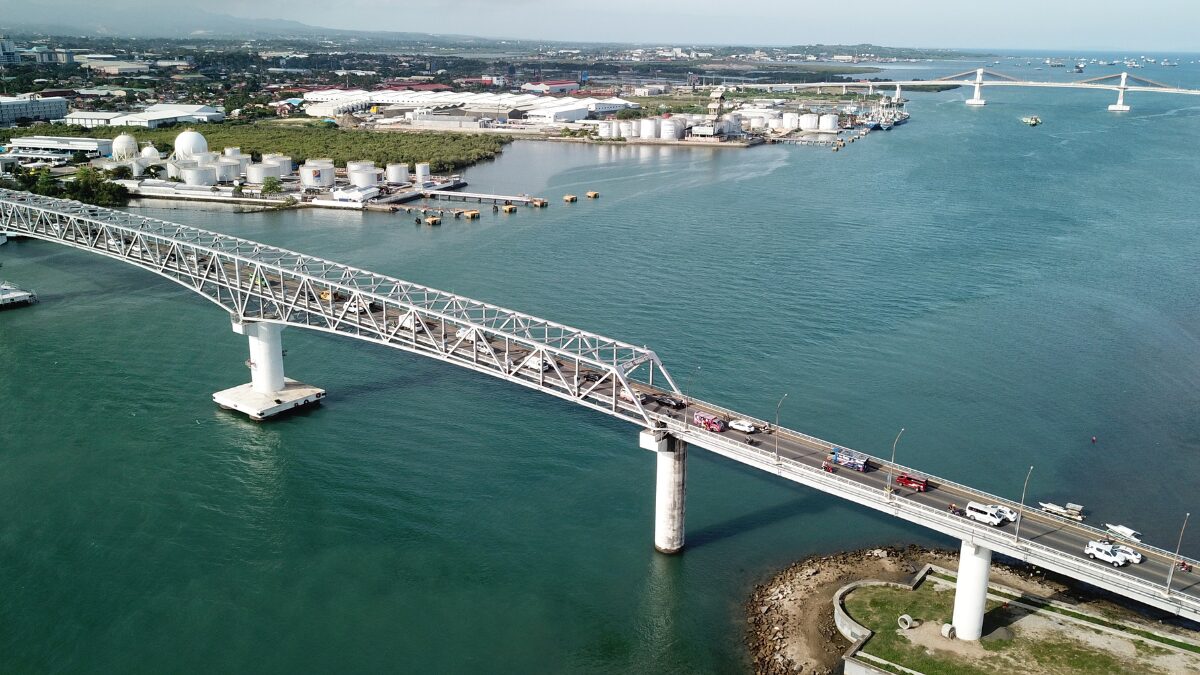
    Cebu, the old Mactan bridge between Lapu-Lapu and Mandaue

    Beep and MyBus: Cebu’s (Kinda) Modern Buses

    The sight of a jeepney hurtling down a Cebu street never quite loses its charm (or its ability to induce a bit of heart-pounding terror). But sometimes, a girl needs aircon and a guaranteed seat. That’s where BEEPs and MyBus come in.

    BEEP

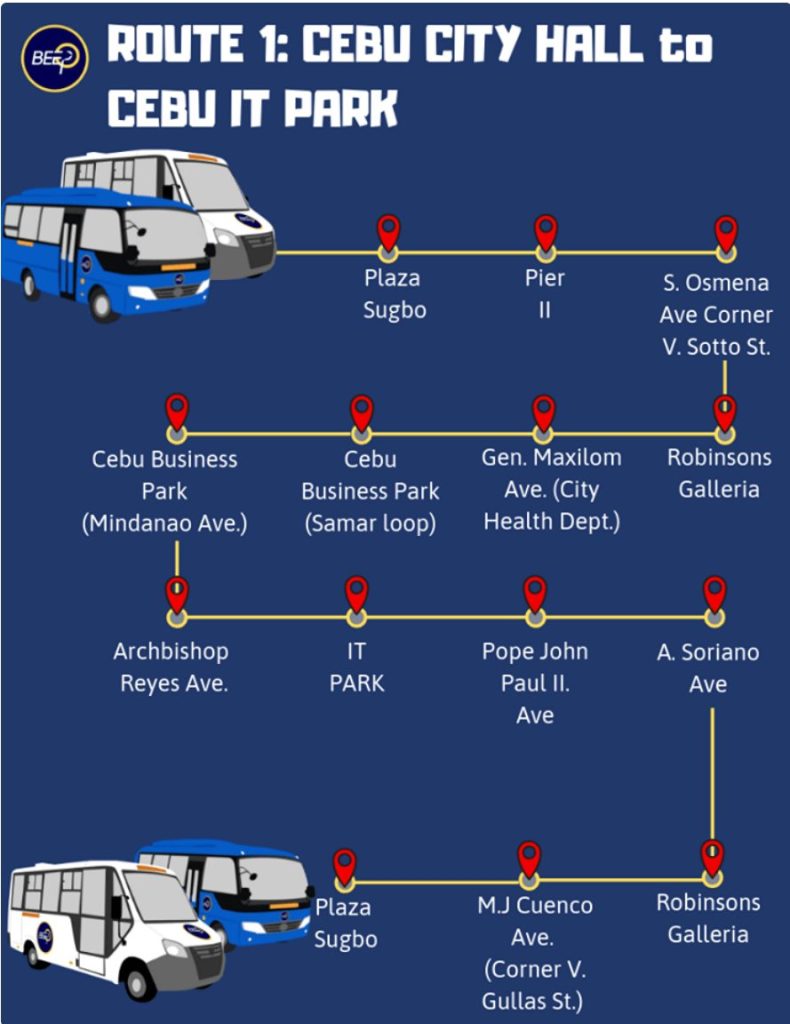
    “Beep” is a total double whammy here: it stands for “Bus-Jeep Enhanced Engine Program,” the fancy name for those modernized bus-jeepney hybrids. Plus, it refers to the beep card payment method – goodbye fumbling with coins! There are a bunch of these plying routes around Cebu City, all sleek and blue (or white, depending on their capacity).  

    The good stuff? Full air conditioning, onboard cameras for a sense of security, and those little TVs that usually blast Filipino game shows. It’s a smoother ride than the jeepney, and a bit more planet-conscious.

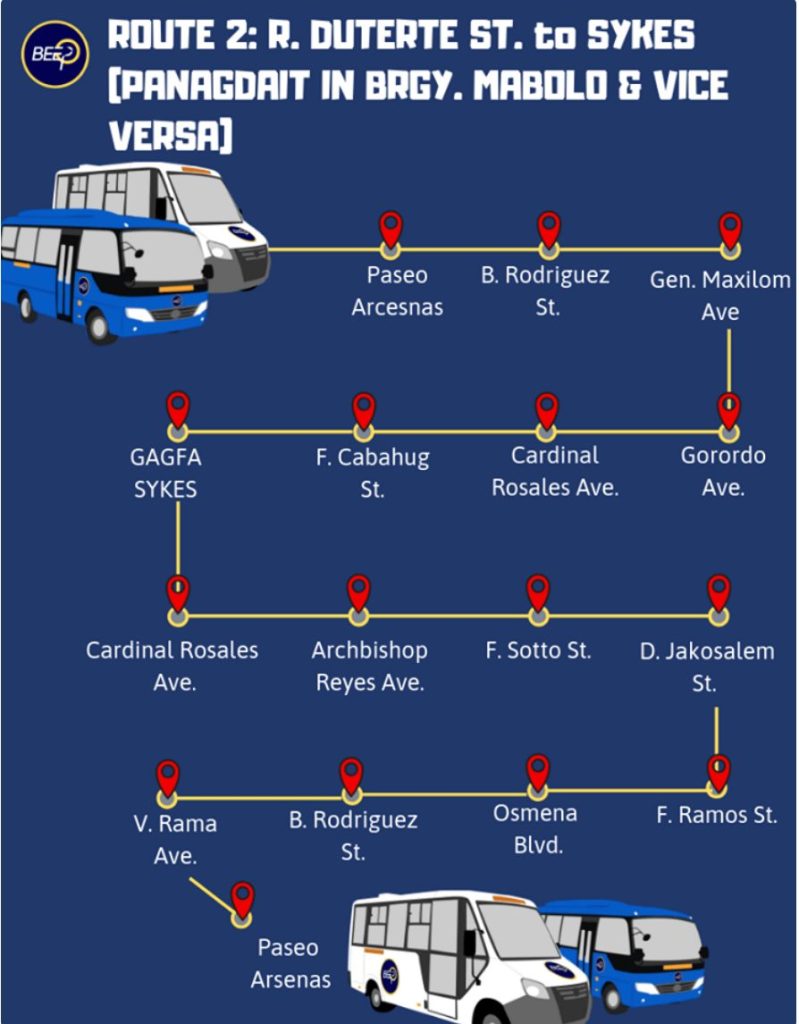
    As of November 2019, there are only three routes available:

    1. Cebu City Hall – Asia Town, I.T. Park

    Photo by: BEEP Program

    2. Paseo Arcenas Banawa (R. Duterte St.) – Sykes Panagdait

    Photo by: BEEP Program

    3. Guadalupe to Carbon market

    • Guadalupe -> Capitol -> Jones Ave. -> Downtown Cebu (vice versa)

    PeoplesJeep

    PeoplesJeep is new kid on the block. Launched in 2019, PeoplesJeep are essentially BEEP buses, but with a cooperative ownership model. They feel like those fancy mini-buses you see in airports, shrunk down for Cebuano streets. Same perks as BEEP apply, with possibly more consistent routes since they’re focused on specific areas.

    Currently, PeoplesJeep follow four routes:

    • Talamban – Ayala – Colon
    • Lahug – Ayala – SM
    • Bulacao – Colon – SM
    • Talamban – Colon (following the 13C route)

    Fare: Php 10 minimum

    MyBus

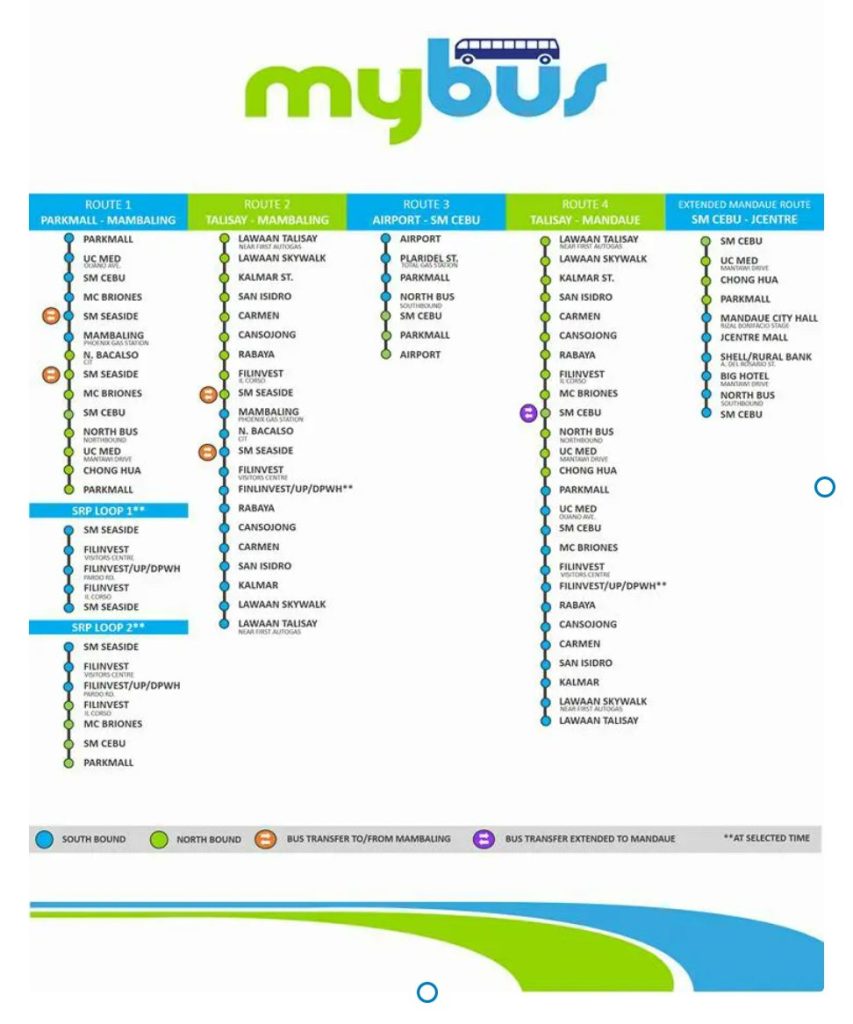
    MyBus serves a slightly different purpose. These bigger guys are best for specific journeys – think airport to SM Seaside mall, or between the major transport terminals. They also have that fancy ePLUS card for cashless payment.

    SM City Cebu – Airport (vice versa)

    Photo by: MyBus

    Fare: Php 25-40 

    Purchase an ePLUS card for Php 200 at any MyBus station or at SM Supermall to pay for your ride. You can use the remaining credit on other MyBus rides.

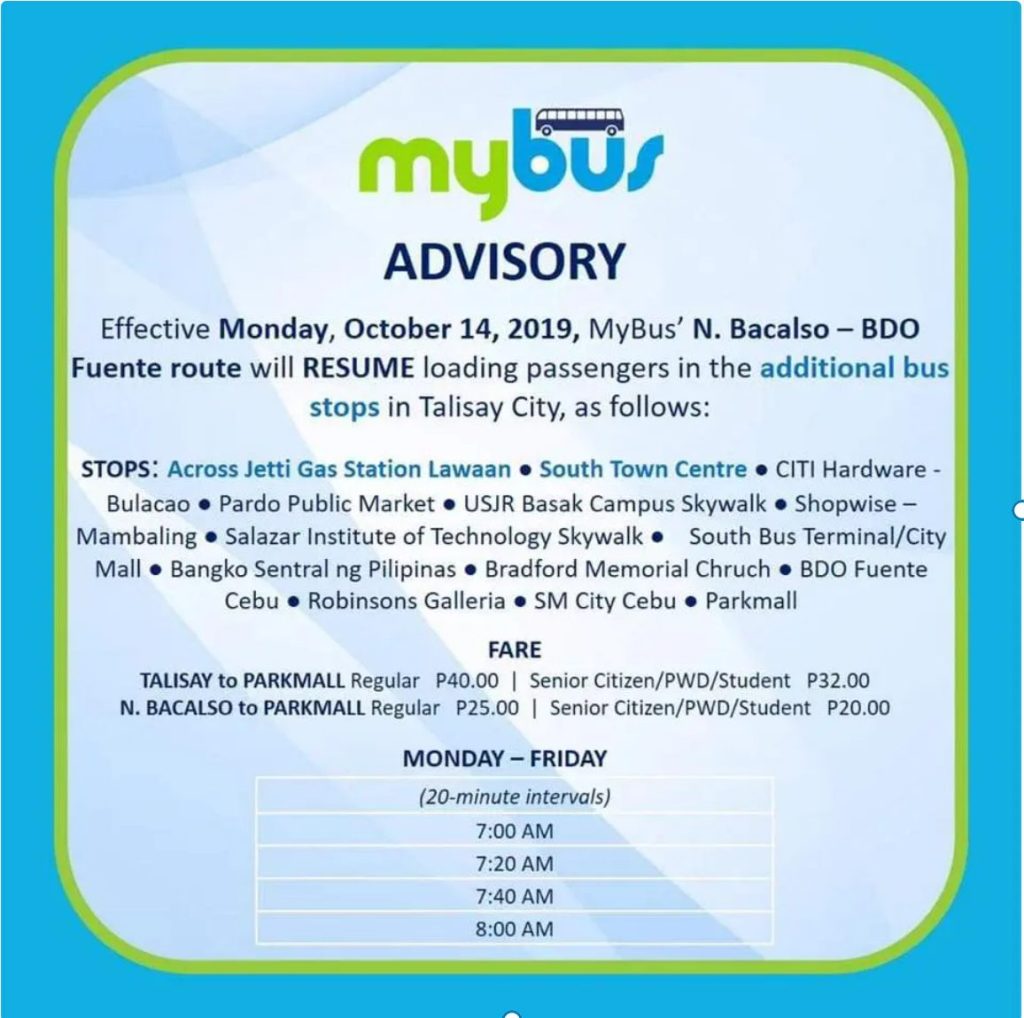
    Recently, MyBus added the N. Bacalso – BDO Fuente route:

    Photo by: MyBus

    If you want to familiarize the streets of Cebu, this is the most convenient means. But if your schedule is tight, choose another conveyance.

    How to Beep (and MyBus) Right

    • Routes are King/Queen. Before hopping on, check the signage for the bus routes. Currently, BEEPs have limited routes compared to jeepneys, so they won’t take you everywhere in Cebu City. Think of them as a step up in comfort when your route happens to match.
    • Stations, Not Hailing. Unlike jeepneys, these guys have designated stops. Keep an eye out, or you might miss your chance to disembark in a flurry of panicked button-pressing.
    • Fares. Beep fares start at around PHP 9.50, which is a bit steeper than a jeepney. MyBus has varying fees depending on the route. Think of it like paying for that aircon privilege, okay?

    My Verdict

    Want to sightsee and soak in the Cebu street vibe? MyBus on the N. Bacalso – BDO Fuente route is a good bet. Tight schedule and desperately need to NOT arrive a sweaty mess? Opt for a taxi or ride-hailing app. But when you want that middle ground between colorful jeepney chaos and the convenience of Grab, the BEEP network can be your jam. 

    Taxis and Ride-Hailing: Trading Chaos for Convenience

    Sometimes, a girl just needs a comfy seat and working AC. Especially after braving a few jeepney rides, the familiar world of taxis and ride-hailing apps offers a comforting hit of predictability when getting around Cebu City. Of course, they come with their quirks.

    White Taxi Cabs

    Similar to the yellow taxis, but sometimes operate on a fixed price rather than a meter. Do your homework beforehand if you have a specific destination in mind. You can bargain, but it takes practice and a little bit of Cebuano wouldn’t hurt.

    White taxi fare: Php 40 (USD .77) flag-down rate + Php 13.50 for every succeeding kilometre and Php 2 per minute of waiting time in traffic

    Grab is Your Friend

    Think of the Grab app as your personal chauffeur service on demand. Sure, “surge pricing” during rush hour can sting, but sometimes paying a bit extra for that sweet air conditioning and the knowledge of exactly where you’re going is downright priceless. Bonus? You can track your ride, minimizing those awkward “Where are you now?” calls on unfamiliar streets.

    Yellow Cabs: When They Work, They’re Fine

    Yellow cabs are the OG Cebu transport option. They’re plentiful, and hailing one gives you that classic “I’m in a movie!” moment. The catch? Not all drivers are created equal. Some are honest, while others might try to “creatively” interpret the meter (remember those language skills!). It’s a bit of a gamble, but asking locals or your hotel for reliable cab companies can up your odds of a smooth ride.

    Yellow taxi fare: Php 70 (USD 1.35) + P4 for every succeeding 300 meters

    Women-Driven Options

    There’s debate around this, and it touches on bigger issues of safety in public transport (a whole other blog post!). Some companies or smaller networks do offer women-driven options, aimed at providing a bit more peace of mind for solo female travelers. I’m digging into finding reputable services right now because that extra layer of comfort matters. 

    My Verdict

    Taxis and ride-hailing won’t replace the cultural experience of jeepneys, and they’re not the most sustainable choice. But hey, we work hard – sometimes a private, climate-controlled ride with a dash of WiFi is the best form of self-care. 

    Safety tips: Always lock the door once you’ve boarded. There have been incidents when robbers would randomly open taxi doors when traffic is at standstill. Also, check that the meter is running. There’s also a newly reported scam where the driver intentionally forgets to turn on the meter so they can charge a higher than usual fare later.

    Getting Off The Beaten Path: Sustainable-ish Escapes

    Alright, let’s dive into the wild side of Cebuano transport! Think less luxury coach tour, and more “Indiana Jones with a latte” vibes. Because when that wanderlust kicks in and Cebu City starts feeling a little *too* urban, we nomads crave those off-the-grid adventures. Luckily, options abound – though “sustainable-ish” is the key phrase here.

    Habal-Habal Adventures: Embrace the Adrenaline (and Sketchiness)

    Imagine clinging to the back of a motorcycle, whipping through mountain roads, views that’ll hijack your Instagram feed. That’s the habal-habal experience. It’s fast, it’s cheap-ish (if you’re a haggling pro), and exhilarating… with a side of safety concerns. It’s the transport equivalent of that street food that’s SO good, but you might regret it later.

    These guys are lifesavers for getting to waterfalls, remote beaches, etc. But know this: no helmets (usually), your driver might be 16, and the ‘road rules’ are… flexible. Think of it as a calculated risk for that epic photo-op.

    As written in our habal-habal guide, here are the fares for the usual routes within Metro Cebu:

    • Ayala to I.T. Park – P30 ($0.57)
    •  Maria Luisa Road to I.T. Park – P70 ($1.33)
    • I.T. Park to SM City – P70 ($1.33)
    • Ayala to SM Seaside – P120 – P150 ($2.3 – $2.8)

    V-Hire Vans: Cultural Immersion, Sardine-Style

    Craving a dose of authentic Cebuano life? Hop on a V-hire! These shared vans cram in as many passengers as humanly possible. You’ll be elbow-to-elbow with locals, groceries, and maybe a live chicken… it’s loud, sweaty, and an experience you won’t forget.

    Bonus points: It’s dirt cheap for longer hauls to nearby towns. But bring snacks, because stopping is unpredictable. Like that overstuffed suitcase you should’ve unpacked, it’s all part of the journey.

    Bike Rentals: Cebu’s (Questionable) Cycling Scene

    Cebu has bike rentals… but the city itself? Not ideal. Traffic is chaotic, and bike lanes are rare. Think twice before pedaling through downtown. However, there ARE quieter areas for scenic rides (check out online cycling groups for tips).

    So, it’s not like bike-friendly Copenhagen, but doable if you’re smart about routes. A mountain bike opens up more remote possibilities, too.

    Angkas: The ‘Grab’ of Motorcycle Taxis

    If habal-habal bargaining stresses you out, Angkas is your friend. This app lets you hail a motorcycle ride (with a helmet, yay for safety!), and fares are fixed upfront. Think of it as Uber but with more wind-in-your-hair excitement.

    Ferries: Your Scenic Sea Shortcut

    Need a Mactan Island escape? Ferries across the channel are fast, and breezy, and offer stunning skyline views. Way more charming than a taxi in traffic, and eco-friendlier too. 

    A ferry departs every 10-20 minutes in Pier 3 bound for Lapu-lapu City.

    If you’re coming from Mactan Island, here’s where you can take a ferry boat:

    Topline Express Ferry

    At Mactan Marina Mall, walk towards Island City Mactan where the ferry terminal is located. The Island Ferry 1 that will take you to Pier 3 in downtown Cebu City. It’s a 30-minute ride coast-to-coast – add to that the time spent buying tickets. Daily route is from 5 am to 9 pm.

    Fare: Php 25-30 ($0.48 to $0.57)

    Metro Ferry

    Go to the Muelle Osmena port near Opon Mercado. Buy your ticket and pay the terminal fee. Metro Ferry will take you to Pier 3 in just 15-20 minutes.

    Fare: Php 14 ($0.27) + Php 2 (terminal fee).

    Sea Jeepney

    From southern Cebu, commuters can now travel to Cebu City onboard the MyBoat “sea jeepney.” The vessel sails from Naga City port to Pier 1 and vice versa for a total of 10 trips daily. Each trip takes 45-60 minutes coast to coast.

    MyBoat schedule is as follows:

    • Heading to Cebu City:
      • 5:30 am
      • 7:50 am
      • 10:10 am
      • 2:10 pm
      • 4:30 pm
    • From Cebu City:
      • 6:40 am
      • 9 am
      • 1 pm
      • 3:20 pm
      • 5:40 pm.

    Fare: Php 60

    Beyond the Basics: Niche Transport Wins

    • Tricycles. Cebu’s version of a tuk-tuk, these covered trikes are perfect for short hops within neighborhoods. Unlike habal-habals, tricycles have a roof which makes them useful on extremely hot or rainy days. You can get one to take you to the nearest bus/jeep station or to rural locations. Tricycles can carry up to 4 passengers at a time. They usually wait for other passengers to ensure full capacity, but you can offer to pay the full-capacity price (pakyaw) if you’re in a rush.
    • Renting Your Ride. If driving doesn’t scare you, motorbike or car rentals unlock serious freedom. Proceed with caution – think of it as playing Frogger with real-life consequences. There are peer-to-peer motorbike sharing services like Book2wheel and Rentmotorcebu.com that let you rent on a daily, weekly, monthly basis. They usually offer delivery and pick-up for free. Rental prices start at Php 350 (daily), Php 2450 (weekly), and Php 6500 (monthly). You can find a lot of car rentals with a quick Facebook or Google search. Be sure to check the reviews to get the best possible service. Hourly rates within Cebu average Php 850 + Php 300 for every succeeding hour, while daily rates average Php 4500. 

    Getting around Cebu City is an adventure in itself. Embrace the chaos a little, trust your gut, and always have backup caffeine on hand. That ‘lost and kinda loving it’ moment? That’s where the best stories start. 

    Tech to the Rescue: Apps That Save Your Sanity

    Time to unleash your inner tech goddess! I know navigating a new city can feel overwhelming, especially in Cebu City where the streets sometimes seem to have a mind of their own. But fear not, because I’m about to arm you with digital tools that’ll help you conquer this urban maze.

    Google Maps, Your Trusty Sidekick

    Okay, we all know Google Maps. It’s like the trusty compass of our digital age. But here’s the thing: Google Maps in Cebu deserves its masterclass. Let’s unlock those lesser-known superpowers:

    • Offline Savior. Spotty internet is the bane of every nomad. Before venturing out, download offline maps of Cebu. Trust me, this is your lifeline when the wifi gods betray you. It’s like a cached treasure map for navigating those moments of signal darkness. 
    • Hidden Gems. Google Maps isn’t just about routes. Search cafes, coworking spaces, and even those hole-in-the-wall eateries your fellow nomads rave about. Tap the “Explore” tab and unleash your inner digital Magellan!

    Waze for the Traffic Win?

    Think of Waze as your personal traffic whisperer. It taps into the wisdom (and occasional grumbling) of fellow drivers to paint a real-time picture of traffic jams, accidents, and those sneaky shortcuts. Here’s how to use Waze with the savviness of a local:

    • Eyes on the Prize. Waze is meant for pre-trip intel, not while driving (safety first!). Plan your route before you hit the road, keeping those little Waze icons in mind (they could mean potholes, speed traps, or even a random mango stand).
    • Rush Hour Radar. Cebu traffic worsens at predictable times. Waze helps you outsmart the gridlock during peak periods, suggesting alternative routes even if they seem circuitous at first.  

    Like with any crowdsourced app, Waze relies on user input. Sometimes it’s incredibly accurate, other times a little less so. It’s a fantastic tool, but not an infallible oracle. Pair it with your gut instincts, and you’ll be dodging those traffic jams with ninja-like reflexes. 

    Extra Credit: Leveling Up Your Cebu Street Cred

    Okay, you’ve mastered the jeepney, survived a Grab price surge, and (mostly) know where you’re going. Now, let’s go from a newbie digital nomad to a seasoned Cebuana traveler. Because getting around Cebu City is one thing, but thriving in it? That’s a whole different skill set.

    Rainy Day Retreats: Because It WILL Rain

    Cebu’s got that tropical charm, which means sun…and sometimes a whole lotta downpour. Here’s your wet-weather survival kit:

    • Coffee + Wifi Havens. Bo’s Coffee (local chain, everywhere!), Abaca Baking Company (those pastries, tho), and Coffee Factory (if you’re in IT Park). 
    • When Only AC Will Do. Malls are your overly chilled sanctuary. Ayala Center Cebu and SM City Cebu are classics, SM Seaside is the fancy schmancy option. 

    Cebuano 101: Transport Edition

    Knowing a few keywords makes all the difference. No, you won’t be fluent overnight (unless you’re secretly a linguistic genius), but these get you by:

    • “Para!” (Stop!). Yell this LOUDLY when you want the jeepney to pull over.
    • “Bayad!” (Payment!). Hand this to the driver along with your fare, with a smile if you can manage.  
    • “Asa dapit and…?” (Where is…?). Best followed by pointing and looking hopeful.
    • “Tabang!” (Help!). When things get real. A last resort, but good to know.

    Lost in Translation: What To Do When Panic Sets In

    It happens to the best of us. Maps fail, batteries die, and suddenly you’re on a street corner feeling VERY far from home. Let’s troubleshoot:

    • Who to Ask. Security guards (they’re everywhere), friendly-looking shop staff, or fellow young people (better chance of English). 
    • Breathe. Panic makes things worse. Remember, Cebuanos are generally kind folks, willing to help if they can.
    • Power Bank = Lifeline. Dying phone + being lost is a recipe for a meltdown. Your backup battery saves the day.
    • Embrace the Detour. Sometimes, getting lost is the BEST way to find hidden gems and unexpected adventures.

    Think of this like a language-learning game, an upgraded version of charades with a Cebuano twist.

    FAQs

    Is Cebu safe for a solo female traveler?

    It’s generally safe, but like any city, awareness is key. I stick to well-lit, populated areas at night, and I’ve learned a bit of self-defense… just in case a stray mango decides to challenge me.

    How much money do I need to survive as a digital nomad here?

    I budget more for comforts than bare-bones backpacking, since good coffee and reliable WiFi are survival gear for me. Expect to spend more than Southeast Asia hotspots, but less than Western cities.

    Is it walkable?

    Depends on your heat tolerance and shoe choice! I walk short distances, but Cebu rewards those prepared for uneven sidewalks and the occasional tropical downpour.

    Do people speak English?

    Widely! Filipinos are amazing at English, even with that charming Cebuano accent. But I suggest learning basic Bisaya phrases – it breaks the ice and will help you navigate better.

    Can I live a sustainable lifestyle in Cebu?

    It takes effort. I seek out refill stores, carry my reusables, and love exploring markets. But single-use plastic is still a reality here, so it’s about finding your balance.

    Can I work from cute cafes?

    Absolutely! Cebu’s cafe scene is booming. In a separate post, I’ll share my favorite work-friendly spots, where the coffee is strong and the WiFi is stronger. My go-to is Abaca Baking Company on the top floor of Ayala Center.

    Must-have apps?

    Grab for transport, Google Maps for life, and Gcash for cashless payments. Language apps are fun, but a smile and “salamat” (thank you) go a long way.

    How do I meet people?

    Coworking spaces, expat groups, even striking up conversations in cafes! Cebuanos are friendly, and if you’re like me, a slightly awkward introvert, a little effort goes a long way.

    What about island hopping?

    Cebu’s your launchpad for amazing beaches! I’ll cover ferry logistics, and how to find eco-conscious stays for those weekend escapes in the future.

    Best tips for a newbie?

    Patience is key, as is a sense of humor. Things WILL go wrong, but that’s half the adventure, right? Besides, there’s always a strong coffee waiting around the corner.

    Takeaway Message

    So, did I conquer all your Cebu transit fears? Probably not. But hey, half the fun is in the figuring it out, right? Getting around Cebu City will always have some chaotic charm thrown in, no matter how much tech you try to throw at it. But that’s also what makes it memorable. I guarantee those near-misses with jeepneys and frantic moments of lost-in-translation will make the best stories later, told over a fantastic cup of Cebuano coffee.

    And remember, as digital nomad women, we got this. We’re adaptable, resourceful, and caffeinated to the max. Cebu might throw some unexpected routes our way, but who says we have to follow a perfect map anyway? Sometimes the best adventures start when we ditch the itinerary and embrace the unknown.

    And speaking of adventures, if you’re ready to ditch the tourist hotspots and dive deep into Cebu on a seriously shoestring budget, check out my guide on the Ultimate Cebu Itinerary: The Really Frugal Solo Traveler’s Guide.

    Until then, maayong adlaw (that’s Cebuano for “good day”), and happy wandering!

  • Motorcycle Rental in Cebu: Best Choices, Requirements, and More

    Where can you find the best motorcycle rental in Cebu? Read our list of agencies, their prices, and contact information here.

    Nothing lets you enjoy Cebu City and the island more than having your own transportation. The freedom to go where and when you want is gold. And especially in the city, a motorcycle beats a car by miles, allowing you to wiggle yourself through bumper-to-bumper traffic. To help you out, we’re listing places we found where you can rent a motorcycle or scooter in Cebu.

    We have not tried any of these services, so we can’t recommend any.

    Note: Some ask to leave your passport as deposit. That sounds like a bad idea, right?

    Where to rent motorcycle in Cebu?

    Cebu Rental Motorbike Services

    Address: 165 4th street, Espina Village B. Rodriguez street, Cebu City.

    Contact Number: 0915 983 1533

    They offer free delivery and pick-up.

    Requirements

    Rent Motor Cebu

    • Passport as deposit
    • Or photocopy of passport and cash bond 8000-10000 or any other currencies
    • Photocopy of company ID with any other ID as deposit for foreigners who are living/working in Philippines

    For Locals (Filipino Resident)

    • Present government ID and company ID or two (2) government IDs. One government ID will serve as deposit. No cash deposit

    Note: The Renter must have a driver’s license for checkpoint purposes. They don’t accept driver’s license as deposit. You will be penalized for riding without a driver’s license.

    Cebu Relocation Services Inc.

    Address: Zone 6, Graceville Homes, off San Isidro Road, Sitio Kamalig, Dumlog, Talisay City Cebu.

    Contact Number: +63 929 528 3032 | +63 917 129 3870 | Landline: (032) 324 3901

    Free delivery within Cebu City, Mandaue City and Mactan Island. Free delivery and pick-up only in business hours Mon-Fri: 09:00am – 04:00pm. No weekends delivery.

    Requirements

    • Renters must leave the passport
    • Drivers license

    Rent Motorbikes Cebu

    Address: 3rd floor, Citi Circle Guesthouse

    Contact Number: +63 923 913 7585 | Landline: (032) 342 0256

    They offer 5% discount for personal pick-up and return of motorbikes. They also provide delivery for minimal cost.

    Requirements

    • Valid Driver’s License
    • Passport

    Mactan.N.Nu

    Address: Basak Kagudoy, Mactan, Lapu-Lapu

    Requirements

    • Original Passport (deposit)
    • Xerox copy of driver’s license
    • Deposit for gasoline and helmet

    P200 gasoline deposit for 125cc

    P600 gasoline deposit from 250cc to 650cc

    P600 deposit for new helmets

    P300 deposit for old helmets

    Silawan Motorcycle Rentals Services

    Address: Mactan Cebu

    Contact Number: +63 916 421 7826 | Landline: (032) 494 0696

    Requirements

    • Original Passport or 
    • Pre auth by visa or Mastercard or
    • Cash Deposit

    ZG Motorbike Rental Cebu

    Address: D. Jakosalem Street Cebu City 

    Contact Number: +63 932 331 0661

    Pick-up personally at Premiere Business Loft  

    G/F 219 D. Jakosalem St. corner Ranudo st. Across Indiana CONDOTEL orange building beside Bridgestone Speedmasters.

    Requirements

    • Driver’s license
    • Valid ID’s or Passport for Security Deposit

    P2000 Cash Deposit for:

    • Mio I 125cc
    • Honda click 
    • Honda beat
    • Raider 150 cc
    • XR 150cc

    P3000 Cash Deposit for:

    • Nmax 155cc
    • Aerox 155cc

    Habal: don’t really need a motorcycle because you’re only staying in the city but want to avoid traffic? Try a habal habal, a motorcycle for rent.

  • Guide to Annual Report for PH Immigration in Cebu

    If you’re staying in the Philippines for longer than a few weeks, chance are you need to show up at  an immigration once a year. That’s the Annual Report.

    Who needs to do it and how does it work?

    Note that we’re not immigration lawyers—the info here may be inaccurate or wrong. All we can say is: we’re trying to give you up to date info. No guarantees from our side about info here. When in doubt, check the  official Immigration page on the Annual Report or their Frequently Asked Questions.

    What is the Annual Report? (And why?)

    If you have a long-term visa, you don’t really come into contact with the immigration authorities much. What we think: The Annual Report is their chance to check up on you. Fair enough. 🙂

    When do you need to go?

    You must go in the first 60 calendar days of the year, i.e. roughly in January or February.

    Being late even a day is not funny. With visas, immigration tends to be somewhat forgiving. Late for your annual report? You’re in trouble. (See below.)

    Who needs to go?

    The Bureau of Immigration says this on its website:

    All registered aliens and ACR I-Card holders except Temporary Visitor’s Visa holders or Tourist Visa holders

    So, if you have or should have an ACR card, you must go.

    If you just use your temporary visitor visa for 30 days, you don’t. If you stay or plan to stay for longer than 60 days, I’d go.

    How does it work?

    Here are the rough steps. For details see how our Annual Report looked like in February 2020 below.

    1. At an immigration office you hand in a copy of your ACR card.
    2. Wait until called by the cashier.
    3. Pay.
    4. Get the confirmation.

    What do you need to bring?

    • P310 — P300 for the fee, P10 Legal Research Fee
    • Your ACR card.
    • Time: Expect two hours, be happy if less.

    Experience Report February 2020 at Immigration in JCentre Mall

    I went on a Wednesday afternoon. JCentre immigration has two offices opposite each other. When coming from the elevator, then the ACR card office is on the left, and the main office including cashier is on the right.

    In total, it took me 1 hour and 20 minutes. Here is the time table:

    • 14:14 I arrived at immigration.
    • Asked at the ACR office what to do.
    • Copied the ACR card (both sides).
      • The small stall between the offices selling smartphone accessories also makes copies, for P6 per page. 
    • Handed in the copy at the ACR office. Got it back with some paper attached.
    • Gave the copy to the guard on the other side.
      • The guard you’re looking for is at the door to the backoffice, near the escalator.
    • Waited for the cashier to call my name.
      • This was a bit confusing, because multiple counters were calling for people. You’re waiting for the cashier.
      • The cashier is in the main office with all the chairs on the right. You pay for the Annual Report on the right of the two counters.
    • 14:37 My name is called. I go pay.
    • Wait for the receipt to be released.
      • The guard you handed your ACR copy to will also be the one to give you the receipt.
    • 15:26 The guard hands me the receipt.
    • I go get a copy of the receipt at the smartphone booth. I queue at the ACR office.
    • 15:34 The clerk takes the copy of my receipt, checks me off the list.
    • I’m done. Total time: 1h 20m

    What happens if I miss the Annual Report?

    That is not a trifle thing. Basically, lawyers need to file a “motion for reconsideration”. While the motion is to be heard by a judge, which can take months, you’re not allowed to leave the country. (Well, you can’t—you need to hand in your passport.)

    Better do your Annual Report on time.

    Where can I read more?

    Start with the official Immigration page on the Annual Report and then read their Frequently Asked Questions.

    Other than that, these pages may be helpful for you, though we haven’t inspected every detail there.

  • Air Pollution in the Philippines

    Air pollution is all around us. It is not just the vehicle exhaust we see or the combustion fumes we smell. Many air pollutants are invisible to the naked eye. And they can easily slip past our body’s defenses, leading to various health issues.

    According to the World Health Organization (WHO), 9 out of 10 people now breathe polluted air. This contributes to 7 million deaths each year.

    What is Air Pollution?

    Put simply, air pollution refers to the presence of harmful particles or chemicals in the air that we breathe. These pollutants come from both natural (e.g. volcanoes, pollen, sea spray, etc.) and man-made sources (e.g. industrial production, construction work, fossil fuel combustion, etc.).

    Air pollutants take many forms, but they are classified into five major types.

    Types of Air Pollutants

    Particulate matter (PM)

    PM is a complex mixture of particles composed of mineral dust, hydrogen, black carbon sulfate, nitrates, ammonia, and sodium chloride. 

    PM can be measured in microns, which is a millionth of a meter. They are further classified according to their size, i.e. PM10 (less than 10microns in diameter) or PM2.5 (less than 2.5 microns in diameter). 

    The tiniest particulates (PM2.5) are especially dangerous to humans. When inhaled, PM2.5 passes through the lungs and enters the bloodstream. This can exacerbate asthma, lead to heart attack, or even cause premature death.

    Smog

    Also called “ground-level ozone,” smog occurs when sunlight reacts with combustion gases. The thick smoke consists of particulate matter, nitrogen oxides (NOx), carbon monoxide (CO), and volatile organic compounds (VOCs). These chemicals come from emissions by cars, power plants, chemical plants, and similar sources.

    Smog can irritate the eyes and throat. Prolonged exposure can also lead to reduced lung function and respiratory infections. High levels of smog can also cause difficulty in breathing and an increased risk of pneumonia and bronchitis.

    Nitrogen oxide (NOx)

    A major component of urban air pollution, NO2 comes from vehicles, power stations, and other heating sources. Inhaling high levels of this gas can lead to irritation or inflammation of the airways.

    Sulphur dioxide (SO2)

    Most of this pungent, colorless gas comes from electric industries that burn fossil fuels, as well as from cement manufacturing, coal factories, and petrol refineries. Aside from throat and lung irritation, other effects of SO2 exposure include asthma flare-ups, coughing, tightness of the chest, and a greater risk of chest infections.

    Carbon monoxide (CO)

    A colorless and odorless gas, CO comes from motor vehicle exhaust and the burning of fossil fuels. Although high levels of CO are more of a concern indoors, long-term exposure to low concentrations outdoors is also associated with various health effects.

    How is air pollution measured?

    Air quality is measured through the Air Quality Index (AQI). Like a thermometer that shows changes in temperature, the AQI shows changes in the amount of pollutants in the air.

    Ambient air pollution is detected based on the individual concentrations of all known pollutants. The amounts are expressed in micrograms per cubic meter (ÎĽg/mÂł) per 24-hour average or per annual mean. A 24-hour mean is the average of all hourly concentration readings over an entire day. An annual mean is the average for one-hour daily measurements over an entire year.

    Based on the chart, an AQI under 50 means that the air quality is good. That is, the amount of PM2.5 in the air is within the safe range of 0-12.0. 

    Satellites and instruments on the ground monitor particle pollution in the air and in our atmosphere. For example, the Joint Polar Satellite System (JPSS) detects airborne particles, including particles from wildfires; sand storms; volcanic ash; smog; and urban and industrial pollution. The NOAA’s GOES-R (Geostationary Operational Environmental Satellites-R) can also provide particle pollution measurements in five-minute intervals.

    In the Philippines, the Environmental Management Bureau (EMB) measures ambient air pollution. Under the Clean Air Act, otherwise known as RA 8749, the EMB must conduct an inventory of emissions once every three years. This inventory estimates emissions from mobile stationary, and area sources.

    EMB has regional monitoring stations that routinely measure criteria air pollutants. They have sampling equipment all over the country, which is classified according to the type of monitoring and criteria pollutants they monitor. For example, a general air pollution monitoring station checks the ambient air quality within a fixed area, while a roadside air quality monitoring station assesses air pollution caused by mobile sources.

    How does the Philippines fair in terms of Air Pollution?

    WHO imposed the following thresholds for key air pollutants to reduce associated health impacts:

    • MP10 – average of 20 micrograms per cubic meter (ÎĽg/mÂł) per annum
    • PM2.5 – average of 10ÎĽg/mÂł per annum.

    Every year, WHO ranks countries based on this standard. 

    In 2018, the World Air Quality Report ranked Philippines in 48th place for an estimated average PM2.5 concentration of 14.6. That’s obviously not a good score. 

    Most of the air pollution (65%) in the country is attributed to vehicle emissions, according to EMB’s national emissions inventory in 2015. Almost 21 percent comes from stationary sources like power plants and factories. The rest come from area sources such as biomass burning, construction activities, and kaingin in the uplands. 

    The Philippines has around 11.6 million vehicles registered in 2018, more than 2 million of which are located in the National Capital Region. But that’s just the registered ones! If you take into account the unregistered vehicles, you’ll get a better grasp of the real situation.

    That said, air quality differs vastly between rural and urban cities. With fewer vehicles and power plants, some cities in the provinces enjoy better air quality than other industrialized areas in the Philippines.

    Ironically, 11 Philippine cities were cited for having the cleanest air in Southeast Asia in 2019.

    Air Pollution in the Philippines

    Air Quality in Cebu City

    In Cebu, the air quality is fairly good.

    A quick search using the IQAir AirVisual site shows Cebu’s real-time air quality information.

    While the regional EMB has a monitoring station located in Talisay City, Metro Cebu itself does not have its own equipment for measuring air pollution. So it is hard to evaluate the actual pollution level in the city.

    The effects of pollution are undeniable. 

    Health experts have urged the Philippine government to take action towards improving air quality as PH had the third-highest number of air pollution-related deaths. That is 45.3 deaths per 100,000 Filipinos.

    In addressing air pollution problems, WHO is hopeful that middle- and low-income countries would scale up their efforts as well as high-income countries.

    “Awareness is rising and more cities are monitoring their air quality. When air quality improves, global respiratory and cardiovascular-related illnesses decrease,” said Dr. Maria Neira, WHO Director for the Department of Public Health, Social and Environmental Determinants of Health.

    PH’s former Department of Health Secretary Esperanza Cabral echoes the same sentiments.

    “It is time we embrace the adage of putting a premium on prevention of disease over cure… We address air pollution, we address these diseases,” she stated.

    New in Cebu? Check out our page living in Cebu for more information on Cebu City.

  • SIM Cards in the Philippines for Travelers

    Savvy travellers know that they should get a local SIM card in their destination country. Why? It’s often a cheaper option than paying roaming services for international calls and text. 

    It’s especially useful when you’re travelling in the Philippines, for a lot of good reasons. Having a Philippine SIM card lets you:

    • access the internet (public WiFi, or good WiFi access at a good price, is hard to come by in the country)
    • use GPS for finding your way around the city
    • keep your social media and email active
    • make international calls and texts (local rates are way cheaper than roaming fees)
    • transfer funds via online banking

    Be aware that the internet here can be relatively slow compared to other SEA countries and is often limited in the country side. So you need a backup for your communication needs. If you booked a tour, your travel company will ask for a mobile number for sending your trip details. Many locals don’t have smartphones, so business is done mostly via text and calls.

    Where to Buy a SIM Card in the Philippines

    It’s ridiculously easy to get a Philippine SIM card. In most other countries, you’ll need to apply for a SIM. But, here in the Philippines, you can buy one literally anywhere – at airport kiosks, seaport counters, convenience stores, mini shops, street vendors or wherever there’s a Globe, Smart, TNT, TM and SUN advertisement banner.

    It’s best to get one as soon as you arrive so you’re sorted right away. Make sure you have cash (local currency) on you because hardly anywhere takes card payments. 

    If you can find the Smart counter, you can get a free Tourist SIM upon arrival at any international airport. 

    Other prepaid SIM cards cost around P20 to P40. Most of them come in tri-cut form (standard, micro and nano sizes). You can specifically ask for an iPhone SIM or nano SIM if the .

    You can buy a “load” for at least P10, but a 1GB data package is usually priced at Php50 (US$1).

    Philippine SIM Cards to Choose From

    There are two major mobile networks in the country: Globe Telecom and Smart. Each one has its own pros and cons. In terms of coverage, Globe offers better access than Smart particularly in Luzon and Mindanao. 

    Globe carries another network, Touch Mobile (TM). And Smart carries Talk n Text (TNT) and Sun Cellular. 

    There are prepaid SIM cards tailored for travellers:

    Smart LTE Tourist SIM

    This one’s FREE and preloaded with 300MB data (valid for 3 days upon activation). It works with any device – smartphones, feature phones, tablets, and pocket WiFis.

    To claim one, just show your foreign passport at the Smart booth in the airport. You can ask the personnel to do the activation for you. It’ll be a quick 10 minutes.

    Load at least P30 load within 3 days of activation to get an additional 700MB mobile data.

    The SIM pack comes with iFlix and Uber voucher cards.

    Globe TravelSurf

    Available at Globe booths at the Cebu International and Domestic Terminal. Also in NAIA (T1, T3, T4), Clark International Airport, Kalibo International Airport, Caticlan Jetty Port, Francisco Bangoy International Airport (Davao), Iloilo International Airport and Laoag International Airport.

    The SIM pack is free but you need to purchase load to avail of a mobile data plan. To do that, text any of the codes below to 8888:

    • Travel3 (P150) – 250MB valid for 3 days
    • Travel7 (P500) – 1GB + P200 credit valid for 7 days 
    • Travel30 (P10000) – 5GB valid for 3 days

    You’ll get a text confirmation shortly. 

    Alternatively, you can buy a Traveler SIM for P40, which gives you FREE 35 SMS to all networks. For more credit, buy a load in denominations of P100, P300, and P500.

    It’s ready to use (no activation required). Valid for three (3) months but can be extended if topped up within the validity period.

    The Globe Traveler SIM lets you make calls abroad for as low as US$0.40/minute and access 4G LTE speed up to 42 Mbps.

    Other than being free, a traveler/tourist SIM is not much different from a regular prepaid SIM. You could even get better data plans with a regular SIM.

    On that note, it’s recommended to choose an LTE SIM so you can access 4G connections wherever available

    How to use your Philippine SIM card

    Most prepaid SIM cards don’t require activation, so you can use them right away.

    Choose a Regular, Micro or Nano SIM 

    To top up, you can either buy a prepaid load card or buy electronic load (e-load) online or from merchants. 

    Load card denominations are P100, P300 and P500. Via online stores, you can buy P50, P100, P200, P300 or P500 worth of credit. From retailers (convenience stores, sari-sari stores, etc.), you can load at least P20.

    Standard Text, Call and Surf Rates

    Below is a quick comparison of regular rates for Globe, Smart, Sun Cellular and Touch Mobile networks. Obviously, Smart and Globe favors their subsidiary brands. You’ll see why they have better promos with carriers on their respective networks.

    different sim cards in the philippines

    Tip: To get the most bang for your buck, take advantage of promos or data plans. There’s one for every budget and data needs. And you can continuously register for promos after using up your MB data allocation.

    Surfing Promos for Smart:

    GigaSurf offers the best data bundle, while All-Out Surf gives you credit for sending texts and making calls.

    smart sim card in the philippines

    Dial *121# to choose a Smart promo.

    Surfing Promos for Globe:

    Below are data packages for Globe users. GoSURF is good for tourists who casually browse the internet and make lots of calls. Meanwhile, SuperSURF works best for heavy data users.

    globe sim cards in the philippines

    Dial *143# to choose among other Globe promos.

    Surfing Promos for Sun:

    SunCellular prepaid subscribers enjoy lower rates for all services. Still, you can squeeze out more value for your dollar by subscribing to their Non-Stop Surf plans:

    To avail, text the code to 247:

    Surfing Promos for TM:

    TM also offers generous promos for data and call/text bundles. These include:

    Download Speed and Availability

    Every SIM performs differently depending on location, among other factors. 

    As mentioned, Globe has better geographical coverage than Smart, making it the default choice for tourists. It pays to research or ask your local friends (even the tour company) which provider is preferable in your destination. There are places that only Globe can reach and there are some that only Smart can reach.

    However, if you’re confident that Smart has a good coverage in your destination, then go with that. Smart provides faster download speeds on LTE connections. 

    Another factor than can affect SIM performance is the weather. Globe usually suffers a significant dip in signal strength when it’s raining. 

    Both Smart and Globe has a daily data cap of 800MB, regardless of the data allocation for the promo.  

    If you know what SIM your friends are using in the Philippines, it’s best to get the same one as theirs. This lets you save on your balance whenever you send regular texts or calls.

    We only discussed prepaid options here because a postpaid SIM is much harder to get. You’ll need all sorts of documents to apply for one. A prepaid SIM is much cheaper anyway. And it gives you more control over your communication expenses.

    Tip: Spend layovers at coffee shops, coworking spaces, restaurants or travellers’ lounges. They offer Wi-Fi for free so you can switch off your mobile data and save it for the road.

    mactan airport to cebu city

    Just arrived in Mactan Airport? Here are 7 ways to get from Mactan airport to Cebu City.

    About the author

    Hey, it’s Chenzi! A writer made in Cebu. Stringing words is my bread and butter, but baking and mothering my 3-year-old are what feed my soul. I have an insatiable thirst for learning. 

  • Moments of Serenity near Buzzying JY square

    “Tops My friend, where do you go? Tops?” The Habal2 driver is shouting, and so are his five colleagues, but I almost still can’t hear them over the honking of dozens of cars that desperately try to make it across JY square before the traffic light switches back to red. Kids run by screaming with joy, the vendors advertise fruits, peanuts, sunglasses and music is blaring from McDonalds.

    JY square is many things, but it’s not quiet.

    Wouldn’t it be nice to take a break from all the buzz, wouldn’t it be nice if there was a place of Serenity nearby? You’re in luck: there are a bunch. These three are our favorites.

    Marisse Patisserie

    Hidden inside the 32 Samson compound, you need to gather the courage to enter the gate of this fancy place to find the oasis that is Marisse Patisserie. It’s a quaint little café, situated in green surroundings at a pool, which separates the Patisserie from KAYU Kitchen bar, an upscale restaurant.

    Of course Marisse has the usual coffee and tea specialties, but where it really shines is with pastries: a whole array of self-made, delicious pastries. Here a small selection and we’re not even showing any of the cakes:

    Three of the four outer walls are glass, so there is plenty of sunlight, even if you choose to sit indoors. If you occupy one of the outdoor seats, you’ll be rewarded by the smell of trees and the sound of the wind.


    Definitely a retreat like few others in the busy town of Cebu.

    Circa 1900

    From JY walk to Jollibee and turn left into the dark alley that is Sanjercas Ville Road. Now keep walking down the dimly lit road all the way to its end … haha that sounds like a bad idea, right? Trust me, you’ll be delighted.

    You probably have seen the gleaming church of the Latter Day Saints and you might have been to La Vie Parisienne for a glass of sparkling wine—tucked away behind both of them is Circa 1900, an upscale restaurant compound with two houses and a swimming pool. More important than that, it’s without a lot of other things: there is no traffic, no karaoke and no crowd.

    circa 1900 in Jy square

    Sudlon Tophills

    You already feel a bit of solemnity seep in, when you pass the Sudlon bridge and turn left towards the Ecotech complex. Less traffic, less people, mostly government offices. Breathe.

    Then, right in front of the Ecotech gate turn right and climb up the hill and you suddenly find yourself on a hill overlooking Peace Valley: Welcome to Tophills.

    Tophills is home to sitio [NAME OF SITIO/VILLAGE] and side-lining as a golf training ground. During the day you can go here for some green and for the view. Don’t expect it to be quiet though: there is a basketball court and people are living nearby.

    But when Tophills really shines is at night. Head there with friends, sit on the lawn and enjoy the view over Cebu, a sea of lights spread before your feet. With plenty of dark places, Tophills serves as a retreat for couples, too. And on a cloudless night, it’s also a decent place for stargazing.

    All in all, I was amazed to find realms of quiet near this ever busy hotspot of JY square.

  • Sending and Receiving Parcel/Packages Nationwide and Abroad

    Sending a package from Cebu to another city or abroad? Or are you expecting to receive one? Here’s a guide on your shipping options and some useful tips.

    Sending via Post Office

    The public post office, PHLPost or Philippine Postal Corporation, is the cheapest way to send a parcel. It’s also the slowest means. It’s quite normal for packages to arrive way beyond their expected delivery date. 

    That being said, PHLPost is generally reliable. If you select shipping with tracking, you’ll be able to keep tabs on your item en route in real time through the Domestic Mail Tracking System (https://tracking.phlpost.gov.ph/).  For international deliveries, you’ll initially have to track the item using the tracking site of the origin country, until it arrives in PH.

    Within Metro Cebu, you can find PHLPost at the following locations:

    • Cebu Central Post Office (CCPO) at A. Pigafetta Street
    • Cebu City Hall Post Office at Magallanes Street
    • Robinsons Galleria
    • Gaisano Country Mall

    See the complete list of PHLPost offices in Cebu.

    PHLPost mail services include:

    Express Post

    • International Express Mail Service. Any articles from documents to merchandise and goods can be sent via IEMS, given they are not prohibited by regulations (more on this later). This service works for 45 countries with which the Philippines has a bilateral EMS exchange agreement.
    • Domestic Express Mail Service. DEMS items are delivered the next day provided they are posted or before the cut-off time on the date of mailing. This is available in all major cities and towns nationwide.
    • Express Pouch. Guaranteed next-day door-to-door delivery but only to selected areas.

    Parcel Post

    For non-perishable foodstuff, handicrafts and other merchandise. Parcel may be sent via surface or air means. Delivery for parcels with a maximum insured value of Php 5,000 is available to Switzerland and the U.S.A. and its possessions.

    Letter Post

    Letters and postcards weighing not more than 2 kilos which can be classified as:

    • Ordinary. Basic postage charges, delivered through regular channels
    • Priority. Next-day delivery in Metro Manila and selected cities and towns
    • Registered. Accorded mail security
    • M-Bags. for books and other printed materials
    • Small packets. Trade samples and other goods less than 2 kilos

    Below are the rate matrices for various PHLPost services. Alternatively, you may use their rate calculator (http://www.philpost7.com/rate_calculator.php) to figure out the cost for a specific type of delivery.

    Claiming your item at PHLPost

    Once you see in the tracking system that your item has arrived at the delivery office, go there with your tracking number, a valid ID and some cash. It’ll make things easier if you bring a printed copy of the tracking results. If you wait to get a notification/notice card from the office, it can take ages! 

    If there’s a delay in delivery and you see that your parcel is “en route to the delivery office,” you can call or visit the post office to check and claim your parcel.

    At the post office, present your tracking result and your ID. You’ll be asked to pay storage/handling fees (around Php 112) if the item came from overseas. And that’s it!

    Sending via Private Courier

    A local courier is often preferable for sending time-sensitive and bulky items (or just about anything actually). They’re also patronized by most online sellers. Because private courier companies have a professional transport system in place, deliveries move at a faster pace. And there’s also the convenience of having the item delivered to your doorstep, instead of having to go to the local post office. 

    Sending a package is pretty straightforward. You can either bring your package to the nearest hub of your chosen courier or request for a pick-up. They will explain your delivery options depending on the weight and type of item you’re sending. The rates are then calculated. You pay, and get the receipt with the tracking number. 

    While there isn’t a single courier trusted by all, here are some of the commonly used companies in Cebu:

    LBC

    Provides both domestic and international express delivery services. There’s usually a branch or two in malls including Ayala Center, SM City, E-Mall, JY Square, Robinsons Cybergate, Gaisano Country Mall, etc.  Check their rates here

    FedEx

    FedEx is one of the world’s largest express shipping companies. Their massive network allows you to ship to more than 220 countries and territories. And everything can be done online. Service-wise, though, FedEx can put you on edge. Deliveries can take forever and sometimes you are given the wrong tracking information. There’s also the issue with hidden charges.

    DHL

    DHL offers time-definite and day-definite international express delivery, which comes in handy for important documents and goods. You can either drop off your parcel or schedule a pick-up. You can even ship and pay using your credit card. However, complaints about hidden charges and packages getting stuck somewhere are not uncommon. Check the full rate transit guide to get a better understanding of their fees.

    JRS Express

    They charge according to the size and weight of your package, so it can be a bummer if you’re hoping to send a bulky package. Customer service differs from day to day and from one branch to another. Generally speaking, JRS Express gets more bad reviews than good. It can be hard getting updates or answers regarding the status of your package.

    ABest

    ABest has nationwide coverage For international shipping, ABest only accepts documents at present which are priced according to weight and destination. Pouch and parcel receptacles are good for 2kg weight only. Above that limit, you may pack your own parcel or buy an ABest box costing Php 25 (3 kg) or Php 35 (5 kg). Items above 5 kg are considered as cargo and charged accordingly.

    Cebu City Branch: 

    62-D Jakosalem Street, Unit 104 Marijoy Building (back of Gaisano Main, across the Freeman)

    Mandaue City Branch: 

    Door 8 Esperanze Building, Cabahug St., Corner A.C. Cortes Ave.

    Rates exclude valuation charge, which is 1% of the item’s declared value. Minimum declared value if Php 500.

    Lalamove

    If you’re going to send something anywhere within Cebu, use Lalamove to have it delivered the same day. It works the same way as Grab Express. They deliver parcels, food, documents and even bulky items (e.g. office equipment, home furniture, etc.) 24/7. To use Lalamove, just download their app and make a booking request. The price is calculated on the app according to item type and delivery distance.

    Hub: Unit 3-104 GF OIC3 – Oakridge Business Park, Mandaue City, Cebu


    Online shopping in Philippines

    Wondering how online shopping and deliveries work in Ph? Check out our article Online Shopping in Ph and How deliveries work.

    Receiving Packages from Abroad

    Be it a gift from home or an item you ordered online, any package coming into the Philippines from abroad is subject to Customs regulations and restrictions. It’s a long list of do’s and don’ts, so we’ll just highlight all the important parts you need to know. 

    The general rule is that all goods brought to the country “are subject to duty and tax upon importation, including goods previously exported from the Philippines, except as otherwise provided for in the CMTA (Customs Modernization and Tariff Act) or in other laws.”

    Prohibited, restricted and regulated goods

    What’s the difference?

    • Regulated goods may be imported after securing necessary documents and any other requirements from the concerned regulatory agency.
    • Restricted goods may be imported only when regulation or law authorizes them.
    • Prohibited goods are unlawful by their nature, ergo, not allowed into the country.  This includes

    Regulated and restricted goods include live animals and plants, fishery and aquatic products, wood products, medicines, essential chemicals and dangerous drugs (e.g. Ketamine, Ameneptine, etc.), color reproduction machines that may be used for printing money, explosives, used motor vehicles, boats, wired household appliances, selected medical devices. These will require clearances or a certificate of authority to import from the concerned government regulatory agency.

    For example, used vehicles need a Certificate of Authority to Import (CAI) from the Fair Trade Enforcement Bureau (FTEB) of the Department of trade and Industry (DTI). On the other hand, 

    Prohibited items include arms and ammunition, weaponry, dangerous substances, gambling articles (including lottery tickets), pornographic materials, and written or printed materials inciting treason or rebellion.

    See the full list here.

    Customs Duty

    All imported goods must go through customs to clear the shipment. Clearance depends on the country of origin, the quantity of goods, and the value including transport charges.

    Customs duty, which is a tarrif or tax imposed on imported goods, is usually not included in the price of goods you purchase online, and therefore might be excluded in the overall shipping costs you pay to the online seller.

    To ensure the delivery is done in the shortest possible time, your courier typically pays any inbound duties due on the goods on your behalf. Then, the courier will release the goods to you once you have fully repay them the duties and taxes paid on your behalf.

    This applies to items given to you as gifts, too. 

    Moreover, depending on value and type of goods you are receiving, you may expect to pay the following additional charges:

    • Local tax
    • Regulatory charges
    • Courier advance payment surcharge
    • Ad valorem tax (for automobiles)

    Note: Goods valued at Php 10,000 and below are tax exempt. The value of your package is ascertained at the local post office once it arrives. If below 10K, you’ll only pay the Php 112 handling fee.

    payment gateways online shopping in philipines

    What’s the best payment method that work for your peso transactions? Read our article Payment gateways for online shopping in PH.

    About the author

    Hey, it’s Chenzi! A writer made in Cebu. Stringing words is my bread and butter, but baking and mothering my 3-year-old are what feed my soul. I have an insatiable thirst for learning.