This fully – equipped and IT-enabled workplace is an asset for any business, whether run by a single person or a large team. To better meet your needs, they offer flexible lease terms and zero downtime during the move-in process.
Coworking Spaces
Avant Offices coworking spaces are collaborative spaces where freelancers, digital nomads, and entrepreneurs can choose between open seating and assigned desks. In a coworking space, you can enjoy the perks of an office without the associated overhead costs. Try it for a day to make sure it’s conducive to your working style.
Virtual Office
Gain exposure for your new company by setting up a virtual office. Ensure your customers know where to locate you and create the proper impression by using a prestigious business address. Use your business address to send and receive mail.
What’s New in Avant Offices Coworking Space in Cebu
Due to the pandemic, they only cater to monthly subscriptions.
Avant Offices in Avenir Building near IT Park ( not yet reviewed).
In today’s environment of fast-fashion and mechanical looms that can spit out hundreds of meters of fabric each day, hand-loom weaving provides a refreshing and sustainable contrast. Many people are becoming more conscious of the inhumane labor practices and lack of sustainability in the fast-fashion industry. This has caused some fashion brands to begin searching for alternatives. Traditional indigenous Philippine textiles are gaining popularity across the world because of the striking, colorful designs. This has the added benefit of preserving Filipino heritage and weaving techniques through sustainable fabric production.
Textile design in the Philippines has a rich history rooted in connection with both the spiritual realm and the earthly community. Indigenous tribes in the Philippines each have their own traditional patterns and motifs incorporated into their weaving that have meaning to the communities they were created by. The symbolism in each of these patterns is important to understand before using these traditional fabrics.
This is why we researched a few of those patterns and introduce them below, together with companies who are working to keep the tradition and craft alive. You can do your part by spreading the word and by shopping responsibly.
Binakul is a weaving pattern common to Abra and the Ilocos region in northern Luzon. This pattern is created on a pedal frame loom by interlocking two shades of thread – usually white and a darker color – to create various sizes of rectangles. These rectangles are arranged in a repeating pattern across the fabric so that they create an optical illusion of waves, swirls, or circles.
This pattern is meant to ward off evil spirits by causing them to become dizzy and confused. Binakul was commonly used in blankets to protect people from spirits while sleeping.
Matmata pattern
The matmata pattern consists of diamonds, often with double lines, and is sometimes referred to as “eyes of the ancestors.” This design is common among the Bontoc people in northern Luzon. The matmata is a pattern treated with respect as it is meant to help guide someone who has passed away into the afterlife.
This pattern is most often used in burial blankets and clothing worn by the deceased. It is often combined with other patterns, such as the tiktiko triangle or X-shaped pattern, to convey further meaning. When used together, these two patterns indicate abundance and reverence for the deceased.
Bunga sama pattern
Bunga sama is a complex pattern used by the Yakan tribe in the Sulu Archipelago. The Yakans are known for their intricate, geometric textiles incorporating bright colors. The bunga sama in particular incorporates detailed diamond motifs – which are meant to resemble the skin of a python.
As with many of the colorful designs created by the Yakan, the bunga sama design was most often traditionally made into clothing. However, these days this design is commonly found in accessories and home décor items such as table runners and placemats.
Palipattang pattern
The palipattang pattern is another colorful design from the Yakan tribe. This pattern consists of multicolored stripes, often with intricate, smaller designs woven into the stripes. Palipattang is a thread-based representation of a rainbow.
Traditionally, this pattern was used to make the narrow-fitting trousers worn by the Yakan people. However, as with the bunga sama, it is now often sold in the form of placemats, wall hangings, and table runners.
Binituwon pattern
One of the most recognizable patterns is the binituwon – the star symbol used by the Ifugaos from northern Luzon. Stars are thought to be the children of the sun and moon and are regarded with respect. The binituwon symbolizes fertility and abundance, so in many cases women wear belts incorporating the symbol to help them have a child.
Baniya/Bayawak pattern
Another pattern used in traditional weaving from the Ifugao tribe is the bayawak or baniya. This pattern is a literal representation of a lizard that symbolizes the god who came to earth in the form of a lizard to teach the Ifugaos how to irrigate their crops. It also can represent wealth and prestige and is often worn by those who are regarded as elite within the community.
Tinaggu pattern
The tinaggu pattern is also one that takes the form of a more literal interpretation – it is in the shape of a human figure. When incorporated into textiles, this pattern represents the ancestors of the Ifugaos who have moved into the afterlife and become deities or demigods. Blankets and clothing made with fabric incorporating a tinaggu design element are thought to bring protection from the ancestors.
This small snapshot of traditional Philippine indigenous patterns illustrates the deep meaning and connection these patterns create within the communities they come from. That’s why it’s so important to preserve cultural heritage of weaving and the traditional techniques used to create these textiles. Handwoven fabrics can’t compete with machine-woven fabrics on a scale basis, but they can compete on sustainability, originality, and artistry. Because of the demands of customers, the fashion industry is finally starting to turn towards a more environmentally friendly model that offers fair pay to artisans along every step of the process. This may provide an opportunity for indigenous Filipino weavers to market their work and maintain these traditional techniques and patterns.
Ethically Sourcing Handwoven Philippine Fabrics
Supporting local Filipino artisans helps to keep traditional weaving techniques alive while providing a livelihood for the weavers. However, it is important to make sure that communities producing these textiles are compensated fairly.
ANTHILL
ANTHILL, which is an ethical, sustainability-focused company based in Cebu City, works with weavers across the Philippines to showcase and sell their handwoven fabrics.
Habi Textile Council
Another great place to support local artisans is at the yearly Likhang Habi Market Fair put on by Habi: The Philippine Textile Council, where you can watch lectures and demonstrations on traditional weaving techniques and weavers can sell their textiles. They are a great source for learning about Philippine indigenous textiles and have a lot of great information on their website.
ACX Outsourcing Hub is a small and affordable coworking space near Park Mall in Mandaue. Apart from the good pricing, we enjoy that the space is flooded by indirect sunlight and that it’s not crowded.
Facilities are great for the price: Wifi is fast and stable. Electric outlets are available and not just Type A. Chairs are comfortable—but not height adjustable. The CR (rest room) is good.
The atmosphere is pleasant, due to sunlight and decent interiors. We felt it’s also good for focusing because it’s small and currently (Oct 2019) not crowded. The staff is helpful and friendly.
Tip: Right below ACX is The Coffee LAB, a specialty coffee shop. While they have coffee from all over the world, they farm their own coffee in Bukidnon, Mindanao, and roast it in Cebu (though not in their Jamestown outlet). Recommended!
We last visited ACX Outsourcing HUB in October 2019.
What are ACX Outsourcing Hub Promos & Latest Updates
Prices, Hours & Wifi
Rates per hour/conference room
This is how much ACX charges for a seat:
Coworking space/study area
Hourly rate: ₱30
Maximum of 4hrs: ₱100/pax
Maximum of 8hrs: ₱150/pax
Opening Hours
ACX Outsourcing Hub’s opening hours cater to students and professionals with clients in US timezones alike:
Wifi & Internet
Wifi was fast and stable. We had no problem with video calls.
Note that the space was almost empty when we tried. We’ll have to look again when it is full.
How to Contact ACX Outsourcing Hub
Want to make sure a seat’s available? Give ACX Outsourcing Hub Cebu a call:
+63 (032) 345 8138
Apart from their phone number, they can also be reached on their Facebook page: www.facebook.com/acxhub/
Where can you find the best motorcycle rental in Cebu? Read our list of agencies, their prices, and contact information here.
Nothing lets you enjoy Cebu City and the island more than having your own transportation. The freedom to go where and when you want is gold. And especially in the city, a motorcycle beats a car by miles, allowing you to wiggle yourself through bumper-to-bumper traffic. To help you out, we’re listing places we found where you can rent a motorcycle or scooter in Cebu.
We have not tried any of these services, so we can’t recommend any.
Note: Some ask to leave your passport as deposit. That sounds like a bad idea, right?
Address: 165 4th street, Espina Village B. Rodriguez street, Cebu City.
Contact Number: 0915 983 1533
They offer free delivery and pick-up.
Requirements
Rent Motor Cebu
Passport as deposit
Or photocopy of passport and cash bond 8000-10000 or any other currencies
Photocopy of company ID with any other ID as deposit for foreigners who are living/working in Philippines
For Locals (Filipino Resident)
Present government ID and company ID or two (2) government IDs. One government ID will serve as deposit. No cash deposit
Note: The Renter must have a driver’s license for checkpoint purposes. They don’t accept driver’s license as deposit. You will be penalized for riding without a driver’s license.
Free delivery within Cebu City, Mandaue City and Mactan Island. Free delivery and pick-up only in business hours Mon-Fri: 09:00am – 04:00pm. No weekends delivery.
Cacao nibs have been the craze lately. The name sounds fancy but ‘cacao nibs’ simply means “crushed bits of dried cacao beans”. It’s chocolate in its purest, most nutrient-rich form. <3
Where do Cacao Nibs come from?
The cacao tree (Theobroma cacao) is native to the upper Amazon region but is now commercially grown around the world for its beans. The major cacao producers are Malaysia, Indonesia, Nigeria, Cameroon, Ecuador, Ghana, Cote D’Ivoire, and Brazil—but we grow Cacao in the Philippines, too!
Following the harvest, cacao beans are extracted from their pods, then fermented and dried. Crushing the dried beans gives you raw cacao nibs. Some manufacturers roast the nibs for a richer flavor and aroma.
What does it taste like?
Cacao nibs have an intense dark chocolate flavor. It smells like any gourmet chocolate bar but tastes far more bitter.
The nibs have a unique texture similar to a macadamia nut – crunchy yet tender. The cocoa butter in them gives a wonderful mouth-cooling sensation after each bite.
Raw cacao nibs have a slight tang to them. They are firm but chewy like roasted coffee beans. On the other hand, roasted cacao nibs are crunchier and have a nutty and less bitter flavor.
The taste takes a little getting used to. But if you’re already a chocolate lover, then nibs will be a welcome treat.
Cheapest Cacao Nibs in Cebu
Metro Supermarket: Cacao de Davao – Cacao Nibs 150g – P176 (P117/100g)
Landers – Mal Roasted Cacao Nibs 250g – P309.75 (P123.91/100g)
Metro – My Wellness Plain Cacao Nibs 150g – P180 (P120/100g)
Where to Buy Cacao Nibs in Cebu
Cebu has a flourishing cacao industry. So it’s not difficult to find high-quality chocolate products. Some of the local sellers that offer cacao nibs and cacao nib products are:
You may also find cacao nibs at the following supermarkets and specialty stores:
Metro supermarket at Ayala Cebu
Rustans at Ayala Cebu
Healthy Options at Ayala Cebu
Healthy Options at SM City
SM Supermarket
The Chocolate Chamber at Robinson’s Galleria
Cacao Nibs Nutrition
Like most superfoods, cacao nibs contain a chockfull of nutrients. They are the healthiest chocolate product because they are the least processed and contain no sugar.
Flavonoids help protect your cells from damage caused by free radicals. Studies show that people whose diets are rich in flavonoids have a lower risk of heart disease, mental decline, and certain cancers.
Cacao consumption can also help control your blood sugar and boost your immune system. That said, overconsumption can have some nasty side effects.
Cacao contains stimulants like caffeine and theobromine that, when consumed in excess, can cause anxiety, trouble sleeping or digestive unrest. Pregnant or breastfeeding women, as well as children, are more vulnerable to these effects.
How to Eat Cacao Nibs
Get past the bitter taste—and cacao nibs make for a perfect snack. While you can eat them on their own, why not add them to something you already love? For example, you can sprinkle a teaspoon over your morning oatmeal or late-night bowl of ice cream for some crunch and extra nutrition.
Blend them into smoothies, or use them as chocolate chips substitute for healthier cookies and cakes.
You can even throw some into your favorite pasta or enchilada sauce for a deeper flavor. Every foodie knows a little chocolate adds pizzazz to any tomato-based sauce.
If you’re staying in the Philippines for longer than a few weeks, chance are you need to show up at an immigration once a year. That’s the Annual Report.
Who needs to do it and how does it work?
Note that we’re not immigration lawyers—the info here may be inaccurate or wrong. All we can say is: we’re trying to give you up to date info. No guarantees from our side about info here. When in doubt, check the official Immigration page on the Annual Report or their Frequently Asked Questions.
What is the Annual Report? (And why?)
If you have a long-term visa, you don’t really come into contact with the immigration authorities much. What we think: The Annual Report is their chance to check up on you. Fair enough. 🙂
When do you need to go?
You must go in the first 60 calendar days of the year, i.e. roughly in January or February.
Being late even a day is not funny. With visas, immigration tends to be somewhat forgiving. Late for your annual report? You’re in trouble. (See below.)
Who needs to go?
The Bureau of Immigration says this on its website:
All registered aliens and ACR I-Card holders except Temporary Visitor’s Visa holders or Tourist Visa holders
So, if you have or should have an ACR card, you must go.
If you just use your temporary visitor visa for 30 days, you don’t. If you stay or plan to stay for longer than 60 days, I’d go.
How does it work?
Here are the rough steps. For details see how our Annual Report looked like in February 2020 below.
At an immigration office you hand in a copy of your ACR card.
Wait until called by the cashier.
Pay.
Get the confirmation.
What do you need to bring?
P310 — P300 for the fee, P10 Legal Research Fee
Your ACR card.
Time: Expect two hours, be happy if less.
Experience Report February 2020 at Immigration in JCentre Mall
I went on a Wednesday afternoon. JCentre immigration has two offices opposite each other. When coming from the elevator, then the ACR card office is on the left, and the main office including cashier is on the right.
In total, it took me 1 hour and 20 minutes. Here is the time table:
14:14 I arrived at immigration.
Asked at the ACR office what to do.
Copied the ACR card (both sides).
The small stall between the offices selling smartphone accessories also makes copies, for P6 per page.
Handed in the copy at the ACR office. Got it back with some paper attached.
Gave the copy to the guard on the other side.
The guard you’re looking for is at the door to the backoffice, near the escalator.
Waited for the cashier to call my name.
This was a bit confusing, because multiple counters were calling for people. You’re waiting for the cashier.
The cashier is in the main office with all the chairs on the right. You pay for the Annual Report on the right of the two counters.
14:37 My name is called. I go pay.
Wait for the receipt to be released.
The guard you handed your ACR copy to will also be the one to give you the receipt.
15:26 The guard hands me the receipt.
I go get a copy of the receipt at the smartphone booth. I queue at the ACR office.
15:34 The clerk takes the copy of my receipt, checks me off the list.
I’m done. Total time: 1h 20m
What happens if I miss the Annual Report?
That is not a trifle thing. Basically, lawyers need to file a “motion for reconsideration”. While the motion is to be heard by a judge, which can take months, you’re not allowed to leave the country. (Well, you can’t—you need to hand in your passport.)
Air pollution is all around us. It is not just the vehicle exhaust we see or the combustion fumes we smell. Many air pollutants are invisible to the naked eye. And they can easily slip past our body’s defenses, leading to various health issues.
Put simply, air pollution refers to the presence of harmful particles or chemicals in the air that we breathe. These pollutants come from both natural (e.g. volcanoes, pollen, sea spray, etc.) and man-made sources (e.g. industrial production, construction work, fossil fuel combustion, etc.).
Air pollutants take many forms, but they are classified into five major types.
Types of Air Pollutants
Particulate matter (PM)
PM is a complex mixture of particles composed of mineral dust, hydrogen, black carbon sulfate, nitrates, ammonia, and sodium chloride.
PM can be measured in microns, which is a millionth of a meter. They are further classified according to their size, i.e. PM10 (less than 10microns in diameter) or PM2.5 (less than 2.5 microns in diameter).
The tiniest particulates (PM2.5) are especially dangerous to humans. When inhaled, PM2.5 passes through the lungs and enters the bloodstream. This can exacerbate asthma, lead to heart attack, or even cause premature death.
Smog
Also called “ground-level ozone,” smog occurs when sunlight reacts with combustion gases. The thick smoke consists of particulate matter, nitrogen oxides (NOx), carbon monoxide (CO), and volatile organic compounds (VOCs). These chemicals come from emissions by cars, power plants, chemical plants, and similar sources.
Smog can irritate the eyes and throat. Prolonged exposure can also lead to reduced lung function and respiratory infections. High levels of smog can also cause difficulty in breathing and an increased risk of pneumonia and bronchitis.
Nitrogen oxide (NOx)
A major component of urban air pollution, NO2 comes from vehicles, power stations, and other heating sources. Inhaling high levels of this gas can lead to irritation or inflammation of the airways.
Sulphur dioxide (SO2)
Most of this pungent, colorless gas comes from electric industries that burn fossil fuels, as well as from cement manufacturing, coal factories, and petrol refineries. Aside from throat and lung irritation, other effects of SO2 exposure include asthma flare-ups, coughing, tightness of the chest, and a greater risk of chest infections.
Carbon monoxide (CO)
A colorless and odorless gas, CO comes from motor vehicle exhaust and the burning of fossil fuels. Although high levels of CO are more of a concern indoors, long-term exposure to low concentrations outdoors is also associated with various health effects.
How is air pollution measured?
Air quality is measured through the Air Quality Index (AQI). Like a thermometer that shows changes in temperature, the AQI shows changes in the amount of pollutants in the air.
Ambient air pollution is detected based on the individual concentrations of all known pollutants. The amounts are expressed in micrograms per cubic meter (μg/m³) per 24-hour average or per annual mean. A 24-hour mean is the average of all hourly concentration readings over an entire day. An annual mean is the average for one-hour daily measurements over an entire year.
Based on the chart, an AQI under 50 means that the air quality is good. That is, the amount of PM2.5 in the air is within the safe range of 0-12.0.
Satellites and instruments on the ground monitor particle pollution in the air and in our atmosphere. For example, the Joint Polar Satellite System (JPSS) detects airborne particles, including particles from wildfires; sand storms; volcanic ash; smog; and urban and industrial pollution. The NOAA’s GOES-R (Geostationary Operational Environmental Satellites-R) can also provide particle pollution measurements in five-minute intervals.
In the Philippines, the Environmental Management Bureau (EMB) measures ambient air pollution. Under the Clean Air Act, otherwise known as RA 8749, the EMB must conduct an inventory of emissions once every three years. This inventory estimates emissions from mobile stationary, and area sources.
EMB has regional monitoring stations that routinely measure criteria air pollutants. They have sampling equipment all over the country, which is classified according to the type of monitoring and criteria pollutants they monitor. For example, a general air pollution monitoring station checks the ambient air quality within a fixed area, while a roadside air quality monitoring station assesses air pollution caused by mobile sources.
How does the Philippines fair in terms of Air Pollution?
WHO imposed the following thresholds for key air pollutants to reduce associated health impacts:
MP10 – average of 20 micrograms per cubic meter (μg/m³) per annum
PM2.5 – average of 10μg/m³ per annum.
Every year, WHO ranks countries based on this standard.
In 2018, the World Air Quality Report ranked Philippines in 48th place for an estimated average PM2.5 concentration of 14.6. That’s obviously not a good score.
Most of the air pollution (65%) in the country is attributed to vehicle emissions, according to EMB’s national emissions inventory in 2015. Almost 21 percent comes from stationary sources like power plants and factories. The rest come from area sources such as biomass burning, construction activities, and kaingin in the uplands.
The Philippines has around 11.6 million vehicles registered in 2018, more than 2 million of which are located in the National Capital Region. But that’s just the registered ones! If you take into account the unregistered vehicles, you’ll get a better grasp of the real situation.
That said, air quality differs vastly between rural and urban cities. With fewer vehicles and power plants, some cities in the provinces enjoy better air quality than other industrialized areas in the Philippines.
Ironically, 11 Philippine cities were cited for having the cleanest air in Southeast Asia in 2019.
Air Quality in Cebu City
In Cebu, the air quality is fairly good.
A quick search using the IQAirAirVisual site shows Cebu’s real-time air quality information.
While the regional EMB has a monitoring station located in Talisay City, Metro Cebu itself does not have its own equipment for measuring air pollution. So it is hard to evaluate the actual pollution level in the city.
In addressing air pollution problems, WHO is hopeful that middle- and low-income countries would scale up their efforts as well as high-income countries.
“Awareness is rising and more cities are monitoring their air quality. When air quality improves, global respiratory and cardiovascular-related illnesses decrease,” said Dr. Maria Neira, WHO Director for the Department of Public Health, Social and Environmental Determinants of Health.
PH’s former Department of Health Secretary Esperanza Cabral echoes the same sentiments.
“It is time we embrace the adage of putting a premium on prevention of disease over cure… We address air pollution, we address these diseases,” she stated.
Though it is an ancient crop, quinoa has reached superfood status only recently. It’s now a popular substitute for white rice and a non-animal protein option for vegans and vegetarians.
Here’s some more interesting information about what quinoa is:
Quinoa Facts
It’s pronounced as “KEEN-wah,” not “KWEE-NO-ah.”
Although it is dubbed as the “mother of all grains,” quinoa is actually a seed. Chenopodium quinoa is a native crop of the Inca Empire in South America. The herbaceous plant is grown for its edible seeds. Its young leaves are also nutritious and can be eaten as a vegetable similar to spinach (to which it is botanically related).
Quinoa is a complete protein since it contains all nine essential amino acids that the human body cannot make.
Every cup of cooked quinoa provides:
222 Calories
8.14 g Protein
5.18 g Fiber
3.55 g Fat (of which 0.42 is saturated)
39.4 g Carbohydrate
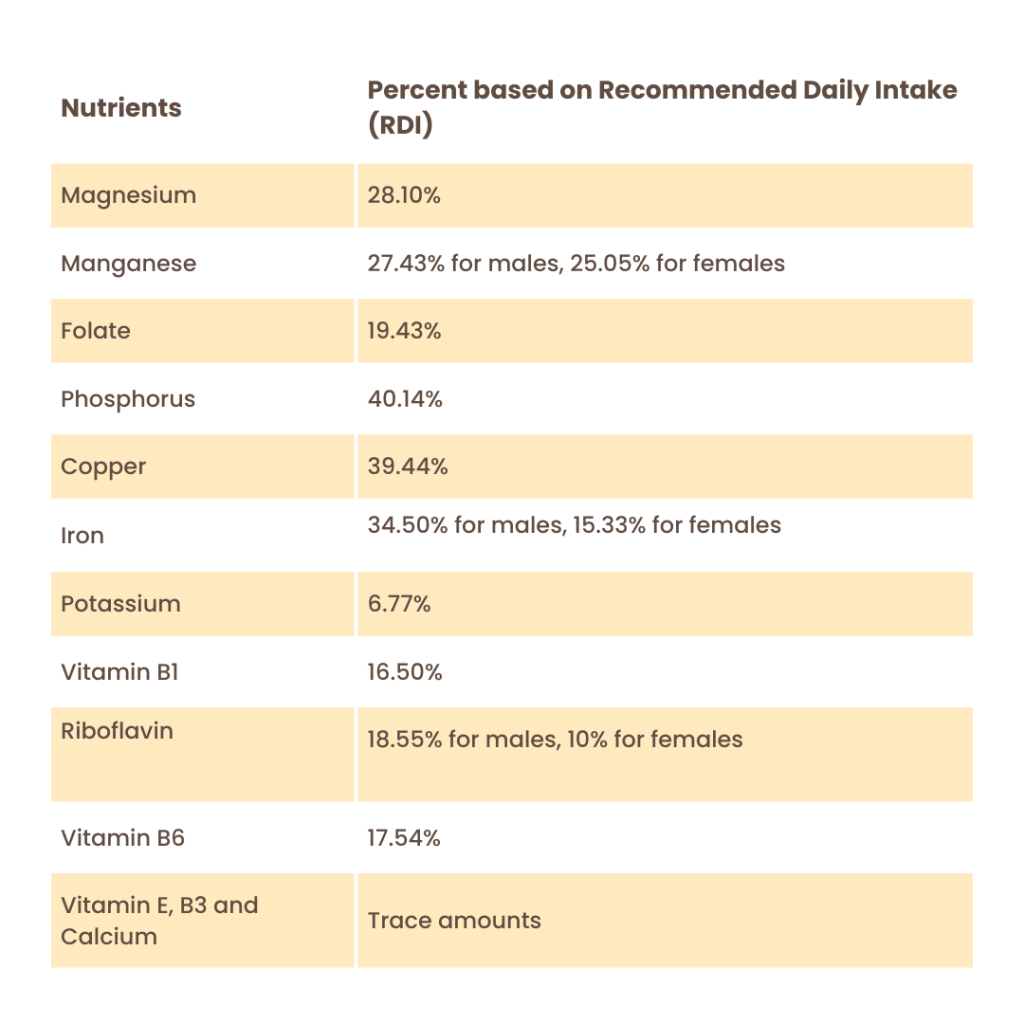
The same amount contains the following nutrients:
Quinoa is gluten free and loaded with antioxidants that fight free radicals in the body. It is a low-GI food which keeps you feeling full for longer and helps control your blood sugar level.
Kinds of Quinoa
There are more than 120 different types of quinoa. But what you’ll usually find in groceries are white, red and black quinoa. These are sold as whole grain, flakes and flour forms. Quinoa is also sold in tri-color.
Does color matter? Yes, but only in terms of flavor and texture.
White quinoa has a mild nutty flavor that does not overpower other ingredients in a recipe. It also has a lighter and fluffier texture and it cooks quicker than colored varieties.
Black quinoa is crunchier and has a sweeter and earthier taste. Red quinoa has a good bite and holds its shape better when cooked. It’s often used in salads.
Where to Buy Quinoa in Cebu
Quinoa can easily be found in major supermarkets in Cebu:
Ayala Metro Supermarket
Rustans Supermarket Fresh (also in Ayala Center Cebu)
SM City Supermarket
SM Seaside Supermarket
Landers
Healthy Options stocks a wider variety of quinoa products. You can find their stores here:
White Quinoa 600g – P479.75 (White Quinoa Price for 100g is P79.95)
Metro Supermarket
Vitalia Quinoa Seed 250g – P546 (Price for 100g is P218.4)
Arrowhead Mills Organic Quinoa 396g – P731 (Price for 100g is P184.59)
How to cook Quinoa
Cooking quinoa is similar to cooking rice or any other cereal grain. Most packaged quinoa has been rinsed (a.k.a. processed) and is ready to cook. The rinsing process gets rid of the bitter natural compound (saponin) that coats the dried seeds.
Here’s the quinoa recipe for perfect, fluffy goodness:
Place quinoa in a fine mesh sieve and rinse until the water runs clear. Drain well.
Add quinoa and liquid in a pot. Bring to boil.
Once boiling, reduce heat to maintain a gentle simmer. Cook until all liquid is absorbed (10-20minutes depending on how much you’re cooking).
Take the pot off the heat, cover, and let steam for 5 minutes.
Take the lid off and fluff the quinoa with a fork. Season to taste.
You know your quinoa is ready when those curly “tails” or the germ pop out from the seed.
Tip: Use twice as much liquid as the amount of quinoa (e.g. 1 cup quinoa + 2 cups water). To add more flavor, use low-sodium stock instead of water or add olive oil and salt to cooked quinoa.
Looking for chia seeds in Cebu? Check out our article
Hey, it’s Chenzi! A writer made in Cebu. Stringing words is my bread and butter, but baking and mothering my 3-year-old are what feed my soul. I have an insatiable thirst for learning.
Savvy travellers know that they should get a local SIM card in their destination country. Why? It’s often a cheaper option than paying roaming services for international calls and text.
It’s especially useful when you’re travelling in the Philippines, for a lot of good reasons. Having a Philippine SIM card lets you:
access the internet (public WiFi, or good WiFi access at a good price, is hard to come by in the country)
use GPS for finding your way around the city
keep your social media and email active
make international calls and texts (local rates are way cheaper than roaming fees)
transfer funds via online banking
Be aware that the internet here can be relatively slow compared to other SEA countries and is often limited in the country side. So you need a backup for your communication needs. If you booked a tour, your travel company will ask for a mobile number for sending your trip details. Many locals don’t have smartphones, so business is done mostly via text and calls.
Where to Buy a SIM Card in the Philippines
It’s ridiculously easy to get a Philippine SIM card. In most other countries, you’ll need to apply for a SIM. But, here in the Philippines, you can buy one literally anywhere – at airport kiosks, seaport counters, convenience stores, mini shops, street vendors or wherever there’s a Globe, Smart, TNT, TM and SUN advertisement banner.
It’s best to get one as soon as you arrive so you’re sorted right away. Make sure you have cash (local currency) on you because hardly anywhere takes card payments.
If you can find the Smart counter, you can get a free Tourist SIM upon arrival at any international airport.
Other prepaid SIM cards cost around P20 to P40. Most of them come in tri-cut form (standard, micro and nano sizes). You can specifically ask for an iPhone SIM or nano SIM if the .
You can buy a “load” for at least P10, but a 1GB data package is usually priced at Php50 (US$1).
Philippine SIM Cards to Choose From
There are two major mobile networks in the country: Globe Telecom and Smart. Each one has its own pros and cons. In terms of coverage, Globe offers better access than Smart particularly in Luzon and Mindanao.
Globe carries another network, Touch Mobile (TM). And Smart carries Talk n Text (TNT) and Sun Cellular.
There are prepaid SIM cards tailored for travellers:
Smart LTE Tourist SIM
This one’s FREE and preloaded with 300MB data (valid for 3 days upon activation). It works with any device – smartphones, feature phones, tablets, and pocket WiFis.
To claim one, just show your foreign passport at the Smart booth in the airport. You can ask the personnel to do the activation for you. It’ll be a quick 10 minutes.
Load at least P30 load within 3 days of activation to get an additional 700MB mobile data.
The SIM pack comes with iFlix and Uber voucher cards.
Globe TravelSurf
Available at Globe booths at the Cebu International and Domestic Terminal. Also in NAIA (T1, T3, T4), Clark International Airport, Kalibo International Airport, Caticlan Jetty Port, Francisco Bangoy International Airport (Davao), Iloilo International Airport and Laoag International Airport.
The SIM pack is free but you need to purchase load to avail of a mobile data plan. To do that, text any of the codes below to 8888:
Travel3 (P150) – 250MB valid for 3 days
Travel7 (P500) – 1GB + P200 credit valid for 7 days
Travel30 (P10000) – 5GB valid for 3 days
You’ll get a text confirmation shortly.
Alternatively, you can buy a Traveler SIM for P40, which gives you FREE 35 SMS to all networks. For more credit, buy a load in denominations of P100, P300, and P500.
It’s ready to use (no activation required). Valid for three (3) months but can be extended if topped up within the validity period.
The Globe Traveler SIM lets you make calls abroad for as low as US$0.40/minute and access 4G LTE speed up to 42 Mbps.
Other than being free, a traveler/tourist SIM is not much different from a regular prepaid SIM. You could even get better data plans with a regular SIM.
On that note, it’s recommended to choose an LTE SIM so you can access 4G connections wherever available
How to use your Philippine SIM card
Most prepaid SIM cards don’t require activation, so you can use them right away.
Choose a Regular, Micro or Nano SIM
To top up, you can either buy a prepaid load card or buy electronic load (e-load) online or from merchants.
Load card denominations are P100, P300 and P500. Via online stores, you can buy P50, P100, P200, P300 or P500 worth of credit. From retailers (convenience stores, sari-sari stores, etc.), you can load at least P20.
Standard Text, Call and Surf Rates
Below is a quick comparison of regular rates for Globe, Smart, Sun Cellular and Touch Mobile networks. Obviously, Smart and Globe favors their subsidiary brands. You’ll see why they have better promos with carriers on their respective networks.
Tip: To get the most bang for your buck, take advantage of promos or data plans. There’s one for every budget and data needs. And you can continuously register for promos after using up your MB data allocation.
Surfing Promos for Smart:
GigaSurf offers the best data bundle, while All-Out Surf gives you credit for sending texts and making calls.
Dial *121# to choose a Smart promo.
Surfing Promos for Globe:
Below are data packages for Globe users. GoSURF is good for tourists who casually browse the internet and make lots of calls. Meanwhile, SuperSURF works best for heavy data users.
Dial *143# to choose among other Globe promos.
Surfing Promos for Sun:
SunCellular prepaid subscribers enjoy lower rates for all services. Still, you can squeeze out more value for your dollar by subscribing to their Non-Stop Surf plans:
To avail, text the code to 247:
Surfing Promos for TM:
TM also offers generous promos for data and call/text bundles. These include:
Download Speed and Availability
Every SIM performs differently depending on location, among other factors.
As mentioned, Globe has better geographical coverage than Smart, making it the default choice for tourists. It pays to research or ask your local friends (even the tour company) which provider is preferable in your destination. There are places that only Globe can reach and there are some that only Smart can reach.
However, if you’re confident that Smart has a good coverage in your destination, then go with that. Smart provides faster download speeds on LTE connections.
Another factor than can affect SIM performance is the weather. Globe usually suffers a significant dip in signal strength when it’s raining.
Both Smart and Globe has a daily data cap of 800MB, regardless of the data allocation for the promo.
If you know what SIM your friends are using in the Philippines, it’s best to get the same one as theirs. This lets you save on your balance whenever you send regular texts or calls.
We only discussed prepaid options here because a postpaid SIM is much harder to get. You’ll need all sorts of documents to apply for one. A prepaid SIM is much cheaper anyway. And it gives you more control over your communication expenses.
Tip: Spend layovers at coffee shops, coworking spaces, restaurants or travellers’ lounges. They offer Wi-Fi for free so you can switch off your mobile data and save it for the road.
Hey, it’s Chenzi! A writer made in Cebu. Stringing words is my bread and butter, but baking and mothering my 3-year-old are what feed my soul. I have an insatiable thirst for learning.
Now that the New Year festivities are over, life goes back to routine for most people. For Cebuanos, though, the turning of a new calendar signals the countdown to the grandest and most popular festival – Sinulog.
The Sinulog Festival is a religious and cultural festival held on the third Sunday of January in Cebu City. Other cities in the country have their own festival in honor of the Santo Niño (Child Jesus), but Cebu’s version is iconic for its vibrant street dance and epic night parties. It’s a major attraction that draws around 1 to 2 million pilgrims and tourists each year.
History of Sinulog
The word “sinulog” describes the prayer-dance that imitates the movement of the water current (sulog).It consists of two steps forward and one step back, danced to the beat of drums. There are two conflicting stories about its origin.
Historians say that the natives of Zebu (now Cebu) have been performing the Sinulog as a ritual before their wooden idols since time immemorial.
Then things took a turn when Portuguese conquistador Ferdinand Magellan came and introduced Christianity in 1521. He presented an image of the Santo Niño as a baptismal gift to Hara Amihan, the queen of then-ruler Rajah Humabon. The newly baptised royalties were later named the first Juana and Carlos. Some 800 natives were also converted to the Roman Catholic faith. Thereafter, Sinulog morphed into a dance which the natives did in reverence to the Santo Niño.
Legend tells a more interesting story though. It is said that Baladhay, the adviser to the Rajah, once lay ill within sight of the Child Jesus. But he was healed and filled with vigor just a few days later, explaining that a small child (pointing to the Santo Niño) had tickled him awake. He said that in his trance, he danced the Sinulog steps (for the first time) to try to scare away the mischievous child. The image was believed to be miraculous and the people (quite literally) followed Baladhay’s steps.
Whether or not it was Baladhay who invented the dance is unclear.
Anyhow, Magellan’s expedition ended shortly when he tried to conquer the neighboring Mactan Island. His reckless quest resulted in his demise in the hands of Rajah Lapu-lapu. Then it took over 40 years for a new group of Spanish explorers to come back and continue the Christianization of the islands.
Miguel Lopez de Legazpi and his ships bombarded the local villages, and in one of the burning huts, one of his soldiers discovered the image of the Santo Niño safely kept in a wooden box. The Augustinian friars who accompanied the expedition built a church on the site where the image was found. The church was named San Agustin Church, now more aptly called the Basilica Minore del Santo Niño.
In essence, Sinulog has become a symbol of the Filipino’s acceptance of Christianity. Candle vendors at the Basilica Minore del Santo Niño would dance the ritual while making offerings to the consecrated image. Small children dressed in moro-moro costumes also dance the Sinulog during the Santo Niño fiesta, which falls on the third Sunday of January.
It was really nothing huge until the year 1980. David Odilao Jr., then Regional Director of the Ministry of Sports and Youth Development (MYSD), organized the first ever Sinulog parade. He invited seven schools and universities to perform a street demonstration depicting the transition from the country’s pagan past to its Catholic present.
The spectacle caught the imagination of Cebuanos. To formalize the event, the city government turned over the Sinulog project to the Cebu City Historical Committee. The Sinulog Organization was born and the start of a new era began.
In the following year, seven floats were created to depict the different periods of Cebu’s Christian history. Sinulog dancers wore costumes reflecting the float they followed. The Festival Queen (the lead dancer) held an image of Santo Niño in her arms while dancing the Sinulog, in imitation of Queen Juana blessing her people.
The committee upgraded the festival each year to invite wider participation from private, commercial and industrial sectors. They would include new features like art exhibits, beauty pageants, singing contests, photo contests, float making contests, fluvial contests, short film festivals, fun runs, and street fairs. Even the Sinulog music evolved from the traditional drum beat to techno funky beat to capture younger participants.
With so many goings-on, Cebu’sSinulog Festival has become a month-long celebration, with the much-anticipated Sinulog Grand Parade held on the day of the feast.
In 2006, the festival was broadcast live on TV and streamed online for all the world to see. And it’s become bigger and better since. It’s given Cebuanos a shared passion, a collective identity, and a culture. In fact, the word Sinulog and its logo are now patented and trademarked – the very first granted to a festival
Sinulog Activities
Sinulog properly kicks off more than a week before the third Sunday of January. The devotees first do a penitential walk to the Basilica, and thereafter hold novena masses in Cebu’s churches for nine consecutive days. A sprinkling of activities happens alongside these masses – all sorts of contests, pageants and mall events.
Then the following activities take place in quick succession prior to the grand festival:
Thursday: Traslacion – The Santo Niño and an image of Our Lady of Guadalupe make their way from the Basilica to the Shrine of Saint Joseph in Mandaue City.
Friday: Fluvial parade – The fluvial procession which bears the Santo Niño starts from Ouano Wharf going to Lapu-lapu island, then back to Cebu and the Basilica.
Saturday: Solemn procession – The procession circles Cebu’s main thoroughfares, starting and ending at the Basilica. Devotees light candles and carry their own image of the Santo Niño while dancing the Sinulog – some join to seek favour for wishes while others do so in gratitude for answered prayers.
On Sunday, the Grand Parade starts early and inches its way down a 4-mile stretch. The Mardi Gras-like spectacle culminates in a grand event at the Cebu City Sports Complex, where the street dance troupes compete for over a million pesos in prizes. Mind you, these dance troupes are the cream of the crop – they come from all over the Philippines dressed in their most intricately designed costumes.
During the parade, the dancers sway to the Sinulog theme song on repeat while shouting “Pit Senyor!”
While some people march along with the parade, many would set up tables by the street sides to hang out and drink.
When night falls, the city comes alive with club parties and shindigs at different locations. The most notable are Sinulog Invasion and LifeDance Cebu, an EDM dance party very much like Coachella. Non-party goers walk their way to malls and plazas for some tasty grubs at food stalls while waiting for the grand fireworks display at midnight.
The Sinulog Festival officially ends a few days after the Grand Parade with a mass called the “Hubo,” the Visayan term for undressing. During the mass, the Santo Niño is ritually undressed, bathed in perfumed water, dressed and put back into its niche.
Sinulog can be overwhelming for first-timers, so you need a few survival tips for the best and safest experience.
Sinulog 2020: “Señor Santo Niño – Cause of our Unity and Charity”
Sinulog is just around the corner. On January 19th, Metro Cebu will once again host the breathtaking and kaleidoscopic religious/cultural display billed as the most captivating festival of the Philippines.
With pulsating tribal beats, out-of-this-world garbs, entrancing chants and fever-pitch energy, you’re in for a sensory overload.
The city is already buzzing with anticipation for the Sinulog activities. There are nightly activities at Plaza Independencia and Fuente Circle, and trade fairs at Osmeña Blvd where you can buy your Sinulog merchandise.
It’s customary for tourists and locals to wear Sinulog shirts – you can have it cut and braided at the sleeves and seams for a more festive look. Face painting, henna tattoos, and other festival accessories are available on site during the grand parade.
Here are some of the highlight events you might want to catch:
January 17: Search for Sinulog Festival Queen.
January 18: Fluvial parade. At dawn, more or less a hundred boats bedecked with red and yellow flowers sail alongside the Spanish galleon-like watercraft carrying the Child Christ. It is a tradition kept alive by faithful attendees. Devotees cheer whenever their boat gets near the float of Santo Niño as it’s considered a blessing. Spectators waiting at the bridge shower the boats with flower petals when they pass. It’s quite a feast to the eyes.
At 7:00 p.m., the Battle of the Best Pyro Competition (Fireworks Display) happens at SM City Cebu.
At 8:30 p.m., you can catch the Sugbuanong Musika Grand Finals at Fuente Osmeña Circle or the IPI Night at Plaza Independencia.
January 19: Sinulog Mardi Gras and Grandstand Competition
January 13-19: Fiesta at the Park 2020 (Cebu Business Park)
January 17-19: Cebu Puso, One Globe Sinulog Fair
Most tourists are expected to pour in a day or two before the main celebration. The city will be in a frenzy on the Sinulog weekend, so visitors are advised to book their flights ahead of time.
Here’s how the day of the feast will go:
4:00 a.m. – Mañanita Mass at the Basilica
6:00 a.m. – Pontifical Mass at the Basilica
6:30 a.m. – Holy Mass at Cebu City Sports Center
9:00 a.m. – Sinulog 2020 Grand Parade Kick Off at Cebu City Sports Center
5:00 p.m. – Sinulog 2020 Grand Finale at Cebu City Sports Center
7:00 p.m. – Wonju Dynamic Dancing Carnival (Korean Cultural Dance) at Plaza Independencia
7:00 p.m. – Pyro Musical Show at SM City Cebu
8:00 p.m – Extraordinary Pyro Magic in the Sky at SM Seaside City Cebu
9:00 p.m. – Festival of Lights – Grand Fireworks Display at Cebu Business Park
Important tip: Stay at a hotel near the procession route. Accommodation around Fuente Circle, Ayala, SM, Lahug sell out fast because they offer the easiest access to the main celebration. These areas also serve as venues for other pre-Sinulog activities. Since the roads around the procession route will be blocked for the solemn procession and the parade, it’s impossible to get a taxi to drop you off where the action is.
If you’re planning to see the grandstand competition among the 26 Sinulog dance troupes, you’ll need to buy a ticket from the Sinulog Foundation Inc. office at the Cebu City Sports Complex (CCSC). This year, they’ll be using wristband tickets with QR codes to counter the selling of forged tickets by unauthorised persons and for security reasons as well.
There’s no info yet as to the prices, but the tickets usually cost from Php 1,000 to Php 3,000.
Sinulog 2020 survival tips
It takes more than enthusiasm to survive the grandest revelry that’s about to unfold. Here are some mental and physical preparations for a fun and safe Sinulog Mardi Gras experience:
Wear breezy clothing… but not too skimpy so you don’t get sunburn and indecent stares. You’ll be in a huge crowd under the scorching sun – for hours! Wear a pair of trusty shoes because there’ll be endless walking. And, of course, don’t forget your sunscreen!
Bring a portable fan or a hat – They’re a lifesaver! The weather can be unpredictable – a raincoat or umbrella may come in handy.
Stay hydrated – Best to bring your own bottle of water. There will be lots of vendors selling drinks and snacks, but the prices are often jacked up.
Follow the crowd… if you don’t know where you’re going. Walk alongside groups so you don’t invite unwanted company.
Keep calm and cool. Expect long lines, constant pushing, rowdy crowds, and paint/beer showers – it’s all part of the game. Just enjoy and keep the festive spirit.
Mind your pocket – Pickpockets and bad elements are rampant during this opportune time, so don’t let your guard down. Better to bring a small amount of cash and your camera/phone, and leave other valuables at the hotel.
No backpacks allowed. Those who wish to go inside the Basilica Minore del Santo Niño Church must observe the Clear Bag Policy. While it may be inconvenient, the policy is meant to pre-empt any bombing or terrorism threats. The general public is advised not to carry prohibited bags to prevent delays caused by having people go through security checks.
Have a backup communication plan. Unlike in previous years, there will be NO SIGNAL SHUTDOWN during Sinulog 2020. The city will be deploying 1,600 police personnel all over Cebu for tighter security. However, they will prompt a signal jam should they encounter any suspicious persons or items.
That means your phone might still lose network signal any time. If you’re meeting with friends on the day of the parade, agree on a meeting place and stick to it. Take screenshots of maps and landmarks on your phone as well. Or, get together the night before so you won’t lose your way finding one another in the crowd.
Last year, the FireChat app was a hit because it allowed users to bypass the signal jam. Have you and your friends download it so you can keep your communication lines open.
Drink moderately – It’s easy to get carried away by the frenetic mood, but it’s best to drink within your limit. Also, keep in mind that there’s a liquor ban within the 300-meter radius from the Sinulog area.
Make friends – Sinulog is best enjoyed in the company of friends – both old and new. People are in their best mood and are much more open to partying with strangers during the event. Going with a group not only means twice the fun but also having someone who will watch your back.
Hey, it’s Chenzi! A writer made in Cebu. Stringing words is my bread and butter, but baking and mothering my 3-year-old are what feed my soul. I have an insatiable thirst for learning.