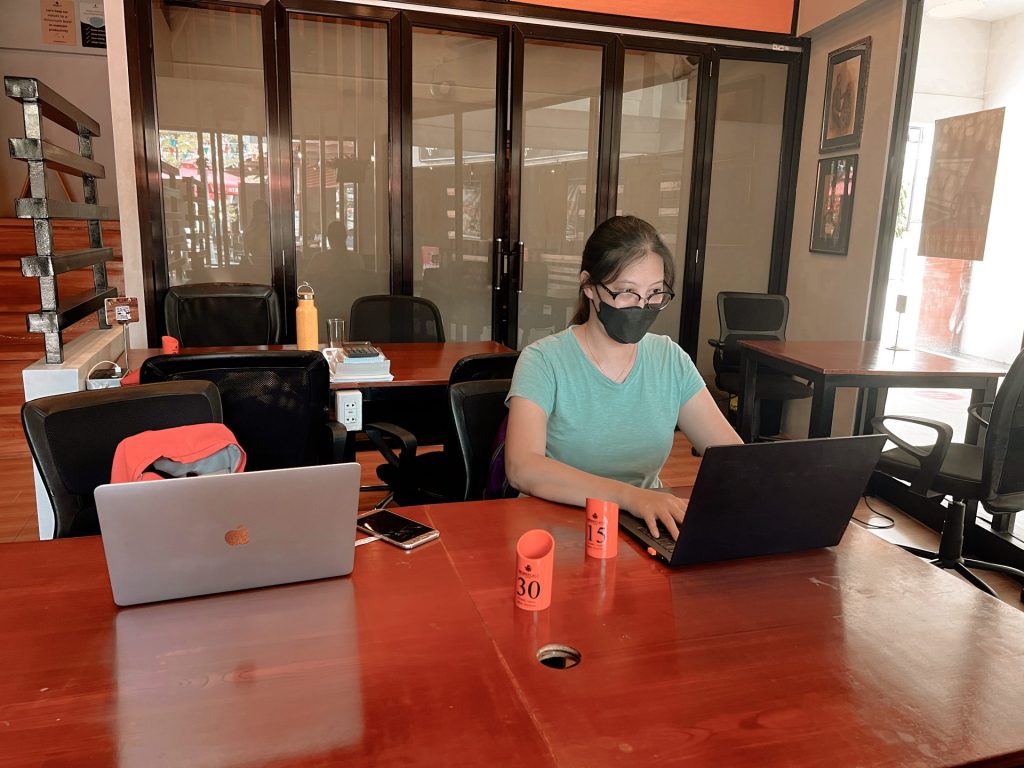
Workplace Cafe Mactan is one of Cebu’s welcome additions to the coworking scene, offering sensible amenities and above-average service.
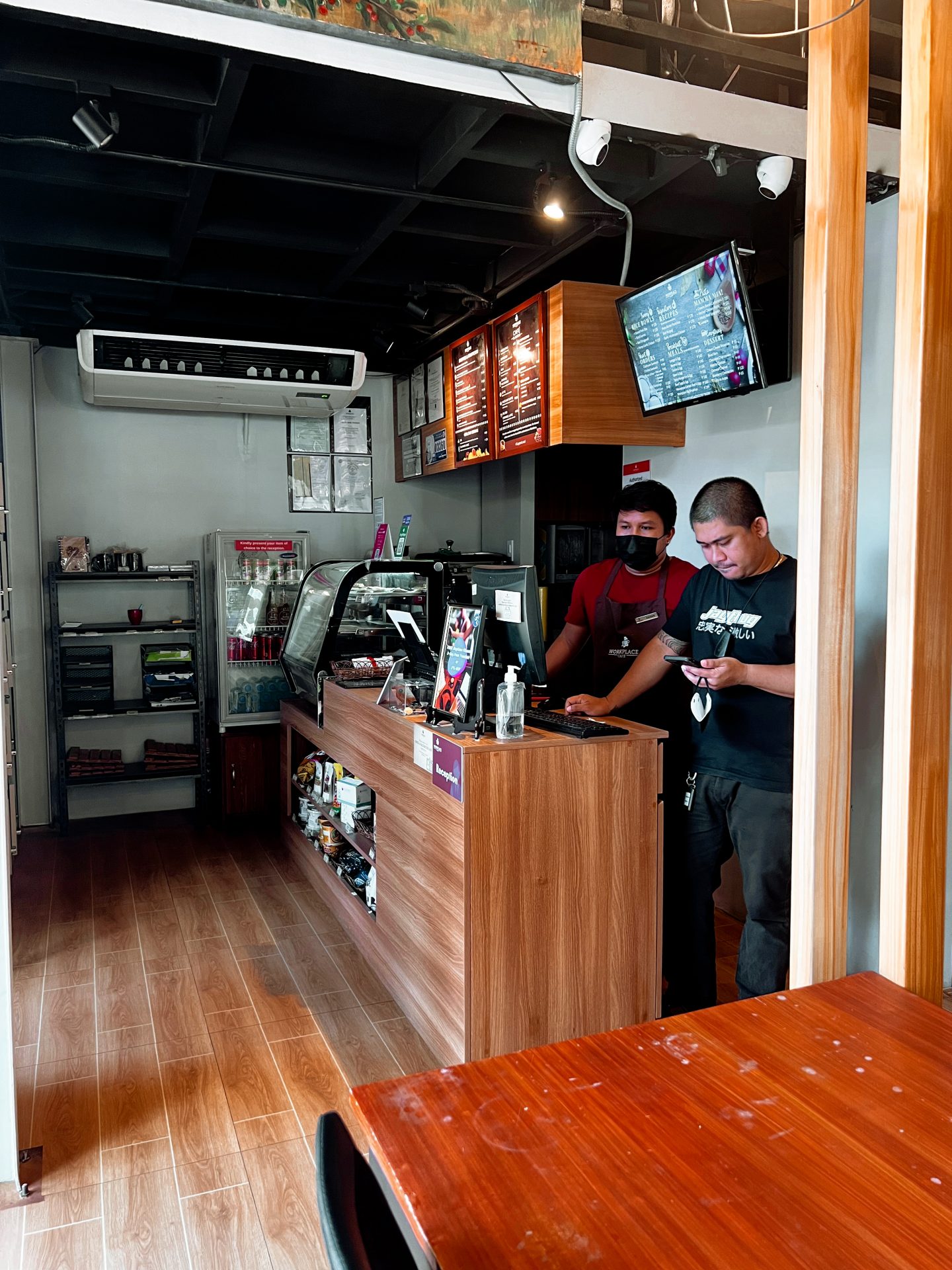
Upon arrival at this shared workspace, the friendly staff greets you, but you most probably will be immediately distracted by the delectable pastries displayed next to the counter.
When we were there, the staff ensured we were comfortable and had what we needed for productive work – from an Internet connection to comfortable seats.
Pueblo Verde, Mactan’s exciting lifestyle destination, makes a perfect backdrop for the thoughtfully designed coworking space. You can find the Workplace Cafe Mactan at Unit 7 Bldg. C, The Outlets at Pueblo Verde, Lapu-Lapu City.
What is Workplace Cafe Mactan’s Opening Hours & Rates?
Like their other branches, The Workplace Cafe Mandaue, Ramos, and Banawa, the Workplace Cafe Mactan branch are open 24/7.
The Workplace Cafe Mactan offers hourly, day pass, weekly and monthly rates.
All rates include complimentary beverages of your choice, such as brewed coffee or iced tea. Aside from cash, they also accept other modes of payments like Gcash, PayMaya, and credit or debit cards.
Are there authentic vegetarian restaurants in Cebu?
As many of us have become more health-conscious in recent years, food has been an important topic. Especially vegetarian food has gotten lots of love recently. It’s no secret that most meat-based dishes aren’t exactly high quality—and that’s not even considering if the meat itself is healthy.
Changing to a plant-based diet can help reduce the environmental impact of your eating habits, which is why many people are turning to veganism. According to research conducted at Oxford University, eliminating animal products from one’s diet is the “single biggest way” to reduce one’s carbon footprint drastically.
So, how about it then? Where can you find vegetarian food in Cebu?
We love vegetarian food. That’s why we’re starting to collect places in Cebu where you have a decent selection of vegetarian or vegan food.
Why? Because, by and large, Cebu is a dream for meat lovers. You’ll find your treat from Korean BBQ and steak to local delicacies such as sisig or lechon.
But it’s a bit more complicated if you’re vegetarian. In fact, a couple of years ago, that might have been a real challenge.
Not anymore!
Vegetarian food is invading the menus in Cebu. Slowly but surely, you’ve got choices. Still, it’s not everywhere. As so often in Cebu, you kind of… need to know.
And since we enjoy vegetarian food ourselves—and have plenty of friends who do—we collect food places for you.
To be included in our list, offering a side of mashed potatoes or sour cream fries is not enough. It’s also not enough if you can ask the kitchen to prepare the salami pizza without the salami. Yes, no salami.
You know you’re in the right place when you can’t decide what to eat when a bunch of yummy things fights to be chosen.
As usual, we’re opinionated in what we add. However, if you think we can improve the list, please let us know at hellodiscoveringcebu@gmail.com.
Let’s discover all the vegetarian food in Cebu!
Check out the map of vegetarian restaurants in Cebu below. A few of them are even exclusively vegan. We hope you find your future favorite food spot through this post. Read on to see a list of vegetarian restaurants in Cebu.
Disclaimer: No affiliations. Opinions and selections are our own. Mistakes happen. Incomplete by nature. Reach out for updates: hellodiscoveringcebu@gmail.com.
Where Else Can I Find Vegetarian Restaurants in Cebu?
We’re not the only ones collecting vegetarian and vegan food places. And since our goal is to be helpful to you, we’re listing our “competition” here. :]
Let us know if you know of other maintained & informative pages!
There are ATM withdrawal limits in Cebu. So, where can you withdraw bigger amounts and save fees? Find out here.
When you go around the Philippines, you need cash. And you should get it in the bigger places, like Cebu: On smaller islands, there may not even be an ATM. Credit cards? Abandon all hope.
Here is the catch: most ATMs enforce a limit of ₱10,000 ($191) per withdrawal using a foreign card, and then slap a ₱250 ($4.80) fee on top. So, where can you withdraw bigger amounts and save fees?
Bank with the highest ATM withdrawal limit
The winner:
UCPB maximum ATM withdrawal with ₱40k ($765)
The ATM withdrawal limit is ₱40k ($765), with a fee of ₱250.
Coworking spaces in Cebu were flourishing in 2019, with new spaces popping up every other month. Then COVID-19 came along and devastated the coworking space scene of Metro Cebu. Fast forward to 2022: with vaccination rates going up and lockdowns being less strict, spaces have opened up again, but we’re still nowhere near 2019 levels.
What Are Coworking Spaces?
Over the last ten years, an exciting new trend has emerged. We’re referring to coworking spaces where employees from various companies gather to get work done.
The concept of coworking is based on renting space and then renting it out at a profit. In the coworking model, companies:
Rent buildings from property owners on long-term, multi-year leases
Renovate the facility by adding communal spaces, coffee shops, and other community-oriented features
Rent out the space to tenants at significantly higher prices and on more flexible rental agreements.
Startups, freelancers, digital nomads, and other independent or creative workers who cannot afford their office space are typical examples of these tenants.
Coworking spaces provide more than just a place to get work done; they also foster a network of like-minded entrepreneurs. Overall, coworking is an innovative new form of organization and business model that brings together entrepreneurs in a single space to create solutions to problems that can’t be solved anywhere else.
We miss rubbing elbows with hardworking, inspiring human beings. And you probably do, too. So here are a few updates on the surviving coworking spaces in Cebu. Watch this space as we are updating it whenever we find out relevant information about Cebu’s coworking scene. We also made a map of coworking spaces in Cebu and you can find it if you scroll down to the end of this article. Other information you can find on this page:
Opening hours
Hourly, daily, and monthly rates
Covid restrictions
And more.
How to Choose a Coworking Space in Cebu
Apart from location, here are some quick recommendations according to our personal preferences. Find the full list of coworking spaces in Cebu and our reviews of them below.
Ground Floor, Building 4, JDN Square, P.Remedio St, Mandaue City
₱400/day
The Best Coworking Spaces in Cebu
Now that you know our personal favorites, we want to play fair and include the others that did not make it to our list. For now. Opinions change, right? So, below are some of the best coworking spaces in Cebu based on Google ratings and reviews. We also added links to our personal reviews of each coworking space.
ACX has lots of sunlight and very affordable prices, including hourly billing. It’s still new and that means it’s currently much less crowded than The Workplace Cafe Mandaue, which is located in the same building.
Desko is one of the bigger coworking spaces near Mango Square and Fuente Osmena circle in Cebu City. You’ll love that it’s always open, 24/7 all year. Students enjoy this space in particular because it features hourly billing and affordable food choices.
G/F Cityscape Tower, Juana Osmena St.
6. The Company IT Park
Most people we ask consider The Company IT Park the best space for professionals: Healthy mix of coworkers, regular events and staff that tries to push the community forward.
Opening Hours for the hot-seat area:
Mon-Fri 9:00am -7:00pm
The Company IT Park is located on the 15th floor of HM Tower in IT Park.
7. The Company Mandaue
The best coworking space for video calls: great internet, not crowded, quiet, has phone booths. Lacking sunlight.
Opening Hours for the hot-seat area:
Mon-Fri 9:00am – 7:00pm)
Located near the Oakridge Business Park on AS Fortuna, Mandaue.
8. The Mezzanine Cafe
The Mezzanine Cafe a café that’s also a coworking space: They don’t charge for the seat, but you do need to buy food or a beverage. The space is split between the cafe part with music and the quiet study part. The biggest downside is that with those amazing offerings, the place gets packed and the internet suffers quite a bit.
Opening Hours:
Mon-Sat 9:00 am – 6:00 pm
Mezzanine is located in Ramos, near Fuente Osmena.
9. The Workplace Cafe Banawa
The Workplace Cafe Banawa offers the usual goodies of a The Workplace Cafe branch: decent chairs, a food menu, call cubicles amongst others. Unlike the other to branches, Banawa feels more spacious—we like it best of the three.
Opening Hours:
Mon – Sun: 8:00 am – 12:00 midnight
Located next to the 1st AutoGas station in Banawa, Guadalupe.
10. The Workplace Cafe Mandaue
The Workplace Cafe Banawa offers the usual goodies of a The Workplace Cafe branch: decent chairs, a food menu, call cubicles amongst others. It’s the branch with the most sunlight, which we love.
Workplace Cafe Mactan is one of Cebu’s welcome additions to the coworking scene, offering sensible amenities and above-average service.
Pueblo Verde, Mactan’s exciting lifestyle destination, makes a perfect backdrop for the thoughtfully designed coworking space. You can find the Workplace Cafe Mactan at Unit 7 Bldg. C, The Outlets at Pueblo Verde, Lapu-Lapu City.
Worklab features cubicles and table seats and a good atmosphere for working. The chairs aren’t too comfortable, but internet is fast.
Opening Hours: 24/7 (it’s always open)
Located near the Talamban campus of University of San Carlos.
Who else writes about coworking spaces in Cebu?
We want this page to be useful for you. We’re most useful when we admit that we can’t do everything and point you in the right direction.
Here are sites that discuss or list coworking spaces in Cebu, sorted by the last update, so you get the most recent content first. Let us know if you know of others that we should add.
Gie is a Filipino digital nomad, blogger and online marketer, and her post on cafés and coworking in Cebu is a great resource. You’ll love the way she writes and how she sets an example for other Filipinos. (Note that currently, Sep 2019, a few places she mentions no longer exist, but we’re letting her know, so maybe that updates soon.)
We’re not affiliated with nay of the places listed here, but we do like some places better than others. Our opinions about places are just that: opinions. Not everyone
We’re not affiliated with nay of the places listed here, but we do like some places better than others. Our opinions about places are just that: opinions. Not everyone agrees with our views, and that’s good: there is a coworking space for every taste.
We try to give you accurate and complete information, but we make mistakes and things change without us noticing. Did you spot a mistake? That’s great! Please tell us at hellodiscoveringcebu@gmail.com or on Facebook or Instagram.
This fully – equipped and IT-enabled workplace is an asset for any business, whether run by a single person or a large team. To better meet your needs, they offer flexible lease terms and zero downtime during the move-in process.
Coworking Spaces
Avant Offices coworking spaces are collaborative spaces where freelancers, digital nomads, and entrepreneurs can choose between open seating and assigned desks. In a coworking space, you can enjoy the perks of an office without the associated overhead costs. Try it for a day to make sure it’s conducive to your working style.
Virtual Office
Gain exposure for your new company by setting up a virtual office. Ensure your customers know where to locate you and create the proper impression by using a prestigious business address. Use your business address to send and receive mail.
What’s New in Avant Offices Coworking Space in Cebu
Due to the pandemic, they only cater to monthly subscriptions.
Avant Offices in Avenir Building near IT Park ( not yet reviewed).
In today’s environment of fast-fashion and mechanical looms that can spit out hundreds of meters of fabric each day, hand-loom weaving provides a refreshing and sustainable contrast. Many people are becoming more conscious of the inhumane labor practices and lack of sustainability in the fast-fashion industry. This has caused some fashion brands to begin searching for alternatives. Traditional indigenous Philippine textiles are gaining popularity across the world because of the striking, colorful designs. This has the added benefit of preserving Filipino heritage and weaving techniques through sustainable fabric production.
Textile design in the Philippines has a rich history rooted in connection with both the spiritual realm and the earthly community. Indigenous tribes in the Philippines each have their own traditional patterns and motifs incorporated into their weaving that have meaning to the communities they were created by. The symbolism in each of these patterns is important to understand before using these traditional fabrics.
This is why we researched a few of those patterns and introduce them below, together with companies who are working to keep the tradition and craft alive. You can do your part by spreading the word and by shopping responsibly.
Binakul is a weaving pattern common to Abra and the Ilocos region in northern Luzon. This pattern is created on a pedal frame loom by interlocking two shades of thread – usually white and a darker color – to create various sizes of rectangles. These rectangles are arranged in a repeating pattern across the fabric so that they create an optical illusion of waves, swirls, or circles.
This pattern is meant to ward off evil spirits by causing them to become dizzy and confused. Binakul was commonly used in blankets to protect people from spirits while sleeping.
Matmata pattern
The matmata pattern consists of diamonds, often with double lines, and is sometimes referred to as “eyes of the ancestors.” This design is common among the Bontoc people in northern Luzon. The matmata is a pattern treated with respect as it is meant to help guide someone who has passed away into the afterlife.
This pattern is most often used in burial blankets and clothing worn by the deceased. It is often combined with other patterns, such as the tiktiko triangle or X-shaped pattern, to convey further meaning. When used together, these two patterns indicate abundance and reverence for the deceased.
Bunga sama pattern
Bunga sama is a complex pattern used by the Yakan tribe in the Sulu Archipelago. The Yakans are known for their intricate, geometric textiles incorporating bright colors. The bunga sama in particular incorporates detailed diamond motifs – which are meant to resemble the skin of a python.
As with many of the colorful designs created by the Yakan, the bunga sama design was most often traditionally made into clothing. However, these days this design is commonly found in accessories and home décor items such as table runners and placemats.
Palipattang pattern
The palipattang pattern is another colorful design from the Yakan tribe. This pattern consists of multicolored stripes, often with intricate, smaller designs woven into the stripes. Palipattang is a thread-based representation of a rainbow.
Traditionally, this pattern was used to make the narrow-fitting trousers worn by the Yakan people. However, as with the bunga sama, it is now often sold in the form of placemats, wall hangings, and table runners.
Binituwon pattern
One of the most recognizable patterns is the binituwon – the star symbol used by the Ifugaos from northern Luzon. Stars are thought to be the children of the sun and moon and are regarded with respect. The binituwon symbolizes fertility and abundance, so in many cases women wear belts incorporating the symbol to help them have a child.
Baniya/Bayawak pattern
Another pattern used in traditional weaving from the Ifugao tribe is the bayawak or baniya. This pattern is a literal representation of a lizard that symbolizes the god who came to earth in the form of a lizard to teach the Ifugaos how to irrigate their crops. It also can represent wealth and prestige and is often worn by those who are regarded as elite within the community.
Tinaggu pattern
The tinaggu pattern is also one that takes the form of a more literal interpretation – it is in the shape of a human figure. When incorporated into textiles, this pattern represents the ancestors of the Ifugaos who have moved into the afterlife and become deities or demigods. Blankets and clothing made with fabric incorporating a tinaggu design element are thought to bring protection from the ancestors.
This small snapshot of traditional Philippine indigenous patterns illustrates the deep meaning and connection these patterns create within the communities they come from. That’s why it’s so important to preserve cultural heritage of weaving and the traditional techniques used to create these textiles. Handwoven fabrics can’t compete with machine-woven fabrics on a scale basis, but they can compete on sustainability, originality, and artistry. Because of the demands of customers, the fashion industry is finally starting to turn towards a more environmentally friendly model that offers fair pay to artisans along every step of the process. This may provide an opportunity for indigenous Filipino weavers to market their work and maintain these traditional techniques and patterns.
Ethically Sourcing Handwoven Philippine Fabrics
Supporting local Filipino artisans helps to keep traditional weaving techniques alive while providing a livelihood for the weavers. However, it is important to make sure that communities producing these textiles are compensated fairly.
ANTHILL
ANTHILL, which is an ethical, sustainability-focused company based in Cebu City, works with weavers across the Philippines to showcase and sell their handwoven fabrics.
Habi Textile Council
Another great place to support local artisans is at the yearly Likhang Habi Market Fair put on by Habi: The Philippine Textile Council, where you can watch lectures and demonstrations on traditional weaving techniques and weavers can sell their textiles. They are a great source for learning about Philippine indigenous textiles and have a lot of great information on their website.
ACX Outsourcing Hub is a small and affordable coworking space near Park Mall in Mandaue. Apart from the good pricing, we enjoy that the space is flooded by indirect sunlight and that it’s not crowded.
Facilities are great for the price: Wifi is fast and stable. Electric outlets are available and not just Type A. Chairs are comfortable—but not height adjustable. The CR (rest room) is good.
The atmosphere is pleasant, due to sunlight and decent interiors. We felt it’s also good for focusing because it’s small and currently (Oct 2019) not crowded. The staff is helpful and friendly.
Tip: Right below ACX is The Coffee LAB, a specialty coffee shop. While they have coffee from all over the world, they farm their own coffee in Bukidnon, Mindanao, and roast it in Cebu (though not in their Jamestown outlet). Recommended!
We last visited ACX Outsourcing HUB in October 2019.
What are ACX Outsourcing Hub Promos & Latest Updates
Prices, Hours & Wifi
Rates per hour/conference room
This is how much ACX charges for a seat:
Coworking space/study area
Hourly rate: ₱30
Maximum of 4hrs: ₱100/pax
Maximum of 8hrs: ₱150/pax
Opening Hours
ACX Outsourcing Hub’s opening hours cater to students and professionals with clients in US timezones alike:
Wifi & Internet
Wifi was fast and stable. We had no problem with video calls.
Note that the space was almost empty when we tried. We’ll have to look again when it is full.
How to Contact ACX Outsourcing Hub
Want to make sure a seat’s available? Give ACX Outsourcing Hub Cebu a call:
+63 (032) 345 8138
Apart from their phone number, they can also be reached on their Facebook page: www.facebook.com/acxhub/
Where can you find the best motorcycle rental in Cebu? Read our list of agencies, their prices, and contact information here.
Nothing lets you enjoy Cebu City and the island more than having your own transportation. The freedom to go where and when you want is gold. And especially in the city, a motorcycle beats a car by miles, allowing you to wiggle yourself through bumper-to-bumper traffic. To help you out, we’re listing places we found where you can rent a motorcycle or scooter in Cebu.
We have not tried any of these services, so we can’t recommend any.
Note: Some ask to leave your passport as deposit. That sounds like a bad idea, right?
Address: 165 4th street, Espina Village B. Rodriguez street, Cebu City.
Contact Number: 0915 983 1533
They offer free delivery and pick-up.
Requirements
Rent Motor Cebu
Passport as deposit
Or photocopy of passport and cash bond 8000-10000 or any other currencies
Photocopy of company ID with any other ID as deposit for foreigners who are living/working in Philippines
For Locals (Filipino Resident)
Present government ID and company ID or two (2) government IDs. One government ID will serve as deposit. No cash deposit
Note: The Renter must have a driver’s license for checkpoint purposes. They don’t accept driver’s license as deposit. You will be penalized for riding without a driver’s license.
Free delivery within Cebu City, Mandaue City and Mactan Island. Free delivery and pick-up only in business hours Mon-Fri: 09:00am – 04:00pm. No weekends delivery.
Cacao nibs have been the craze lately. The name sounds fancy but ‘cacao nibs’ simply means “crushed bits of dried cacao beans”. It’s chocolate in its purest, most nutrient-rich form. <3
Where do Cacao Nibs come from?
The cacao tree (Theobroma cacao) is native to the upper Amazon region but is now commercially grown around the world for its beans. The major cacao producers are Malaysia, Indonesia, Nigeria, Cameroon, Ecuador, Ghana, Cote D’Ivoire, and Brazil—but we grow Cacao in the Philippines, too!
Following the harvest, cacao beans are extracted from their pods, then fermented and dried. Crushing the dried beans gives you raw cacao nibs. Some manufacturers roast the nibs for a richer flavor and aroma.
What does it taste like?
Cacao nibs have an intense dark chocolate flavor. It smells like any gourmet chocolate bar but tastes far more bitter.
The nibs have a unique texture similar to a macadamia nut – crunchy yet tender. The cocoa butter in them gives a wonderful mouth-cooling sensation after each bite.
Raw cacao nibs have a slight tang to them. They are firm but chewy like roasted coffee beans. On the other hand, roasted cacao nibs are crunchier and have a nutty and less bitter flavor.
The taste takes a little getting used to. But if you’re already a chocolate lover, then nibs will be a welcome treat.
Cheapest Cacao Nibs in Cebu
Metro Supermarket: Cacao de Davao – Cacao Nibs 150g – P176 (P117/100g)
Landers – Mal Roasted Cacao Nibs 250g – P309.75 (P123.91/100g)
Metro – My Wellness Plain Cacao Nibs 150g – P180 (P120/100g)
Where to Buy Cacao Nibs in Cebu
Cebu has a flourishing cacao industry. So it’s not difficult to find high-quality chocolate products. Some of the local sellers that offer cacao nibs and cacao nib products are:
You may also find cacao nibs at the following supermarkets and specialty stores:
Metro supermarket at Ayala Cebu
Rustans at Ayala Cebu
Healthy Options at Ayala Cebu
Healthy Options at SM City
SM Supermarket
The Chocolate Chamber at Robinson’s Galleria
Cacao Nibs Nutrition
Like most superfoods, cacao nibs contain a chockfull of nutrients. They are the healthiest chocolate product because they are the least processed and contain no sugar.
Flavonoids help protect your cells from damage caused by free radicals. Studies show that people whose diets are rich in flavonoids have a lower risk of heart disease, mental decline, and certain cancers.
Cacao consumption can also help control your blood sugar and boost your immune system. That said, overconsumption can have some nasty side effects.
Cacao contains stimulants like caffeine and theobromine that, when consumed in excess, can cause anxiety, trouble sleeping or digestive unrest. Pregnant or breastfeeding women, as well as children, are more vulnerable to these effects.
How to Eat Cacao Nibs
Get past the bitter taste—and cacao nibs make for a perfect snack. While you can eat them on their own, why not add them to something you already love? For example, you can sprinkle a teaspoon over your morning oatmeal or late-night bowl of ice cream for some crunch and extra nutrition.
Blend them into smoothies, or use them as chocolate chips substitute for healthier cookies and cakes.
You can even throw some into your favorite pasta or enchilada sauce for a deeper flavor. Every foodie knows a little chocolate adds pizzazz to any tomato-based sauce.
If you’re staying in the Philippines for longer than a few weeks, chance are you need to show up at an immigration once a year. That’s the Annual Report.
Who needs to do it and how does it work?
Note that we’re not immigration lawyers—the info here may be inaccurate or wrong. All we can say is: we’re trying to give you up to date info. No guarantees from our side about info here. When in doubt, check the official Immigration page on the Annual Report or their Frequently Asked Questions.
What is the Annual Report? (And why?)
If you have a long-term visa, you don’t really come into contact with the immigration authorities much. What we think: The Annual Report is their chance to check up on you. Fair enough. 🙂
When do you need to go?
You must go in the first 60 calendar days of the year, i.e. roughly in January or February.
Being late even a day is not funny. With visas, immigration tends to be somewhat forgiving. Late for your annual report? You’re in trouble. (See below.)
Who needs to go?
The Bureau of Immigration says this on its website:
All registered aliens and ACR I-Card holders except Temporary Visitor’s Visa holders or Tourist Visa holders
So, if you have or should have an ACR card, you must go.
If you just use your temporary visitor visa for 30 days, you don’t. If you stay or plan to stay for longer than 60 days, I’d go.
How does it work?
Here are the rough steps. For details see how our Annual Report looked like in February 2020 below.
At an immigration office you hand in a copy of your ACR card.
Wait until called by the cashier.
Pay.
Get the confirmation.
What do you need to bring?
P310 — P300 for the fee, P10 Legal Research Fee
Your ACR card.
Time: Expect two hours, be happy if less.
Experience Report February 2020 at Immigration in JCentre Mall
I went on a Wednesday afternoon. JCentre immigration has two offices opposite each other. When coming from the elevator, then the ACR card office is on the left, and the main office including cashier is on the right.
In total, it took me 1 hour and 20 minutes. Here is the time table:
14:14 I arrived at immigration.
Asked at the ACR office what to do.
Copied the ACR card (both sides).
The small stall between the offices selling smartphone accessories also makes copies, for P6 per page.
Handed in the copy at the ACR office. Got it back with some paper attached.
Gave the copy to the guard on the other side.
The guard you’re looking for is at the door to the backoffice, near the escalator.
Waited for the cashier to call my name.
This was a bit confusing, because multiple counters were calling for people. You’re waiting for the cashier.
The cashier is in the main office with all the chairs on the right. You pay for the Annual Report on the right of the two counters.
14:37 My name is called. I go pay.
Wait for the receipt to be released.
The guard you handed your ACR copy to will also be the one to give you the receipt.
15:26 The guard hands me the receipt.
I go get a copy of the receipt at the smartphone booth. I queue at the ACR office.
15:34 The clerk takes the copy of my receipt, checks me off the list.
I’m done. Total time: 1h 20m
What happens if I miss the Annual Report?
That is not a trifle thing. Basically, lawyers need to file a “motion for reconsideration”. While the motion is to be heard by a judge, which can take months, you’re not allowed to leave the country. (Well, you can’t—you need to hand in your passport.)



 Delivery Services

